Getting to Mykonos is easy: it is one of the best-connected islands in Greece, by ferry from Athens and the other Cyclades and by air from Athens and much of Europe. Getting around it is easy too, once you know a few things the first-time visitor does not: there are two ports, two bus stations in town, a water taxi along the beaches, and remarkably few taxis.
This is everything you need, from the ferry to the last bus home. For the rest of the island, start with my complete guide to Mykonos.
Flying in
Mykonos airport is small and very close to town, about four kilometres away, a ten-minute drive.
From Athens, flights take about forty minutes and run several times a day in summer, with fewer in winter. From late spring to early autumn there are also direct flights from many European cities, which can save you the ferry altogether. Outside the season, you will usually fly via Athens.
The airport is crowded in peak summer, with long queues for the few taxis outside. A public bus runs from the airport to Fabrika, the bus station on the southern edge of town, roughly every hour through the day in summer, for around two euros. A taxi to town is usually somewhere around twenty-five to thirty-five euros, but the wait can be long. Many hotels arrange transfers, and booking one ahead is the easiest arrival.
By ferry from Athens
Ferries to Mykonos leave from two ports near Athens: Piraeus, the big port by the city, and Rafina, a smaller port on the east coast, closer to Athens airport.
From Piraeus, high-speed boats take from around two and a half hours, and conventional ferries around five, often calling at Syros and Tinos on the way. From Rafina, the fast boats take a little over two hours, and the slower ferries around four and a half, calling at Andros and Tinos. Rafina is often the easier choice if you are coming straight from the airport.
Fares depend on the speed, the operator and the season, roughly from thirty-five euros for a conventional deck seat to eighty or more on the fastest boats in summer. Book ahead in July and August, and check which port in Mykonos your boat arrives at.

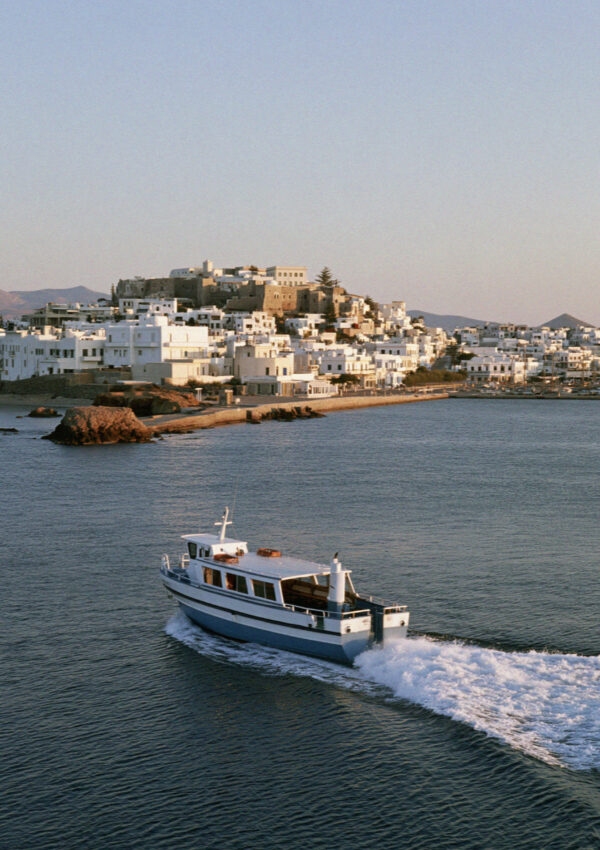
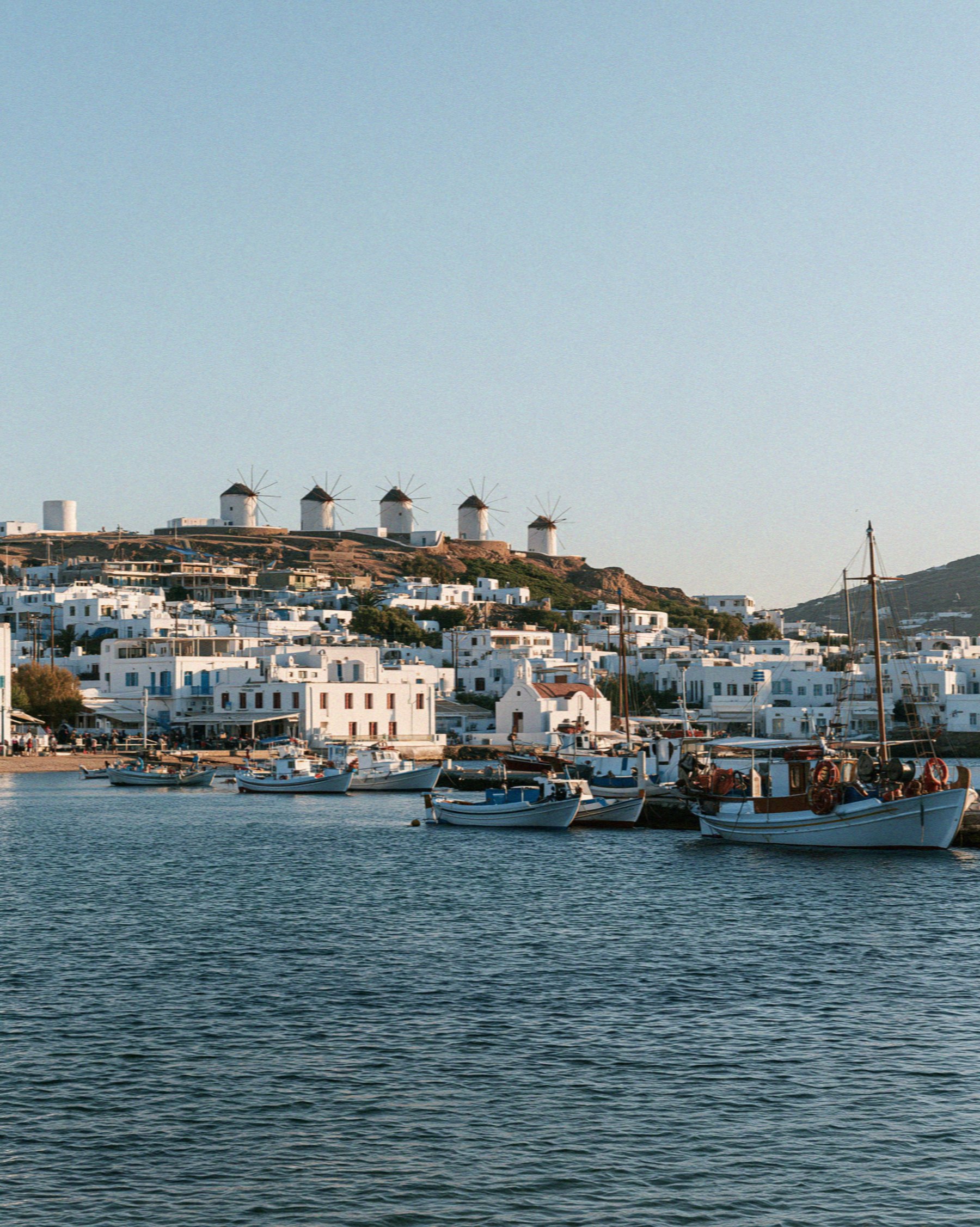
Stand outside on the deck for the arrival if you can. The wind arrives before the island does, and the white town comes up out of the sea with the windmills on the ridge above it.
From the other islands
Mykonos is a hub for island-hopping in the Cyclades.
Tinos is the closest, a fast hop of fifteen to thirty-five minutes, with several boats a day in the season. Syros, Andros, Paros and Naxos are all well connected, Paros and Naxos in under an hour on the fastest boats. Santorini is a little over two hours on a fast catamaran in summer; I came across from Santorini at the end of September in a little under three. There are also connections to Ios, Milos and Crete in the season, and to the islands of the eastern Aegean.
Fast boats are more affected by the wind than the big ferries. If the meltemi is blowing hard, expect delays and the occasional cancellation, and keep some slack in your plans.
The two ports
Mykonos has two ports, and it matters which one you use.
The new port at Tourlos, a few kilometres north of the town, is where most ferries and all the cruise ships dock. It is a modern quay with a big car park, a few cafés and taxi and bus stops.
The old port is right in the middle of Mykonos Town, by the fishing boats and the harbour chapel. Some fast ferries still use it, and the boats to Delos leave from here.
Your ticket says which port your boat uses. If you are leaving by ferry, check it the day before, and give yourself time to get to the new port, because the traffic at ferry times can be heavy.

The buses
The public buses on Mykonos are good, cheap and frequent in summer, and they reach most of the island.
There are two bus stations in town, and the trick is knowing which one you need. Fabrika, on the southern edge of the old town, serves the south coast beaches, Ornos, Agios Ioannis, Platis Gialos, Paradise and Super Paradise, as well as the airport and the new port. The Old Port station, on the northern edge of town near the Archaeological Museum, serves the north and east, including Ano Mera, Elia, Kalafatis and Kalo Livadi, as well as Agios Stefanos and the new port.
Tickets cost around two euros, a little more for the longer routes. Buy them at the kiosk in the station, where cards are accepted, or in cash from the driver at roadside stops. In July and August, the buses to the busiest south coast beaches run every half hour or so, some until late at night. Outside the season, they are far less frequent. The bus does not reach the north coast beaches such as Agios Sostis or Fokos.
The Sea Bus and the water taxi
Two kinds of boat are part of everyday transport on Mykonos.
The Sea Bus is a small passenger boat between the new port and the old port in town, about every half hour in the season, for a couple of euros. It is the easiest way into town from a ferry or a cruise ship, and much quicker than queueing for a taxi.
The water taxi is a fleet of small wooden boats that runs along the south coast beaches in the season, from Ornos and Platis Gialos east to Paraga, Paradise, Super Paradise, Agrari and Elia. A day pass of around twenty euros, paid in cash, lets you hop on and off. It is the best way to spend a day on the beaches without a car.

Hiring a car, quad or scooter
You do not need a car for the town and the south coast, but one makes the rest of the island much easier.
A car or quad for a day or two lets you reach Ano Mera, Armenistis lighthouse and the north coast beaches, which the buses do not serve. Small cars are best: the roads are narrow and winding, and parking near the beaches and in town is very limited. The old town itself is closed to traffic, so park on its edge.
Quads and scooters are popular and fun, but the roads are busy in summer, the surfaces uneven, and accidents are common. Only ride one if you are confident, wear a helmet, and check your insurance and licence: you need the right category of licence for a quad or scooter, not just a car licence.
In summer, book a car ahead, especially in August, and check what the insurance covers.
Before you land on Mykonos
A few things worth sorting before you come. These help support the blog, at no cost to you.
- Hire a car on MykonosPick it up at the airport or the port
- Stay connected with a travel eSIMData from the moment you land, no roaming charges
This section contains affiliate links. If you book through them I may earn a small commission, at no extra cost to you.
Taxis and transfers
Taxis are the weak point of Mykonos. The island has only a few dozen licensed taxis for the whole of the summer crowd, so the queues at the airport, the new port and the rank in town can be very long, especially at night.
Fares are metered, and from the airport to town usually run somewhere around twenty-five to thirty-five euros, more at night and from further out. Private transfers, booked ahead, cost more but turn up, and many hotels arrange them. For a late night out, a transfer booked in advance is worth it.
Always agree the price before you get in a car that is not a metered taxi.
If you are planning your days around the buses and boats, my Mykonos itinerary puts them in order, and my guide to the best beaches in Mykonos has the bus and boat for every beach.
Frequently Asked Questions
What is the best way to get to Mykonos from Athens?
The fast ferry from Rafina or Piraeus takes from a little over two hours. A flight takes about forty minutes, and is better if you are short of time.
Which port do ferries use in Mykonos?
Most ferries and all cruise ships use the new port at Tourlos, north of town. Some fast boats use the old port in the town. Your ticket says which.
How do you get from Mykonos airport to town?
By the public bus to Fabrika, by taxi, or by a transfer booked ahead. The airport is only about four kilometres from town, but the taxi queue can be long.
Do you need to rent a car in Mykonos?
Not for the town and the south coast, where the buses and water taxi work well. A car or quad for a day makes the north coast and Ano Mera much easier.
How much is a taxi in Mykonos?
From the airport to town usually around twenty-five to thirty-five euros, more at night. Taxis are scarce, so book a transfer for arrivals, departures and late nights.
Read also: Where to Stay in Mykonos: Choosing Your Base | A Mykonos Itinerary: 3 to 5 Days | Victoria’s Complete Guide to Mykonos