Take the Lefkes bus out of Parikia, get off once at the quarries and again at Lefkes, then walk down to the east coast on a path paved in marble and swim at the bottom. That is the best day on Paros, and it costs almost nothing.
It is the day I would give anyone who thinks this is only a beach island. This guide covers each part in order: the ancient quarries at Marathi, the old capital at Lefkes, the Byzantine road to Prodromos, and the way on to Marpissa and Piso Livadi, with buses, timings and when to go. For the rest of the island, start with my complete guide to Paros.
Why go inland
Most of what people know of Paros is the coast: the harbour at Naoussa, the beaches, the boats to Antiparos. The middle of the island is a different place. It rises into low hills of olive groves, terraces and stone walls, with white villages tucked into the folds and very little traffic.
It is also where the island’s history is. The marble that made Paros rich in antiquity came out of these hills. When pirates made the coast too dangerous, people moved up here, and Lefkes became the capital. And the villages were joined by paved mule paths long before there were roads, one of which survives almost intact.
The marble quarries at Marathi
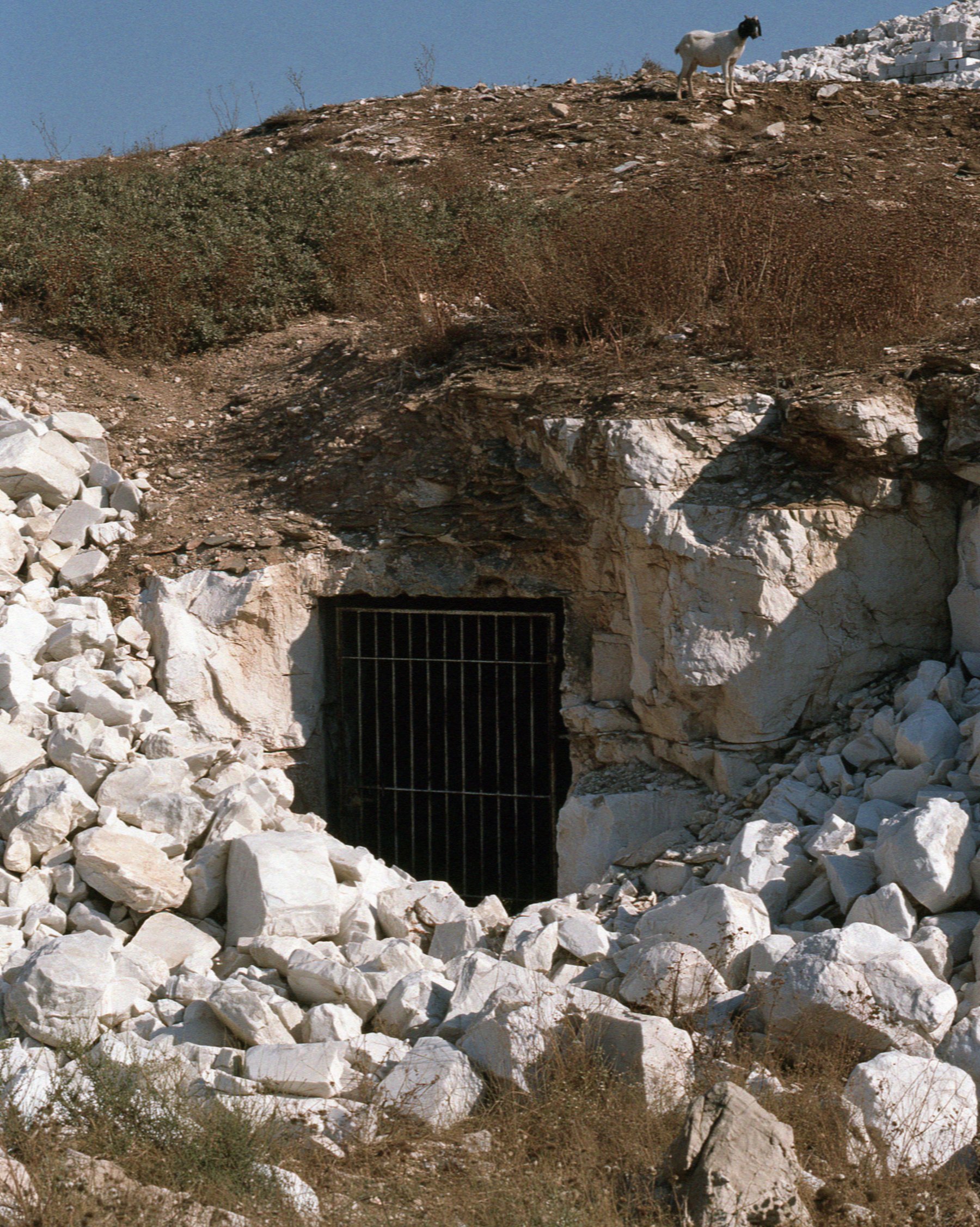
About 4 to 5 km from Parikia, on the road to Lefkes, is the hamlet of Marathi and, on the hillside above it, the ancient marble quarries. This is where the finest Parian marble came from.
The ancients called it lychnites, from lychnos, a lamp. One explanation is that it was quarried in underground galleries by lamplight; the other is that the stone is translucent enough to let light into it. Both are true of it, and nobody has settled which gave the name. The stone was so prized that Parian marble is traditionally linked with the Hermes of Praxiteles, the Venus de Milo and the Winged Victory of Samothrace. Much later, in the 1840s, a French company worked the hill again, and its marble is said to have ended up in Napoleon’s tomb.
From the road, a short path climbs past heaps of broken white stone to the mouths of the galleries, square openings cut into the rock. They are closed off with grilles for safety, so you look in rather than go in. On a hot morning the air coming out of them is noticeably cold. Since 2022 a group of Parian associations has been campaigning to make the hillside a park, so expect more signs and paths before long.
I got off the Lefkes bus here, which is the easiest way to do it: walk up, look, and catch the next bus on. There is no ticket and no opening time.
Lefkes
Lefkes sits high in the centre of the island, among olives and pines, and was once the capital of Paros, precisely because raiders would have had to work hard to reach it.
It is the loveliest village on the island: white houses stacked up the hillside, narrow lanes with arches overhead, small squares with a cafe or two, and flowerpots on every step. At the heart of it is the big church of Agia Triada, built in the 1830s, with twin marble bell towers. In the middle of the day it is so white it is hard to look at.
I was there in October, when the village was almost silent apart from someone sweeping and a radio playing behind a shutter. Have lunch or a coffee before you set off downhill, and see my guide to where to eat in Paros for ideas.
The Byzantine road starts at the edge of the village. Ask anyone for the path to Prodromos and you will be pointed the right way, and there are signs.
The Byzantine road
The path from Lefkes to Prodromos is about 3.5 km and takes an hour to an hour and a half, walking at an easy pace with stops. It is mostly downhill from Lefkes, which is why that is the direction to walk it.
For long stretches it is paved with marble slabs, grey and white, laid edge to edge and worn smooth and slightly hollow in the middle by centuries of feet and hooves. It runs between dry-stone walls, past olive trees and terraces, over small stone bridges across stream beds that are dry for most of the year, and past the odd chapel, with Naxos across the water to the east.
I walked it on a clear day in October, and the whole day is in my diary The Stone That Lets the Light In. The practical notes: wear proper walking shoes, because the polished stone is slippery when wet or dusty, and carry water, because there is very little shade and nowhere to buy anything until Prodromos.
Prodromos
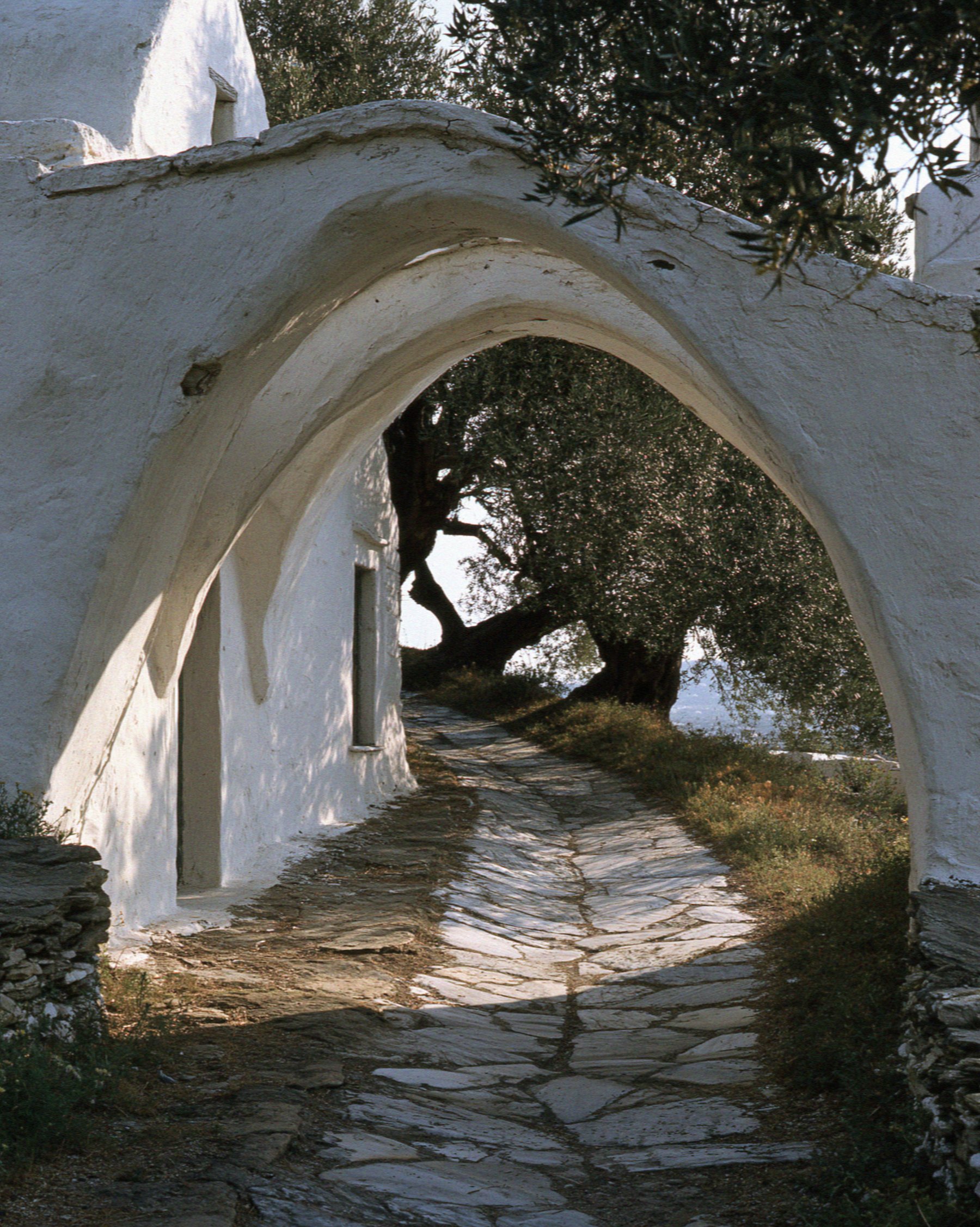
The path ends at Prodromos, a small farming village of white houses and narrow lanes. You walk into it under an arch set between two churches, which is the first sign you have arrived.
It is quiet and unshowy, with a cafe or taverna for a cold drink after the walk. From Prodromos you can catch the bus back to Parikia, or carry on.
On to Marpissa and Piso Livadi
If you have the energy, keep going. From Prodromos the way continues a short distance to Marpissa, a larger village with its own lanes and churches, and then down to the sea at Piso Livadi. From Lefkes to the coast it is about 6 km in total.
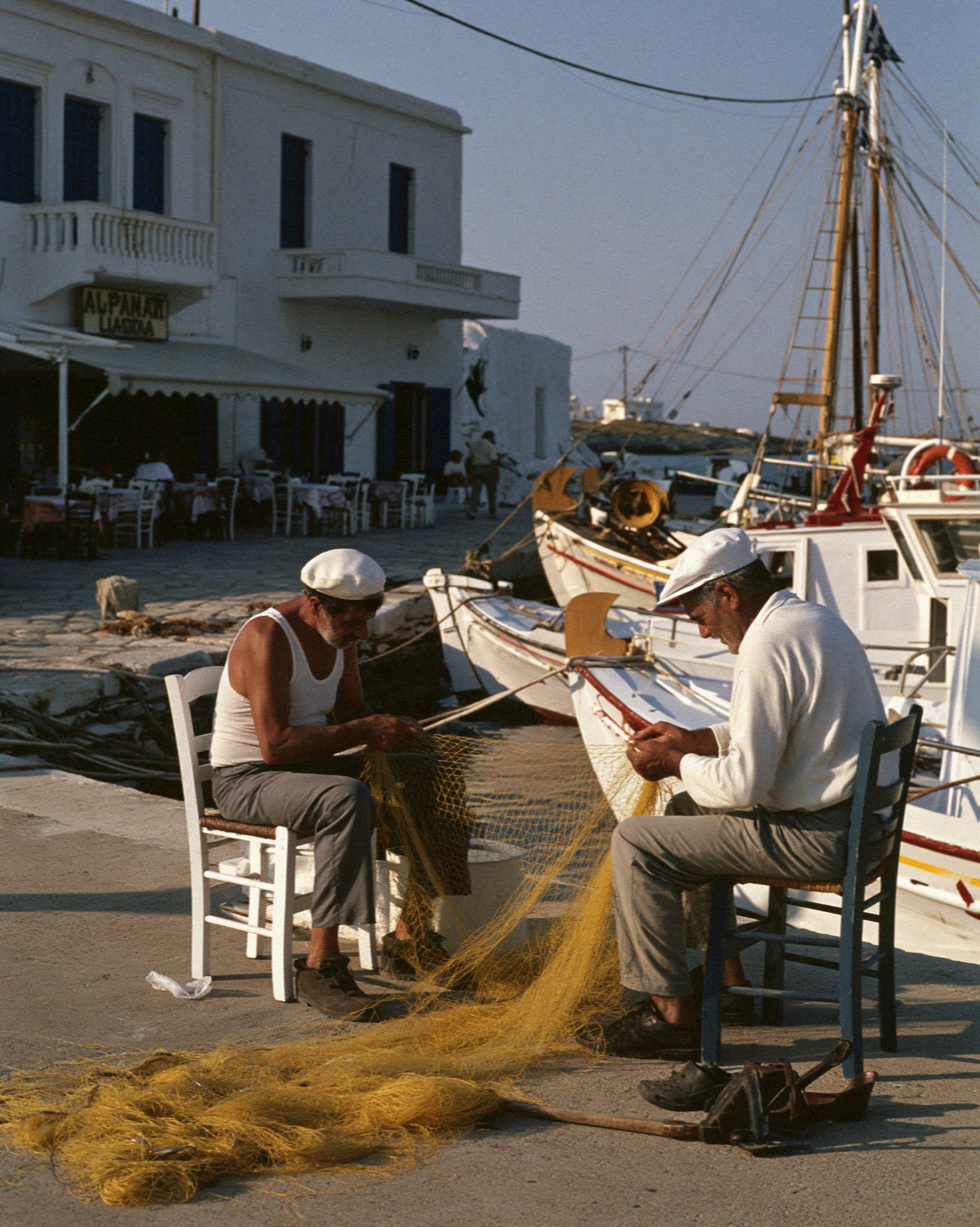
Piso Livadi is a little fishing harbour on the east coast, with boats tied up along the quay, a handful of tavernas facing the water, and a sandy beach just round the point. It is the right place to end: lunch, or a late afternoon swim. When I swam there in October, the season was over and the water had not noticed.
The tavernas on the harbour are the place for fish. Logaras beach, next door, is longer and sandier, and the east coast beaches are covered in my guide to the best beaches in Paros. Day boats to the Blue Lagoon and the islets off Antiparos also leave from Piso Livadi in season.
Getting there by bus
You do not need a car for any of this, and a car is actually a nuisance on a one-way walk.
The KTEL buses leave from the main bus station by the port in Parikia. Buses run from Parikia up through Marathi to Lefkes, and also to Prodromos, Marpissa and Piso Livadi on the east coast. In 2026, tickets are paid by card only, so bring one. Check the timetable at the station or on the KTEL Paros site the day before, especially the last bus back from Piso Livadi, which comes early outside July and August.
The simplest plan: an early bus to Marathi, the next bus on to Lefkes, walk down to Prodromos or Piso Livadi, and the bus back to Parikia from the coast.
When to walk it
Spring and autumn are the best seasons. In April and May the hillsides are green and full of wild flowers, and the air is cool. In September and October the heat has gone out of the day, the sea at Piso Livadi is still warm, and you will have the path almost to yourself.
In July and August it can be done, but start early, by about 08:00, and finish by late morning, because there is so little shade. Avoid the middle of the day altogether. In winter the walk is lovely on a dry day, though cafes in Lefkes and Prodromos may be shut, so bring food. After rain, take extra care on the marble.
For more on the seasons across both islands, see my guide to the best time to visit Naxos and Paros.
Frequently Asked Questions
How long is the Byzantine road on Paros?
From Lefkes to Prodromos it is about 3.5 km, taking an hour to an hour and a half. Continuing to Marpissa and Piso Livadi makes about 6 km in all.
Which direction should you walk the Byzantine road?
From Lefkes down to Prodromos. It is mostly downhill that way, and you finish near the bus routes and the sea at Piso Livadi.
Can you go inside the marble quarries on Paros?
No. The galleries at Marathi are closed off with grilles for safety, but you can walk up to their entrances from the road for free.
How do you get to Lefkes without a car?
Take the KTEL bus from the bus station by the port in Parikia. Tickets are paid by card only in 2026, and you can ask to be let off at Marathi on the way.
Is Lefkes worth visiting?
Yes. It is the old capital and the prettiest village on Paros, with white arched lanes, a marble church, and the start of the Byzantine road to Prodromos.
Read also: The Best Things to Do in Paros | Parikia: the Church of a Hundred Doors, the Kastro and the Old Town | Victoria’s Complete Guide to Paros