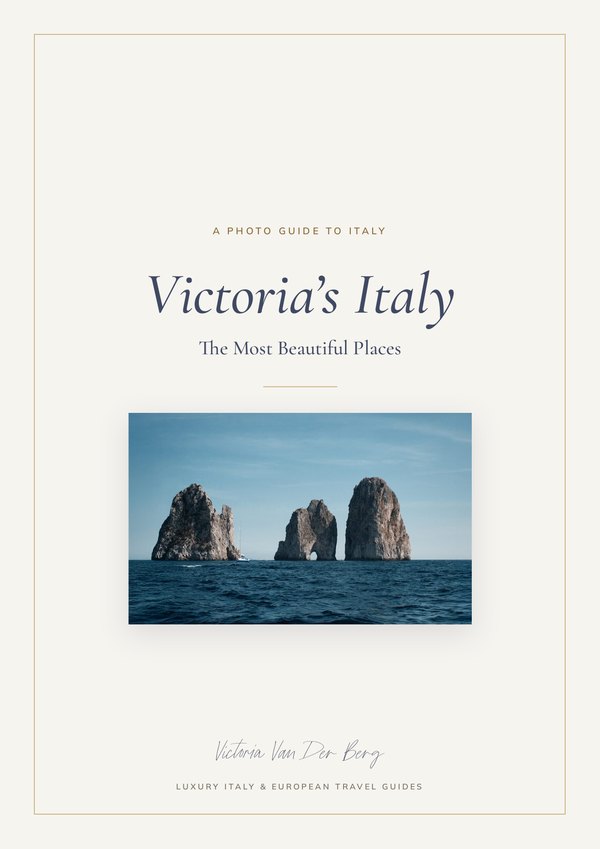
There are places that change you slowly, over many visits, and there are places that change you the first afternoon. The Amalfi Coast belongs to the second category. You arrive by boat or by road, both of which deliver you to the same realization: that the world you came from had been operating at the wrong scale.
The coast runs for roughly fifty kilometers along the southern edge of the Sorrentine Peninsula. Thirteen towns are strung along it, each one pressed into the cliff face as though they are holding on. Between them, the road narrows to the width of a thought. The sea below is the color of something that has not yet been named. The lemon groves climb the terraces above, yellow among green, and the smell of them reaches you before the towns do.
I have been coming here since I was small enough that my memories of the earliest visits are not memories so much as impressions: heat, the color of bougainvillea, the sound of Italian spoken at full volume in a way that feels like music even when it is an argument. The coast was present in me before I knew how to think about it. Every return since then has been a kind of translation, the body recognizing something the mind is still catching up to.
This guide is my attempt to pass along what I know. Not every restaurant and every viewpoint, though some of those will find their way in. What I want to give you is a way of approaching the place. A tempo. An understanding of why it rewards patience and punishes haste. The Amalfi Coast is not a destination you consume. It is a place you inhabit, briefly, and then carry with you for a long time after.
What to book before you come
The single most useful thing to understand about this coast is that the road is slow, narrow and full of coaches, and the sea beside it is empty. Almost everything I would book here is a way of travelling by water instead. Book boats early: the good ones on this coast go weeks ahead in July and August.
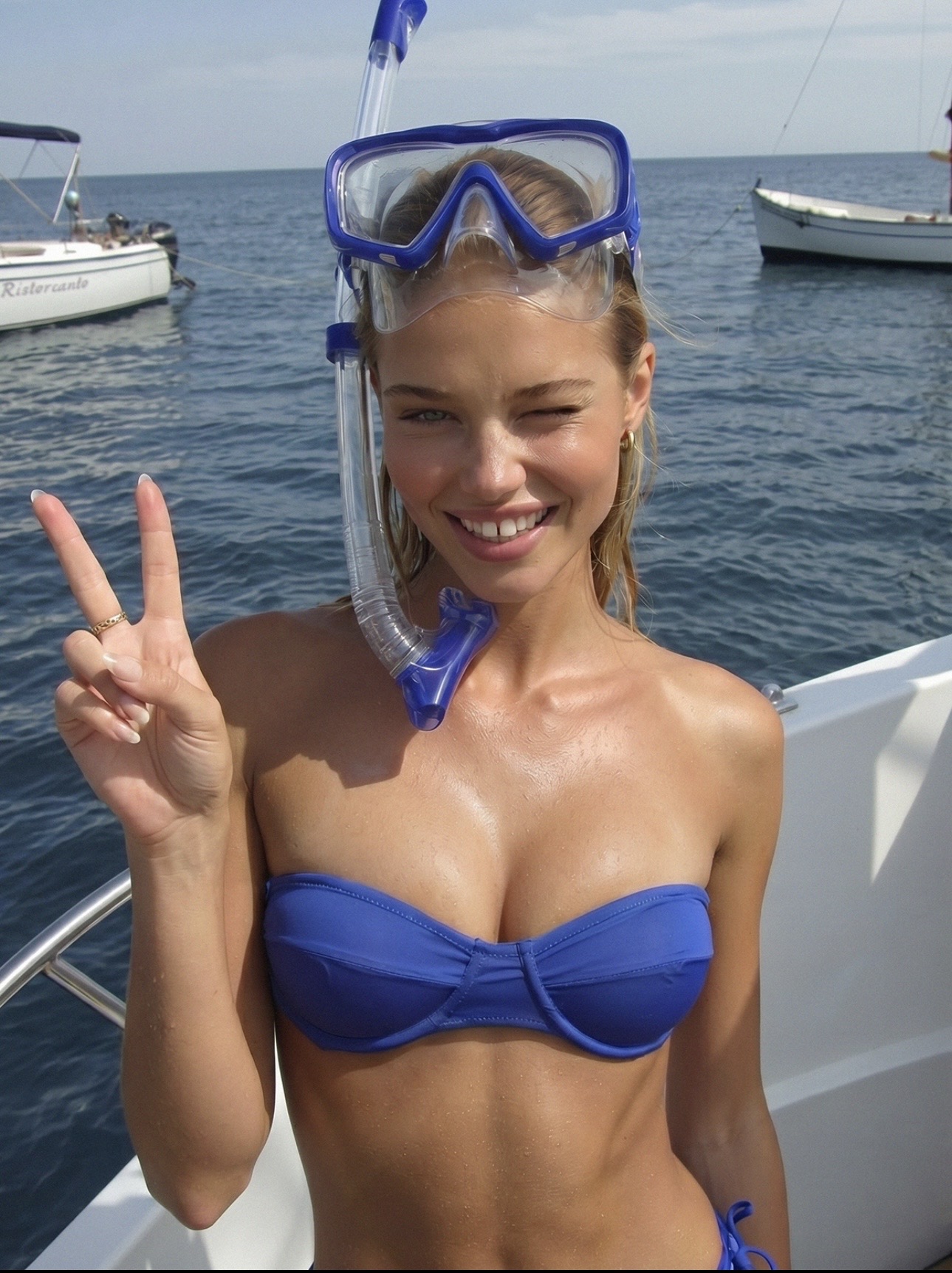
- The coast and Positano by boat, with snorkelling. 4.9 from nearly two and a half thousand people, which is the highest rating on the whole coast. Positano from the water is the view everybody has seen and almost nobody arrives at properly.
- Caves, beaches and snorkelling from Amalfi. The stretch east of Amalfi, which the buses never stop on and which has the best swimming.
- A sunset cruise with aperitivo. The hour this coast was built for. The cliffs go orange and the towns come on one at a time.
- A private boat for the day. Expensive and, split between four, less so than a day of taxis. You stop where you want, which on this coast is the whole point.
- From Naples, the coast in a day. 4.7 from nearly three thousand people. If you are not staying here, this is the sane way to see it without driving the Amalfi Drive yourself.
The Path of the Gods, every beach, the cathedral steps at Amalfi and the walk down through Atrani cost nothing at all. The bus along the coast is a few euros and is a white knuckle sightseeing tour in its own right.
Planning Your Visit
When to Come
The Amalfi Coast has a long season and a clear logic to it. May and June are my preference. The water is cool enough to make swimming feel like an event, the flowers are at full intensity, and the towns have not yet reached their summer density. The light in June has a quality I have not found anywhere else: warm but clean, the kind that makes everything look slightly more itself than usual.
September and October offer a different kind of beauty. The summer crowds have thinned. The sea holds the warmth of three months of sun. The light shifts into something amber and retrospective, and there is a quality of late-season ease that feels earned. Locals return to their favorite tables at their favorite bars. The coast breathes out. Past October, the beach clubs are mostly closed, and if you are like me, that’s part of the charm of the Amalfi Coast.
July and August are high season in the full sense: luminous and full and expensive and crowded. I have spent weeks of August here and loved it, but it asks more of you. You learn to move early and late, to rest in the afternoon when the heat is serious, to accept that the road will be slow and the beaches full. If August is when you can come, come. The coast accommodates. It has been doing this for a long time.
I would avoid the deep winter. Not because the coast becomes ugly, it does not, but because it withdraws. Many restaurants and hotels close. The ferries run on reduced schedules. The towns turn inward. If you love the place already and want to see it at its most private, a November or March visit can be extraordinary. For the first time, wait for the warmth.
How Long to Stay
Five days is the minimum that allows you to actually arrive. The first day is a transition. The second day, you begin to slow down. By the third day, the coast has done what it does to time, which is to make it move differently, and from there, you can actually be present in it. Seven to ten days is ideal. A full week gives you time to have a slow morning in Positano, a full afternoon in Ravello, an early swim at Atrani before anyone else wakes up, and still a day or two of pure idleness at the beach doing nothing in particular, which is where the coast does its best work on you.
If you have only two or three days, concentrate rather than scatter. Pick one town as your base and explore from it. A long weekend in Ravello is more satisfying than trying to see everything in three days and succeeding at none of it.
Getting Around: Ferries and the Road
The ferry is the answer to most questions about getting around. The SITA buses and the coastal road are both options, but the ferry puts you on the water, and the Amalfi Coast seen from the water is the only way to understand its scale. You round a headland and a new town reveals itself, a thousand windows catching the morning sun, and it looks exactly like a painting and nothing like a painting at the same time.
The road, the famous SS163, is worth driving at least once, ideally not in August at midday. It is narrow and dramatic and requires full attention. Scooters appear from nowhere. Tour buses claim more than their share of the lane. The views are extraordinary at every turn, and you will not be able to look at them while driving, which is perhaps the road’s best feature: it forces you to stop. Pull over wherever there is room to pull over, stand at the edge, and look. The coast gives itself to you in these pauses.
From Positano, Amalfi, or Conca dei Marini, you can reach most of the coast’s major towns by ferry in under thirty minutes. I prefer to arrive by sea and leave by road, or the reverse. The two perspectives are genuinely different, and both are worth having.
I don’t drive in Amalfi. Parking is severely limited. Ferries and buses take you where you need to go. If you are continuing on to cities that are not close by than a car can be helpful, but if Amalfi is you destination they can be a hindrance.
What It Costs
The Amalfi Coast is not inexpensive, and it is better to know this and plan for it than to be surprised by it. A good hotel in a good position will cost considerably more than it would elsewhere in Italy. Beach clubs charge for their umbrellas and loungers, and the price is part of what you are paying for: the service, the positioning, the experience of a particular afternoon in a particular place.
Where the coast is generous is in its incidentals. An espresso at a bar in Atrani costs almost nothing. A lemon granita from a café above Minori, the same. The ferry between towns is affordable. A bottle of local wine at a restaurant costs less than it would in Paris or London. Spend on the room and the experience. The food is inexpensive. Economize nowhere that matters.
Plan Your Visit to the Amalfi Coast
A few things I booked and loved. These help support the blog, at no cost to you.
- Where I stayed: search Amalfi Coast hotels
- Boat tours and Amalfi Coast tickets
- Stay connected: get a travel eSIM
This section contains affiliate links. If you book through them I may earn a small commission, at no extra cost to you.
Best Things to Do on the Amalfi Coast
The Amalfi Coast rewards a short, slow list rather than a long one. These are the things worth building your days around.
Ride the coast road, or better still the ferries between the towns, since this coastline was made to be seen from the water. Wander the vertical lanes of Positano, the cathedral square of Amalfi, and the gardens of Ravello above the sea. Walk the Path of the Gods along the ridge for the finest views on the coast. Swim from the beaches and beach clubs below the cliffs, and take a boat to the Emerald Grotto. Eat the lemon in every form it takes here, from granita to limoncello, and give one long lunch to the simple grilled fish that made this coast’s name. And when you want a change of scene, the ruins of Pompeii and the island of Capri are both an easy day away. Each of these has its own section below.
The Towns
The coast is not one place. It is thirteen distinct places sharing a road and a sea, each with its own character, its own hour of best light, its own reason to stay longer than you planned.
Positano
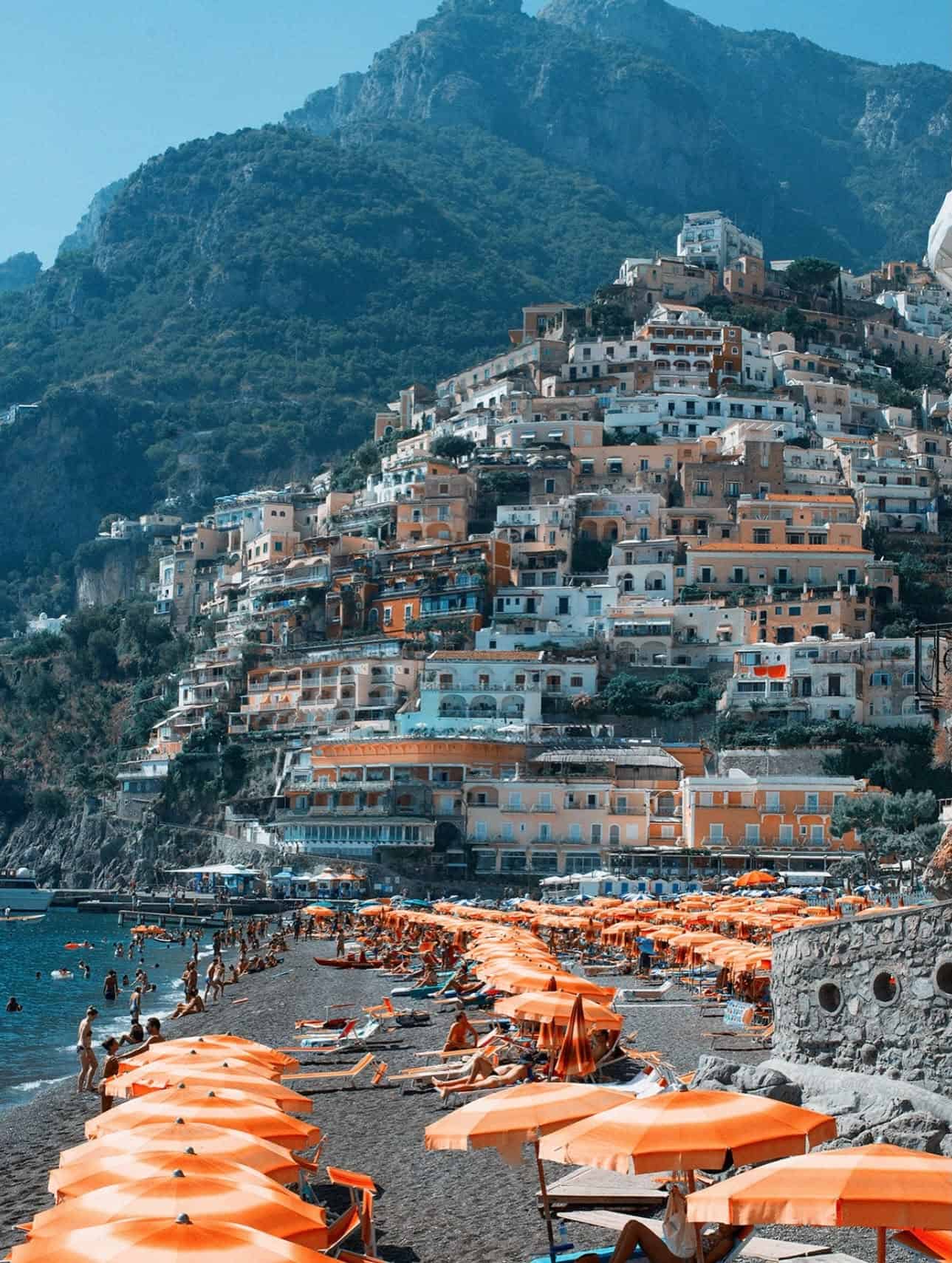
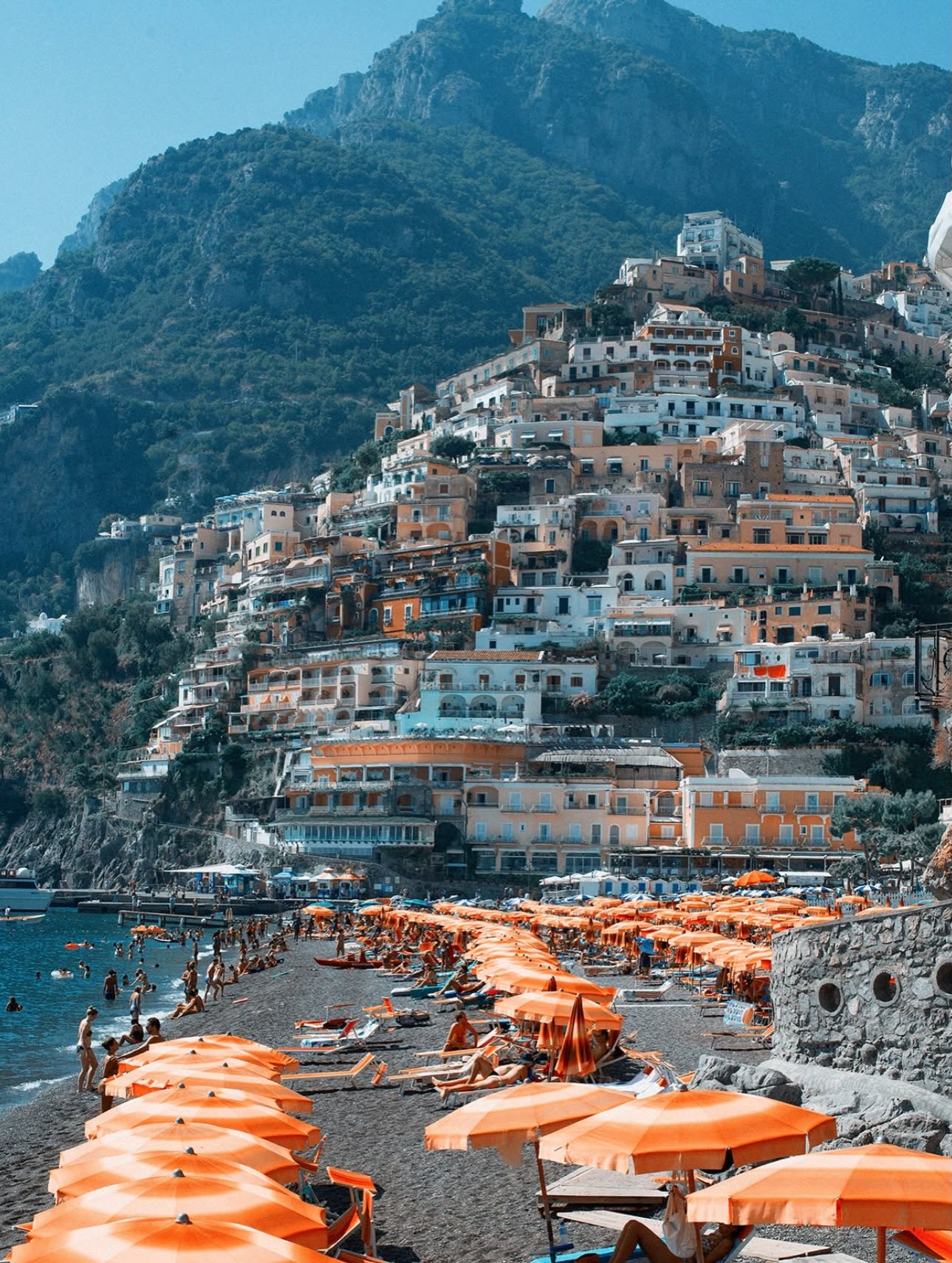
Positano is the one people picture when they picture the Amalfi Coast: white and pink houses stacked vertically above a small beach, bougainvillea at every window, the Church of Santa Maria Assunta with its majolica dome visible from the water long before you arrive. It is beautiful in the way that very famous things sometimes are, beautifully and exactly itself, undiminished by its own reputation.
It is also expensive, and it is busy, and both of those things are real. The main beach fills early in summer. The streets narrow into staircases that climb into neighborhoods where tourists rarely go, and those neighborhoods are Positano’s secret, the part of it that has not changed much. Be aware: Positano is physically demanding. The town is built vertically, and there is no avoiding the steps. Hundreds of them, steep and uneven, and in summer they are crowded with people stopping constantly to take photographs or simply catch their breath and look at the view, both of which are entirely understandable responses to the situation. If you have mobility concerns, plan accordingly. If you don’t, still wear something on your feet that can manage stairs. If you have time, go up past the crowds. The light from above the town in the morning, looking down at the water through lemon trees, is one of the things I keep coming back to.
Positano rewards an early riser. Before nine o’clock, the town is still arriving at itself. The fishermen. The bread is being delivered. The first light on the dome. By ten, the boats are loading for beach excursions, and by noon, the steps are busy, and the beach is full. None of that is bad. It is the tempo of the place. But the early hour belongs to you in a way the afternoon does not.
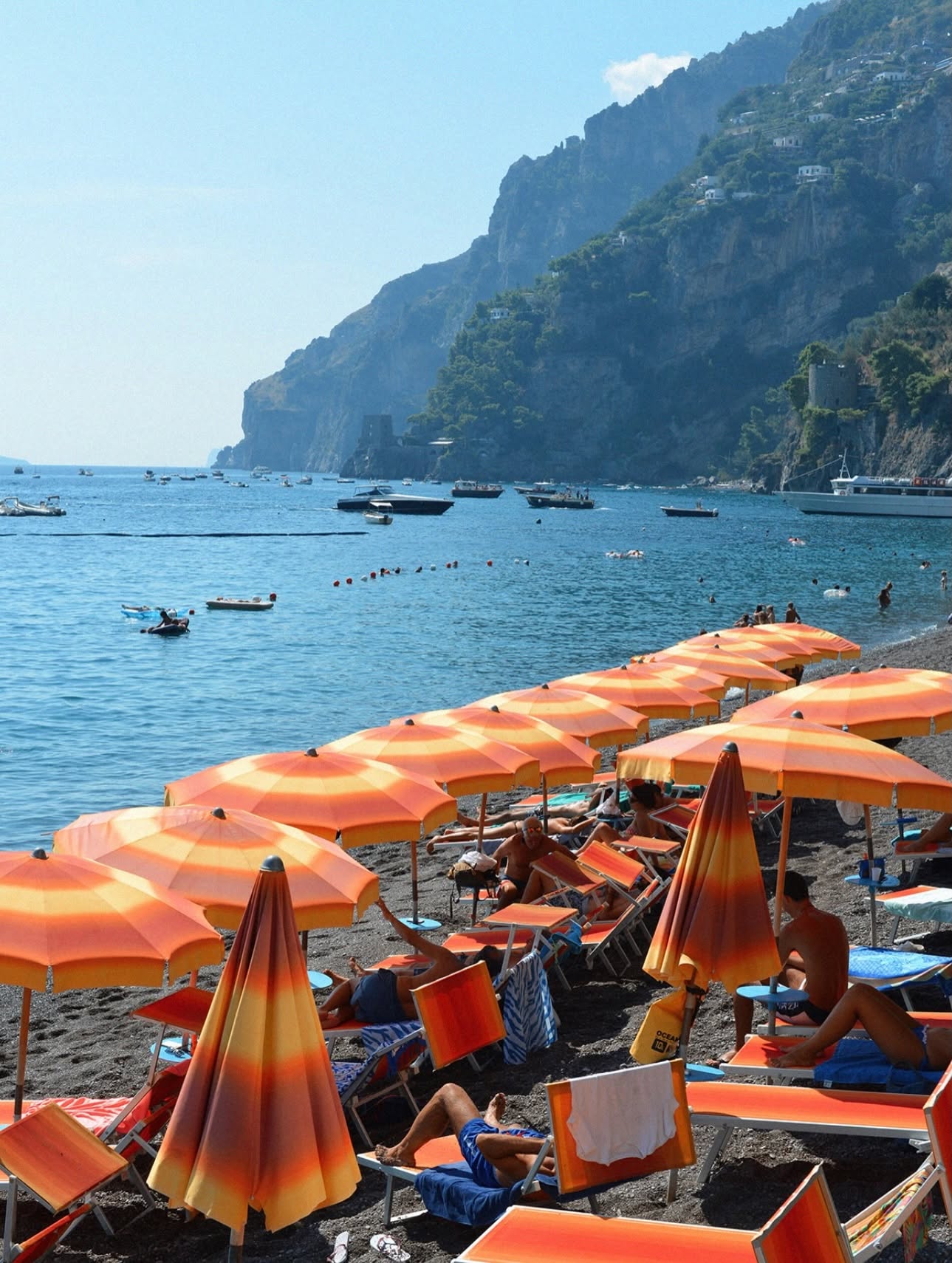
Since childhood, I have spent so many wonderful days in Positano. One of them is here.
You can read my complete guide to Positano here.
Amalfi
The town of Amalfi gives the coast its name and has a history that earns it. It was a maritime republic of genuine power in the ninth and tenth centuries, a city of traders and navigators whose influence reached the entire Mediterranean. The Cathedral of Sant’Andrea at the top of its broad staircase carries that history in its stones: Arab-Norman architecture, bronze doors from Constantinople, and a crypt that holds the remains of the apostle Andrew.
The town itself is more lived-in and less photogenic than Positano, which is part of what I like about it. It has a working center, butchers and pharmacies alongside the tourist shops, a paper museum dedicated to the ancient art of amatruda paper-making that the town perfected centuries ago. The Piazza Duomo at the foot of the cathedral steps is the social center: outdoor tables, good people-watching, and the particular pleasure of espresso drunk standing in a place that has been doing this for hundreds of years. For budget-minded travelers, Amalfi is the place to stay during your visit.
Ravello
Ravello is not quite on the coast. It sits three hundred meters above it, a fifteen-minute drive up into the hills, and the elevation changes everything. The temperature drops a few degrees. The sound of the sea becomes very faint, like something you are almost remembering. The gardens of Villa Rufolo and Villa Cimbrone have been drawing writers and composers, and romantics here for centuries: Wagner found inspiration here, as did D.H. Lawrence, Graham Greene, and Gore Vidal, who lived here for years.
Villa Cimbrone’s Belvedere of Infinity is one of those places where photography cannot quite contain what it looks like in person. The terrace extends into sky and sea, and there is nothing between you and the horizon except a row of marble busts and an implausible amount of blue. I have sat on that terrace in the morning before the day-trippers arrive and understood, in the body before the mind, why people come here to create things.
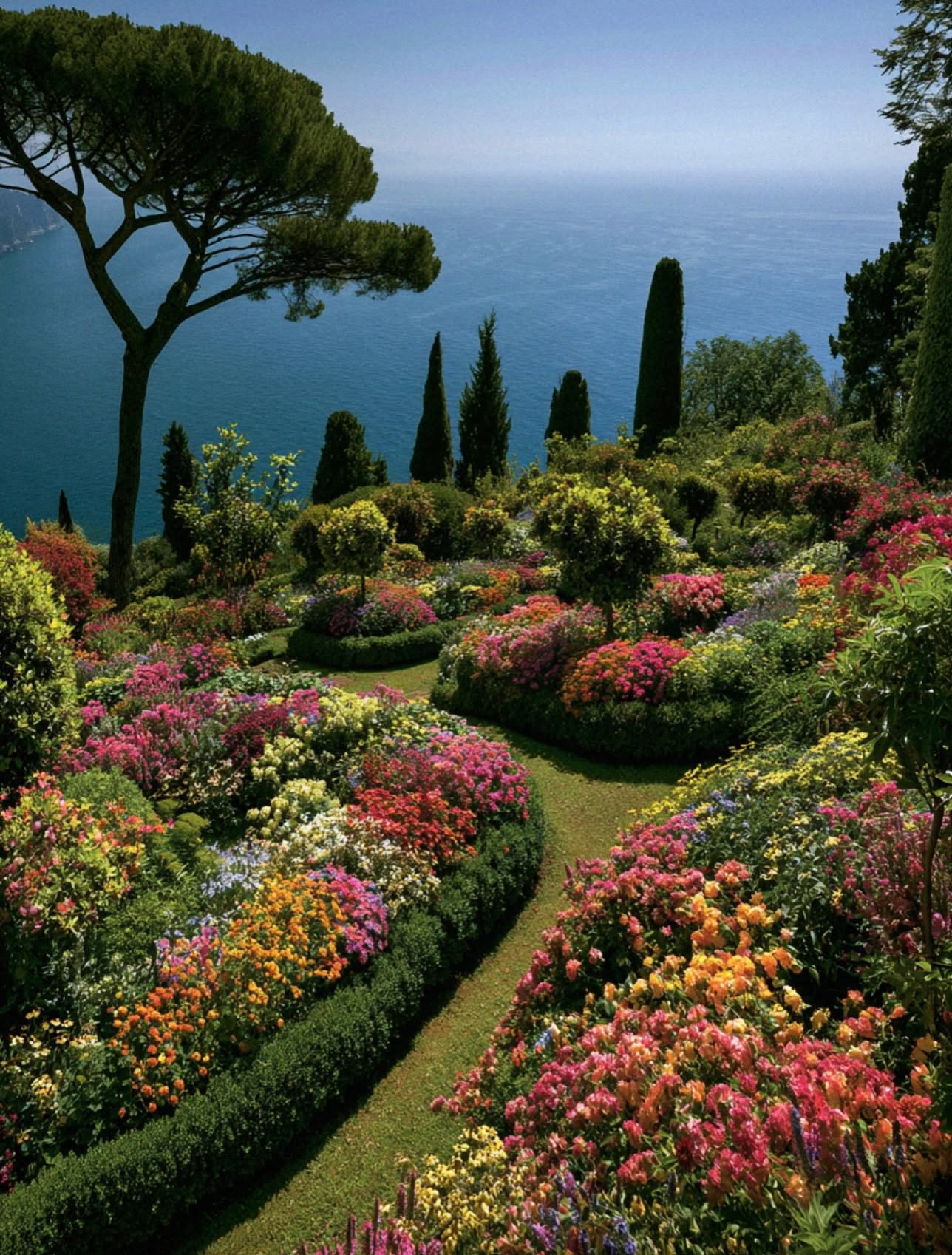
The Ravello Festival brings world-class music to the Villa Rufolo gardens through the summer. To hear an orchestra in that setting, with the coast falling away below, is an experience that belongs specifically to this place and cannot be reproduced elsewhere.
You can read my complete guide to Ravello here.
Atrani
Atrani is five minutes from Amalfi on foot and has a different character entirely. It is very small, very quiet, and very genuinely itself. There is one beach, small and partly shaded, and above it the town’s buildings crowd together in the traditional way, white and close, with the ancient church of San Salvatore de’ Birecto visible from the water. It was here that the Doges of Amalfi were crowned and buried.
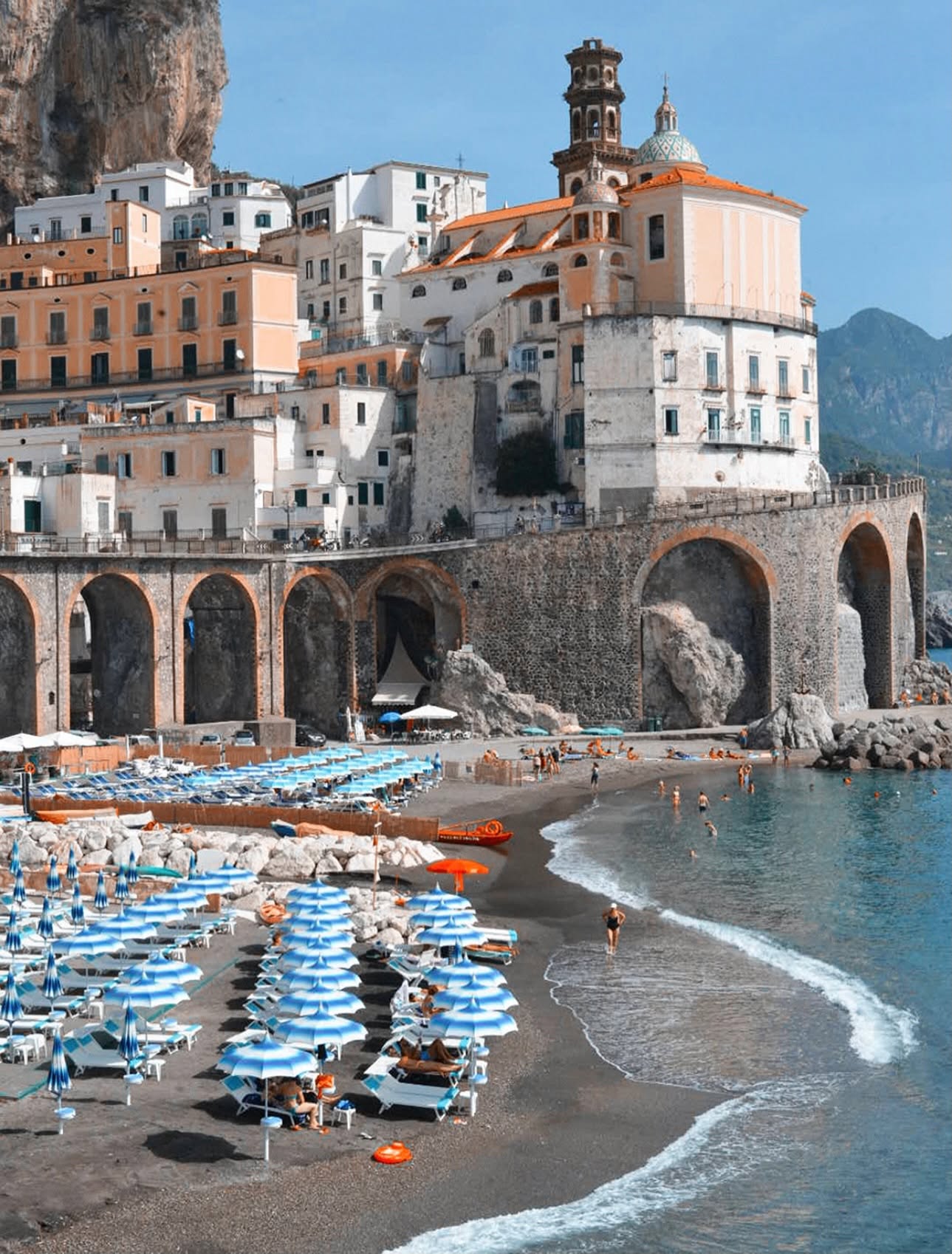
On summer evenings, the small piazza fills with local families. Children run. Old men sit. The bar on the square makes good drinks. There are few tourists, partly because there is nothing in Atrani that a visitor is supposed to do, and this absence of obligation is exactly what makes it worth spending an afternoon. If you are staying in Amalfi, you can access Ravello through a tunnel or walk along the coastline.
I have a complete guide to Atrani here.
Praiano
Between Positano and Amalfi, Praiano sits quietly on the hillside in a way that rewards the visitor who pays attention. It lacks the famous beach and the famous dome, but it has a quality of everyday life that the more celebrated towns have partly sacrificed to their own success. The church of San Luca, visible for miles along the coast, marks the center. Below is a small harbor. Above, the terraced lemon and olive groves that have always been on most of the coast.
Praiano is where people stay when they love the coast and don’t want to pay Positano prices or navigate Amalfi’s summer density. I understand the logic. There is a particular pleasure in being somewhere people don’t assume you are going.
Conca dei Marini
Conca dei Marini is small enough to feel like a secret even when it is not. The village above and the harbor below are connected by steps, and the harbor at Capo di Conca has one of the coast’s best beach clubs, Lido Capo di Conca, set on the rocks with the water impossibly clear beneath it. The Emerald Grotto, the Grotta dello Smeraldo, is here too, a sea cave where the filtered light turns the water a surreal, luminous green. You arrive by boat, and the light inside the cave does something that has no name in English.
Furore
Most people drive past Furore without stopping, and those who stop rarely expect what they find. The Furore fjord is a narrow gorge cut into the cliff face where a small river meets the sea, the houses painted in bright colors on the walls above. In summer, there is a diving competition from the bridge, and in winter, the gorge is almost completely deserted. To swim in the fjord in the early morning, in cool green water surrounded by painted walls, with the sea visible at the mouth of the gorge, is one of those experiences the coast keeps tucked away for the attentive.
Maiori and Minori
The towns of Maiori and Minori sit side by side with a character noticeably different from the western end of the coast: flatter, more accessible, less vertical, more local. Maiori has the longest beach on the coast and is popular with Italian families from Naples and Salerno who return every summer. It has a warmth to it that comes from being genuinely used and loved by the people who live near it.
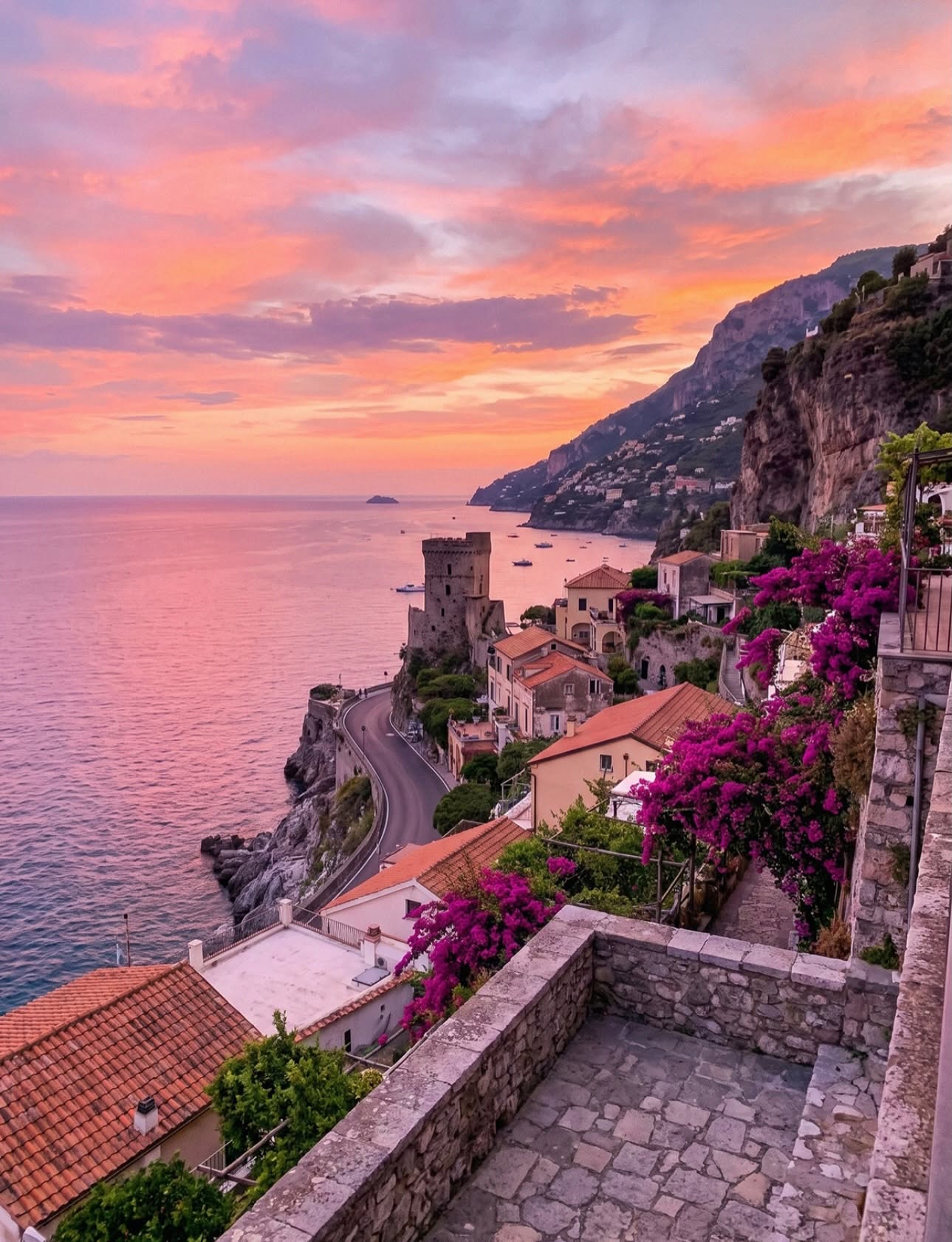
Minori is the pastry capital of the coast, a claim it earns. The sfogliatella riccia from a good pasticceria in Minori, eaten warm in the morning, is an argument for staying at this end of the coast. The town’s archaeological museum contains the remains of a first-century Roman villa, and the excavated rooms below street level have a quiet power.
You can read my Complete Guide to Maiori and Minori here.
Capri
Capri is not technically part of the Amalfi Coast. The island sits at the mouth of the Gulf of Naples, forty-five minutes by ferry from Positano or Sorrento, and it has its own complete world. I include it here because nearly everyone who visits the coast will find themselves drawn toward it, and the crossing, standing at the bow as the island rises from the water, its limestone cliffs catching the morning light, is one of the great arrivals.
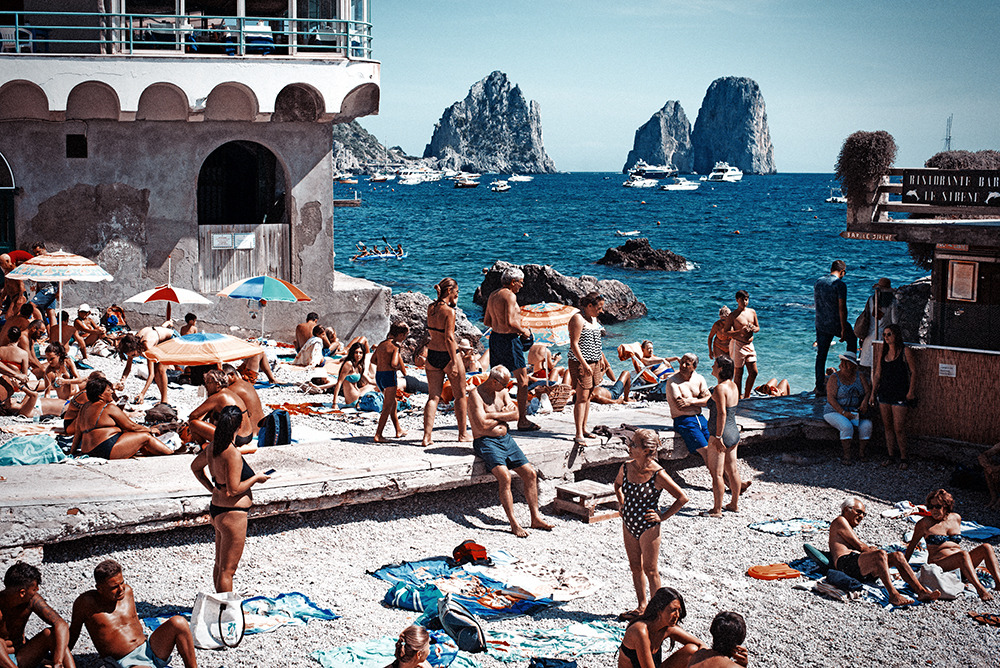
The Blue Grotto is where every itinerary begins correctly. You transfer from the ferry to a tiny rowboat, and the boatman lies flat to guide you through the low entrance into a cave where the only light enters through an underwater fissure, turning the water an impossible electric blue. It lasts about five minutes. It is worth every part of the effort.
The town of Capri and the quieter Anacapri above it each have their advocates. The Piazzetta in Capri town is high theater: beautiful people, excellent aperitivi, prices to match. Anacapri is gentler, the Villa San Michele with its gardens and its views, one of the south of Italy’s finest hours. Take the chairlift to the summit of Monte Solaro and stand above everything.
You can view my complete guide to Capri here.
Nature and the Landscape
Valle delle Ferriere
The Valle delle Ferriere is the valley immediately behind Amalfi, a nature reserve where the cliffs shelter a microclimate dense enough to sustain plant species that have survived here since before the last ice age. Ferns the size of small trees. The sound of water moving constantly through the undergrowth. The light filtered green through the canopy.
The trail from Amalfi into the valley is one of the most rewarding walks on the coast, rising through ancient paper mills and into increasingly wild terrain. It is also a serious walk. The path climbs steadily over uneven stone, and in summer, the humidity inside the valley is genuine. Bring water and bring more than you think you need. You emerge at a waterfall in a setting that feels profoundly removed from the beach clubs and ferry schedules below, and the effort to get there is part of why it feels that way. A full account of this walk appears in this site’s dedicated Valle delle Ferriere diary.
Path of the Gods
The Sentiero degli Dei, the Path of the Gods, is a ridge walk between Bomerano above Agerola and Nocelle above Positano. It is widely regarded as one of the finest coastal walks in the world, and in my experience, that regard is deserved. The path runs along the high ridge above the coast with the Tyrrhenian Sea visible for most of the route, the towns below looking exactly like the postcards, which is to say perfect and slightly unreal.
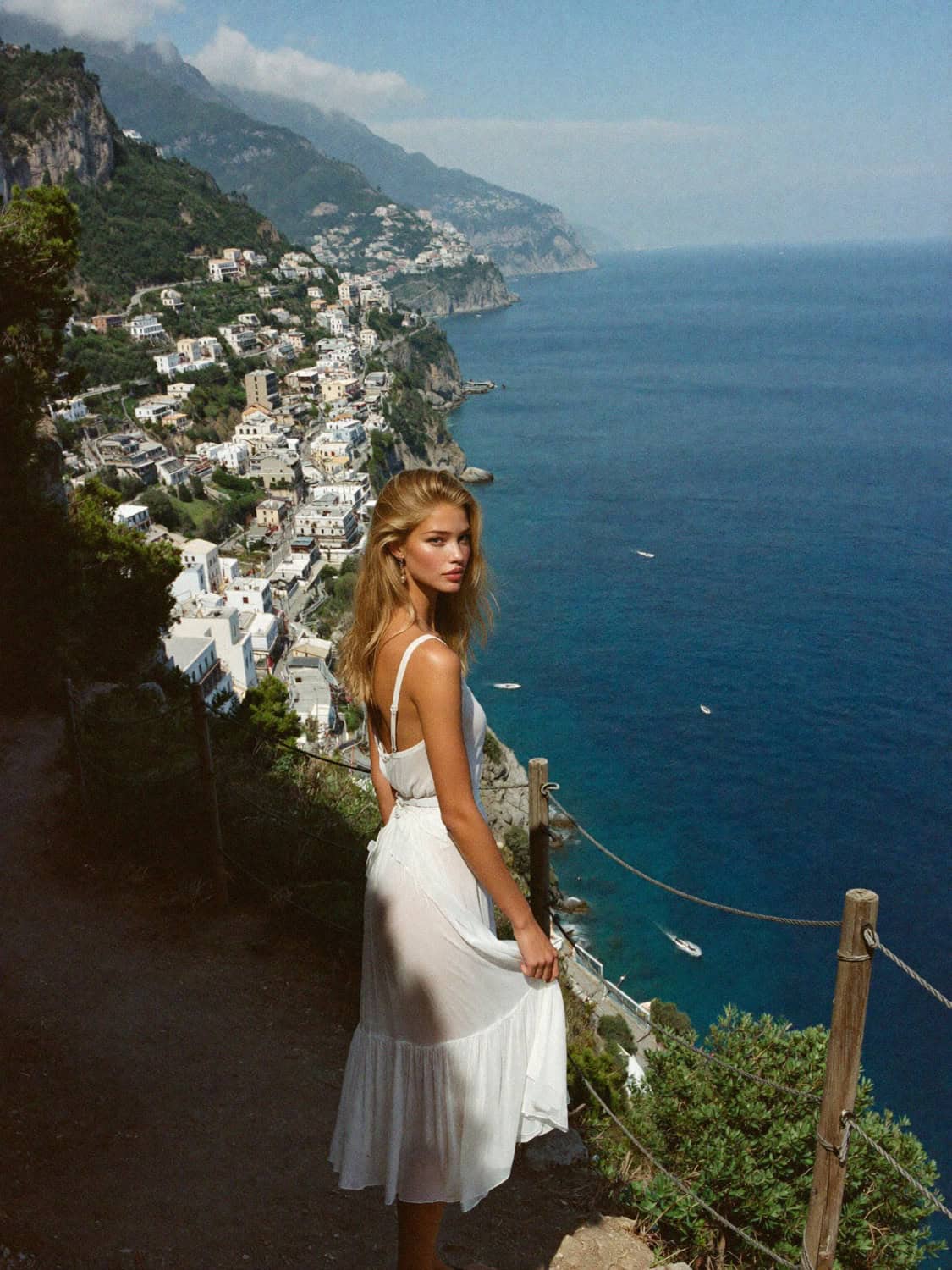
Walk it from west to east, starting at Bomerano, so that Positano is your reward at the end. Start early. Bring water. The path is not technically difficult, but it is long and exposed to the summer sun, and the descent into Nocelle has steep sections that ask for good shoes. At the right hour, with the sea below and the path empty ahead, it is the kind of walk that makes you understand why people climb things.
The Emerald Grotto
The Grotta dello Smeraldo at Conca dei Marini is the coast’s most visited natural wonder and justifies the attention. The color of the water inside, lit from below through a submerged opening, is genuinely otherworldly, a green that seems to come from within the water rather than from any external source. You reach it by boat from Amalfi or Positano, or by the elevator down the cliff face from the road above.
Go in the morning when the light is strongest through the underwater fissure. The guide who rows your boat inside will be efficient and cheerful and will point out a nativity scene made of coral on the cave floor, which is very Italian and oddly touching.
The Viewpoints
The coast’s best viewpoints are not always the famous ones. The terrace at Villa Cimbrone in Ravello is famous for good reason. But there are lesser-known places: the belvedere above Praiano, where the road widens briefly, and you can park and look out at the water from a position where no town is visible below you. The view from the ferry as you leave Positano in the early morning, looking back at the houses stacked above the sea. The road above Conca dei Marini at golden hour, when the light hits the cliffs and turns them a color that has no name.
Beaches and Beach Clubs
The coast does not have large, flat, sandy beaches. What it has is better: small coves, rocky platforms, sea caves, fishing harbors repurposed for swimming, and the beach clubs built into all of these with a particular Italian genius for turning difficult terrain into somewhere you would choose to spend an entire day.
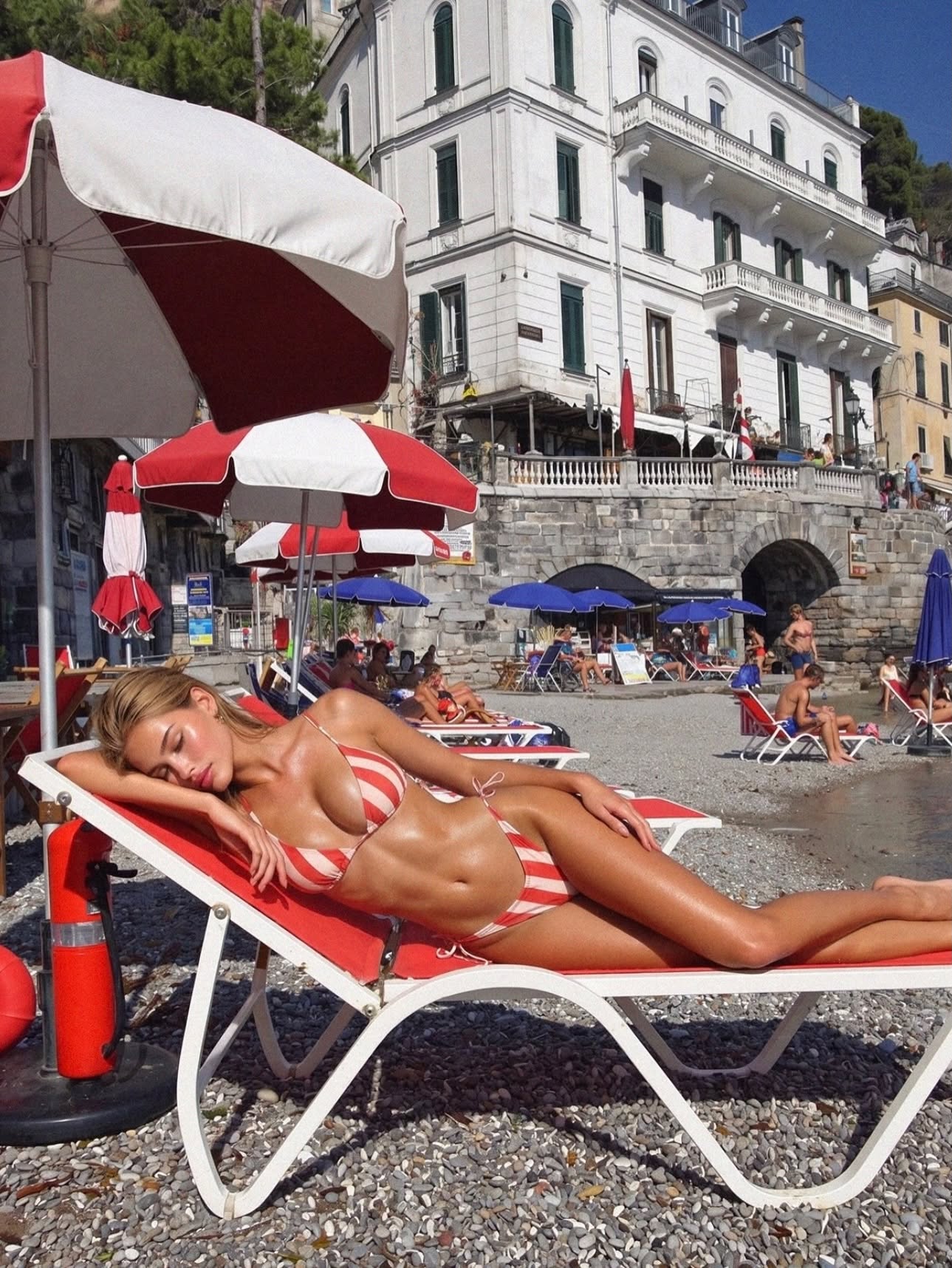
In the town of Amalfi itself, Silver Moon is my favorite. It sits at the center of Marina Grande, the main beach in town, and has been there since 1987. The umbrellas are red and white, a deliberate nod to the American flag, the inspiration of the man who built the original resort here in the 1960s. The beach is pebble, which takes a moment to negotiate, and the food at the restaurant on the sand is worth coming for on its own: linguine alla Silver Moon made with whatever arrived from the sea that morning, pizza from a family dough recipe that has not changed, and desserts made in-house. It is exactly what a beach club in a town with this much history should be: specific, consistent, entirely itself.
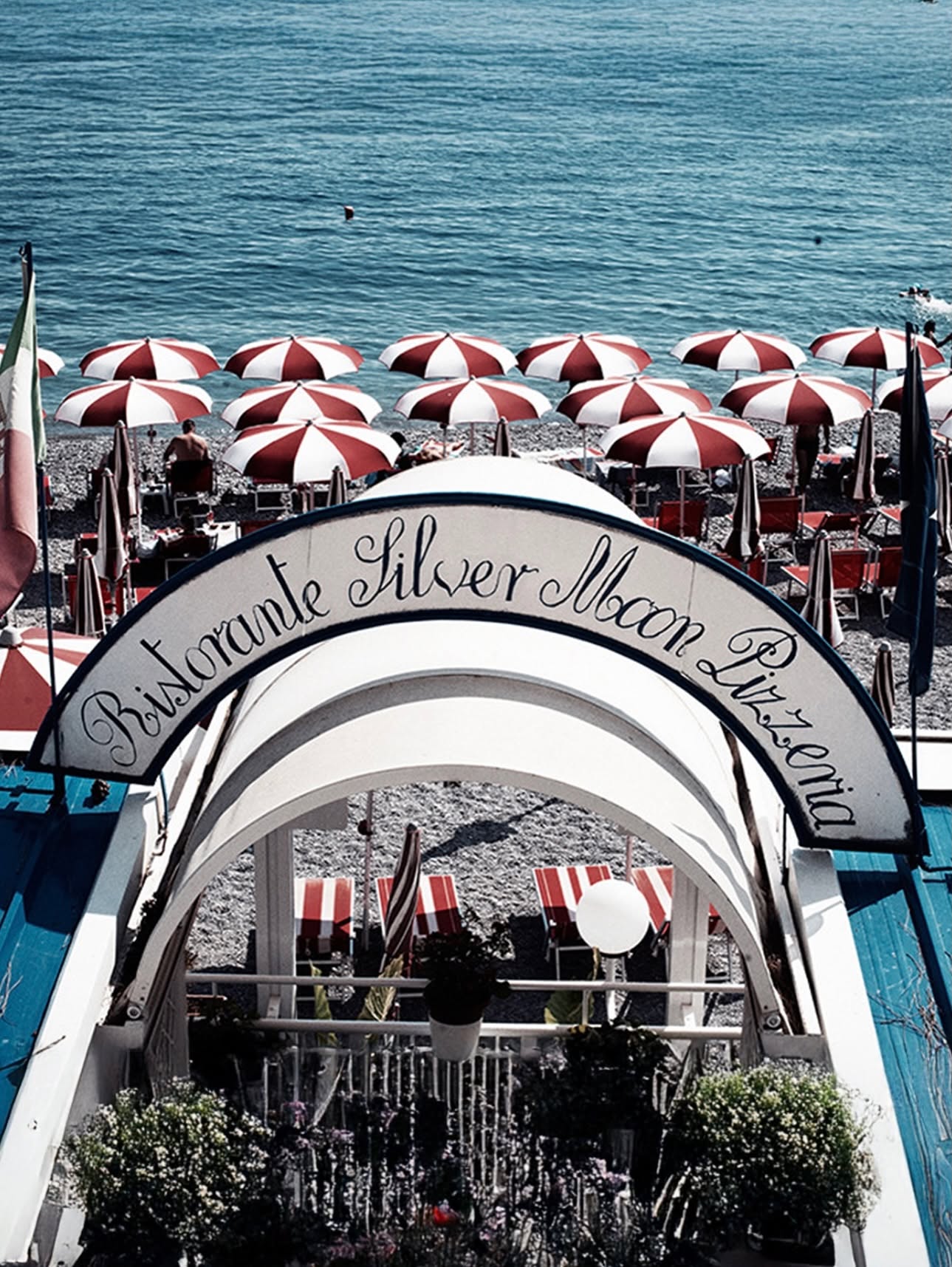
A full day at Silver Moon, the food, the pebbles, the red and white, is covered in a dedicated post.
My primary reason for visiting Amalfi is its stunning beach clubs, and there are many to choose from.
The beach club is an institution here and worth engaging with rather than resisting. You pay for a sunbed and umbrella, and in return you have a base, a place to leave your things, a shower, service from someone who will bring you a Campari spritz at the precise moment you want one. The red umbrellas of the clubs along the coast, seen from the water, are as much a part of the landscape as the lemon groves above. If there is a specific beach club you are eyeing, be sure to arrive early. A few beach clubs may require advance reservations, but most accept walk-ups based on availability.
Positano’s main beach is crowded in season, but the smaller coves to either side, reachable by boat, are significantly calmer. Atrani’s beach, shaded in the afternoon, has a local quality. At Furore, the fjord is its own category. At Conca dei Marini, Lido Capo di Conca sits on the rocks at the cape with water so clear you can see the bottom from the surface at depths that should not permit this.
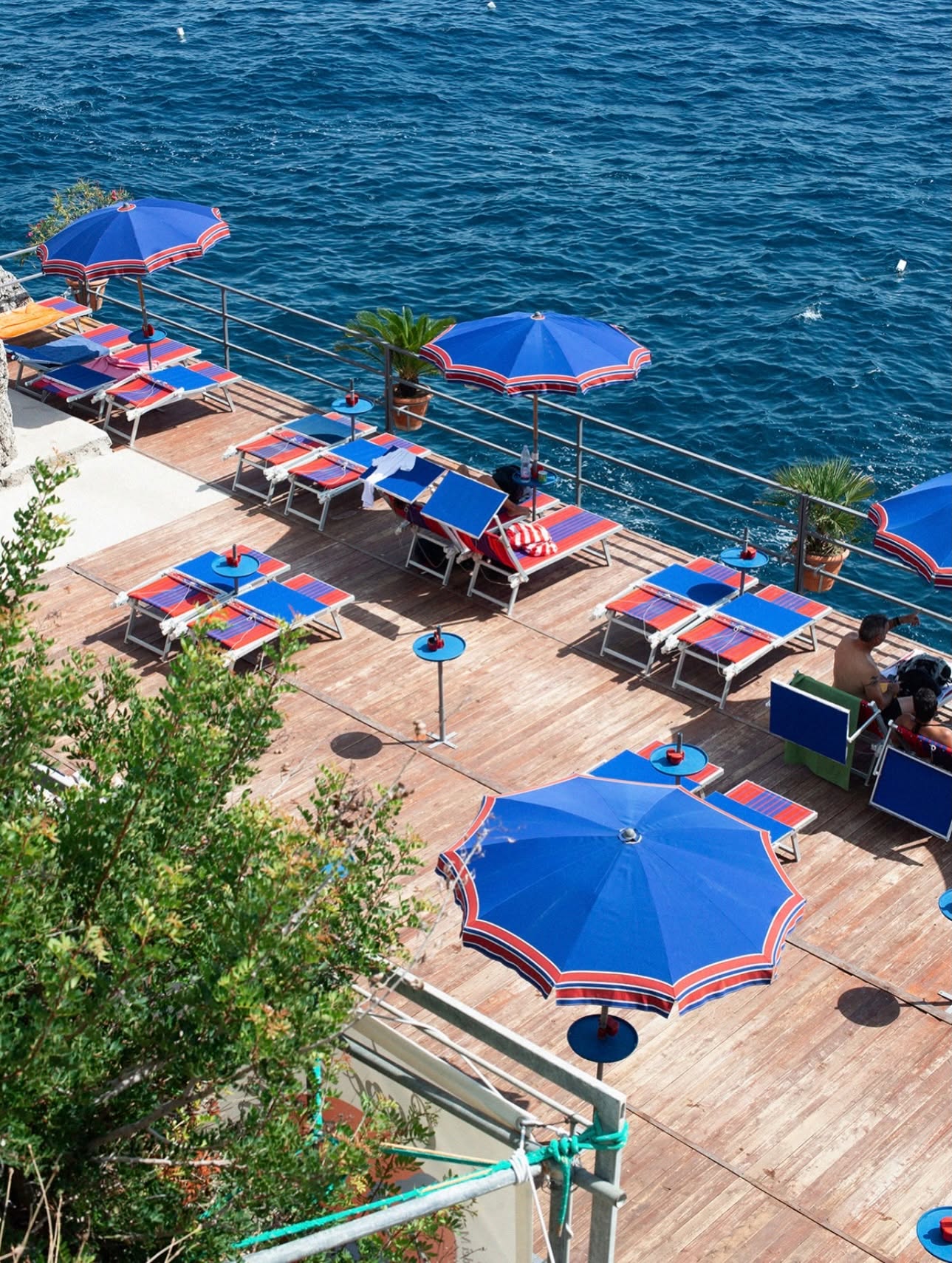
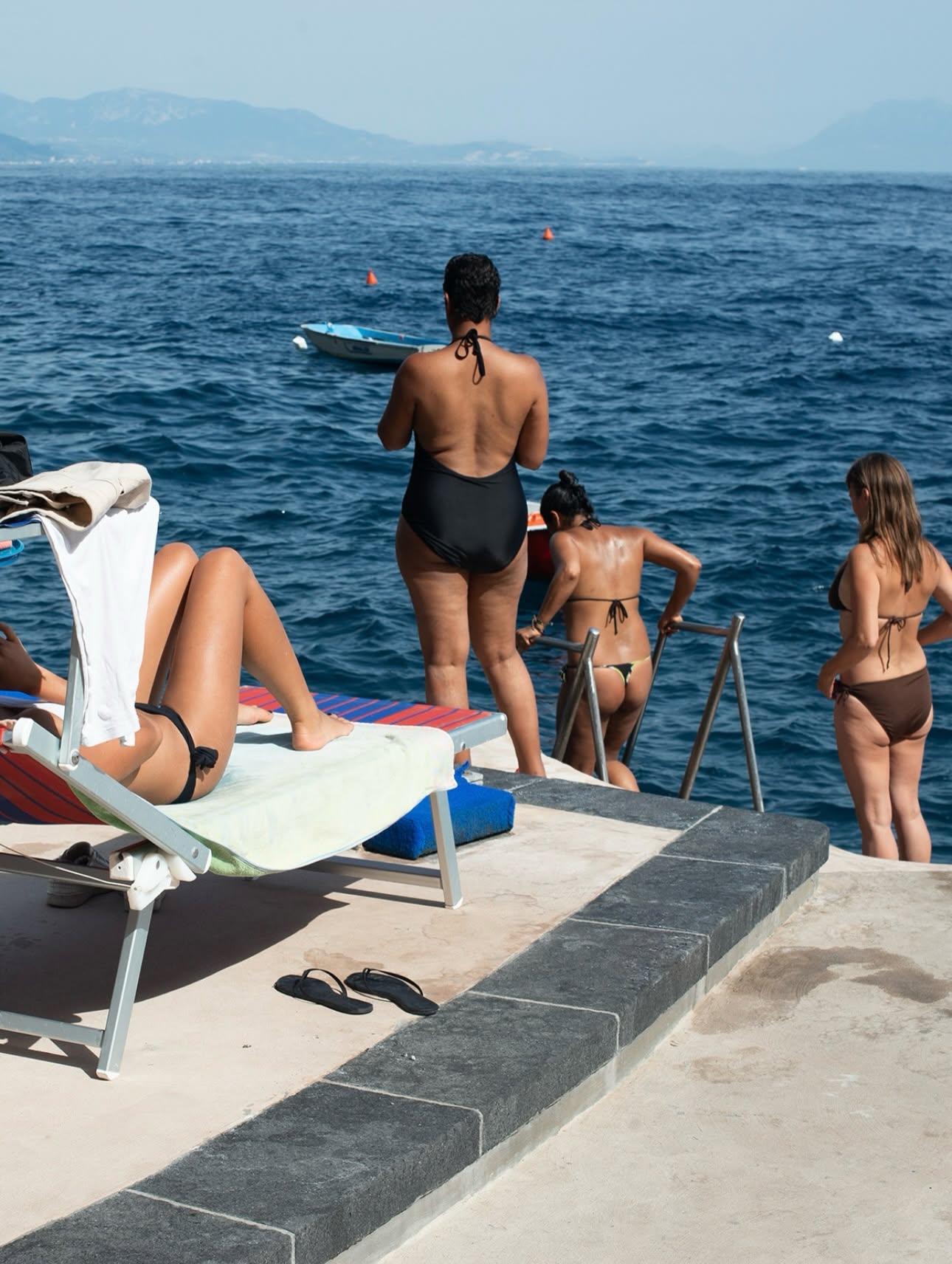
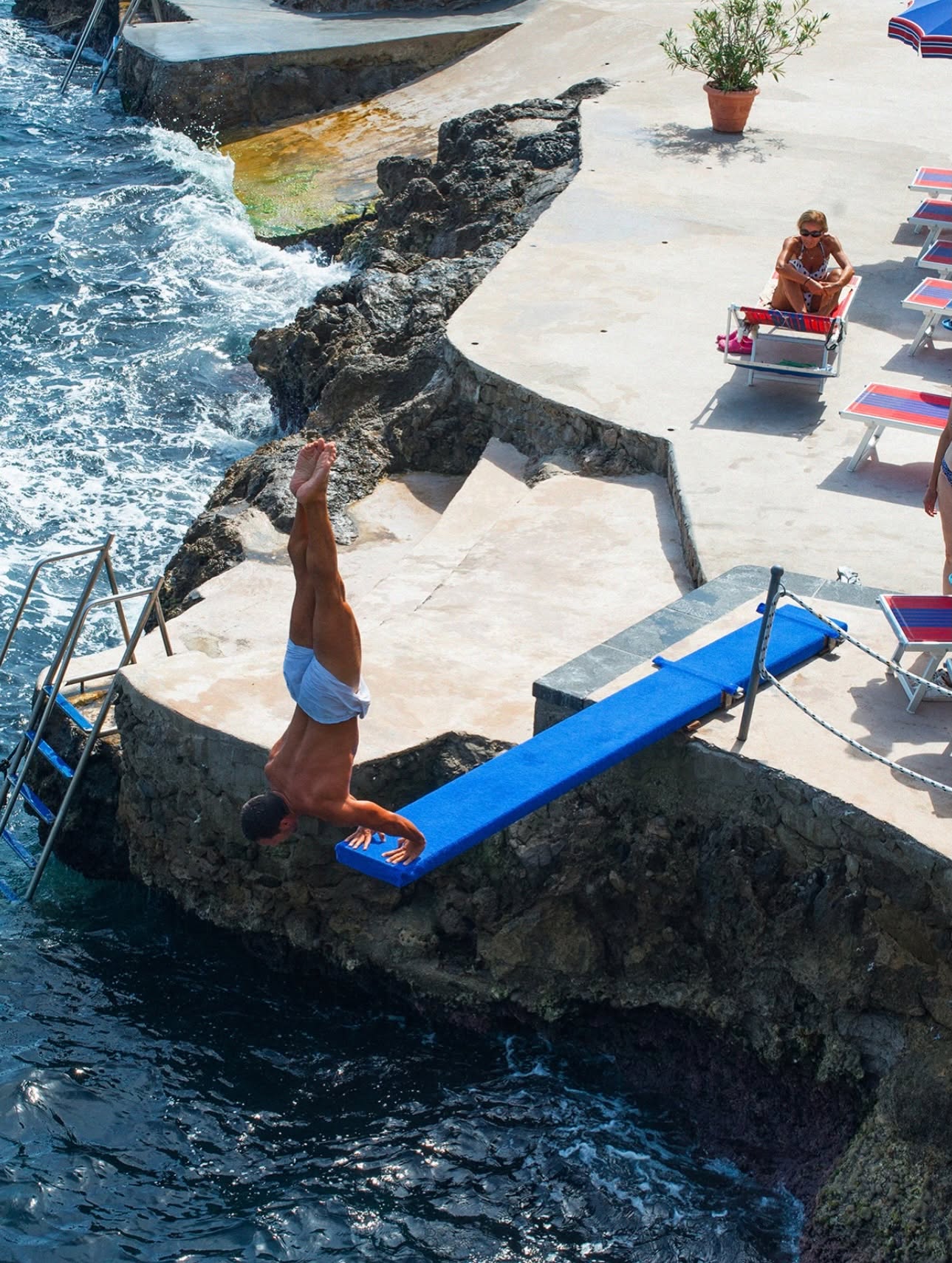
Another favorite club in Amalfi, based on it’s proximity, is at Conca dei Marini, Lido Capo di Conca sits on a rocky promontory four kilometers from Amalfi town, built into the cliff face in descending tiers of wooden sun deck, each level closer to the water than the last. There is no sand. Access to the sea is by ladder, or from the floating dock below the iron arch that carries the name of the place, or from the blue diving board that extends over the water from a flat rock platform and requires a commitment most people make exactly once and then immediately want to make again. The lido is reached by jeep shuttle from the road above, which is part of its logic: it sits below the world rather than on it, and the descent is part of arriving.
A sixteenth-century watchtower stands above the lido, built when this promontory was a lookout post against Saracen pirates approaching from the sea. The restaurant is run by the Ferraro brothers and serves the kind of Mediterranean cooking that earns its setting. The water off the cape is exceptional: deep, clear, cold when you first enter it, and the reason the cliff divers and the coral fishermen who once worked this stretch of coast both chose this particular point on the coast to come to.
Swimming in the Tyrrhenian in summer is one of the simple pleasures that need no elaboration. The water is clear and warm, and the coast drops away beneath you, and you float there and look up at the cliff face and the houses pressed into it, and you think: this is a very good situation.
Atrani Beach Club
The beach at Atrani sits a ten-minute walk east of Amalfi, through a pedestrian tunnel cut into the rock on the eastern side of town. Most visitors to Amalfi never make the walk. This is their loss.
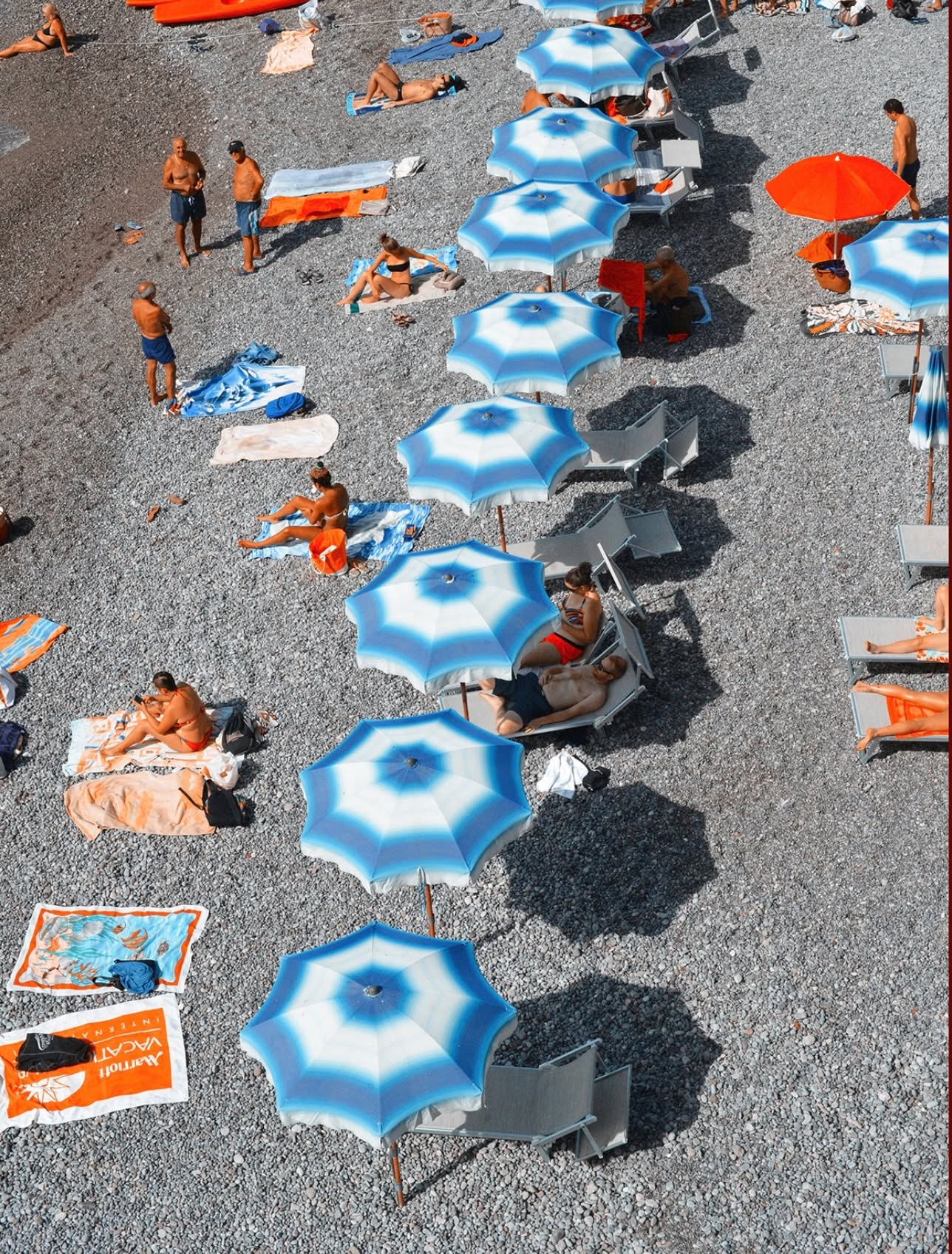
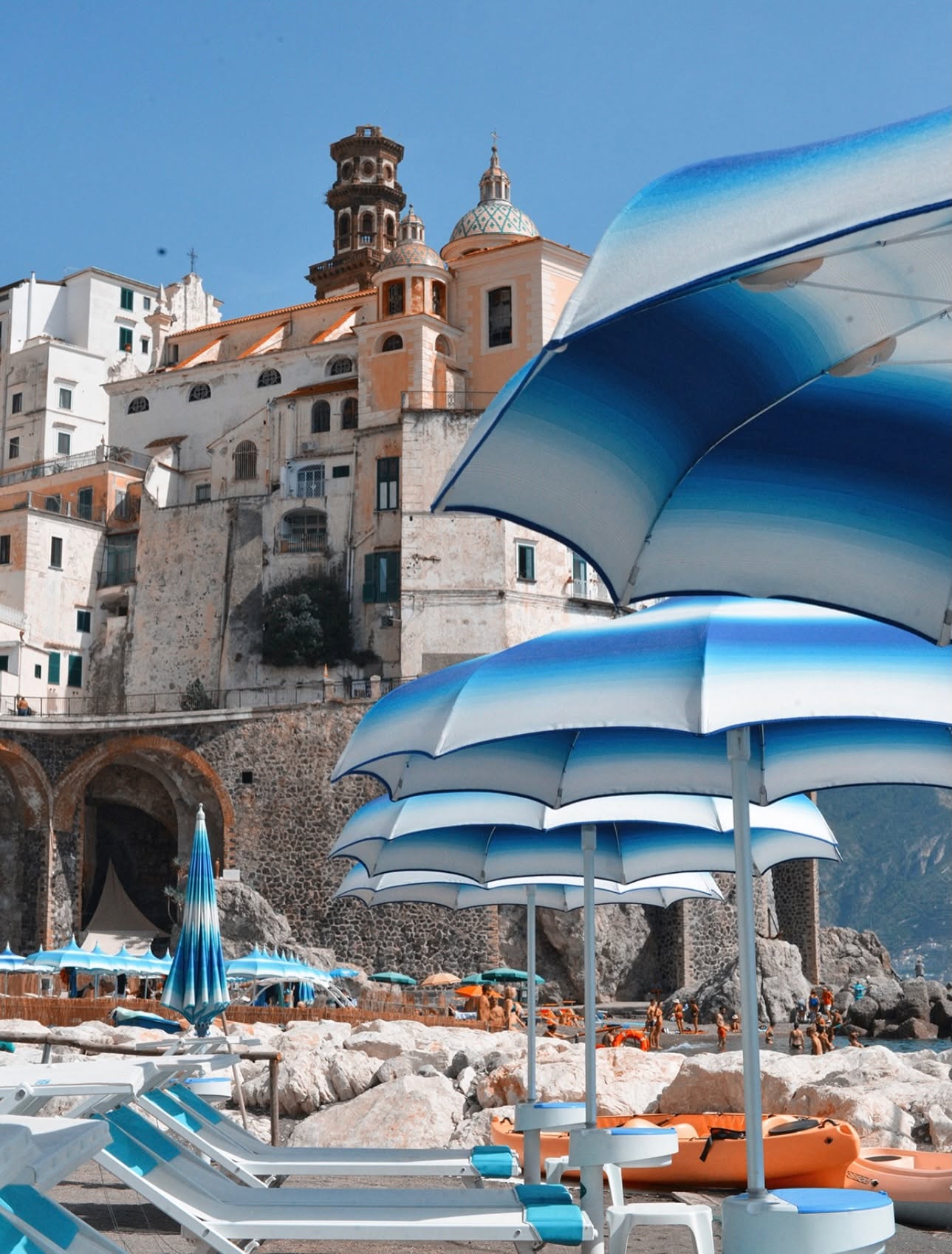
Atrani Beach Club occupies a section of that beach: dark charcoal pebbles, blue and white striped umbrellas, a bar with a wooden counter and bottles arranged without particular ceremony. The water here has the same clarity as anywhere along the coast, but the crowd is different. More Italian, more local, less managed. Families spread across the stones. The bells of the Collegiata di Santa Maria Maddalena strike the hours above. Rent a lounger, order something cold, and let the afternoon do what it wants to do. The outdoor showers at the perimeter offer both cold and hot options. Choose cold.
The Coast by Boat
The road here is slow, narrow and shared with coaches, and the sea beside it is empty. That is the whole argument. These towns were reached by water for a thousand years before the road was cut in the 1850s, and they only compose properly from offshore: Positano from the sea is a stack of colour in a ravine, and Positano from the road is a car park and a queue.
The coves are the other half of it. There is a stretch below Conca dei Marini where the cliff undercuts and the water goes clear over pale rock, and no path reaches it at all.
I have put the operators I would actually book, what each costs and which ones get into the caves, in my guide to the best Amalfi Coast boat tours.
Food and the Table
The Lemon
Everything on the Amalfi Coast circles back, eventually, to the lemon. The sfusato amalfitano, the long pale lemon grown on the terraced slopes above the coast, is unlike any other lemon. The skin is thick and fragrant and contains more essential oils than the varieties you find in supermarkets elsewhere in the world. The lemon of the Amalfi Coast is the lemon that other lemons aspire to.
Limoncello made from sfusato is the correct end to any dinner here. Not the bright yellow industrial version found in airport shops, but the artisan version, pale and cloudy and served very cold, that tastes like the Amalfi morning distilled. Lemon granita on a warm afternoon. Delizia al limone, a dome of sponge and cream and lemon curd that is the coast’s signature dessert, is correct. A lemon squeezed over grilled fish at lunch. The lemon is everywhere, and it should be.
Seafood and the Simple Meal
The best seafood meals I have had on the Amalfi Coast have been simple. Fresh fish, correctly cooked, at a table close to the water. Spaghetti alle vongole made with clams brought in that morning. Frittura di paranza, a mixed fry of tiny fish and squid, eaten hot and standing if necessary. The coast has its elaborations and some of them are extraordinary, but the elaborations rest on a foundation of good ingredients treated simply, and that foundation is where I spend most of my time at the table.
The local pasta shapes matter. Scialatielli, a short, thick pasta developed in Amalfi in the 1970s, has become the coast’s emblematic dish when served with seafood. The name means “to loosen the hair,” and it has the quality of things that were invented for a specific purpose and do exactly what they were invented to do.
Coffee, Pastry, the Morning
Espresso in Campania is a different substance from espresso in Milan or Rome. It is shorter, darker, extracted through a coarser grind, and it arrives in a small warm cup that you drink quickly standing at the bar. The ritual of the morning coffee at a Neapolitan-style bar is one of the great compact pleasures: the sound of the machine, the smell, the brief exchange with the barista, the espresso itself consumed in two sips. It costs almost nothing, and it starts the day correctly.
Pastry in Minori and the towns around it draws on the Neapolitan tradition: sfogliatella in its riccia and frolla forms, babà soaked in rum, and pastiera at Easter. A warm sfogliatella riccia, eaten at the bar with a coffee, is an argument for having woken up early enough to have it.
Evenings
The Amalfi Coast at evening is when the day’s best decision is to find an outdoor table and sit down with a glass of local white wine and nowhere to be for the next two hours. The Fiano di Avellino and the Falanghina from the Campania hills above are the bottles to look for: crisp and mineral with an authority that matches the landscape. The local Ravello whites, made from vines grown at altitude, are worth seeking.
Dinner begins late. Before eight, you are eating alone or with other non-Italians. After nine, the tables fill properly and the evening finds its rhythm. Stay for that rhythm.
If you are looking for clubs, parties, and a vibrant nightlife, spots are few and far between. The Amalfi Coast is a place where you come to relax and enjoy a plate of pasta or seafood and a glass of wine. While it does have some events, it’s nightlife is limited.
Photography on the Coast
The Amalfi Coast was made for photography in the sense that it is impossibly beautiful in every direction at most hours, and the light, the particular Mediterranean light that arrives unfiltered and clear, does most of the work for you. What this means in practice is that the interesting challenge is not finding something beautiful to photograph but finding your own version of a place that has been photographed millions of times.
Morning is where I spend most of my photographing time. Before nine, the light is soft and directional, and the shadows are long, and the towns have not yet filled with people. The boats are setting out. The shutters are still closed. Positano from the water in the early morning, seen from a ferry that is mostly empty, has a quality that the midday version cannot quite match.
The architecture rewards close attention. The majolica tilework on the domes and the facades, the painted ceramic numbers on the house doors, and the geometric patterns of the medieval Arab-Norman influences that run through the whole coast’s visual vocabulary. The coast is not only a panorama. The details are equally photogenic and significantly less photographed.
Golden hour on the west-facing coves turns the water and the stone the same shade of amber and lasts long enough to reward patience. Find your position before the light arrives and wait for it. The coast’s best light is the light that is about to change.
A dedicated photography guide to the Amalfi Coast, with specific locations and timing, is part of this site’s growing archive.
What to Wear
There is a way of dressing for the Amalfi Coast that is not about fashion in the conventional sense but about understanding the environment. The climate is Mediterranean summer: warm days, occasionally very warm, with a sea breeze that makes the heat bearable. The evenings can be surprisingly cool once you are out of the direct warmth of the stone.
Linen is the material of the coast. Light, breathable, beautiful in the way that natural fabrics in honest colors look beautiful against white walls and blue water. White linen. Natural linen. A particular shade of faded denim that the light here handles well. The coast has a long tradition of its own artisan fashion, and some of the linen pieces and hand-painted fabrics available in Positano’s shops are genuinely beautiful.
Swimwear matters more here than anywhere else I know. You will be in and out of the water all day, and the swimwear is not a detail but a decision. Simple shapes in solid colors or classic prints. Something that works at the beach club and on the ferry and at the bar where you stop for a gelato, still slightly damp from your last swim. The test is whether it still looks like something when you are standing in the water.
Evening asks for a slight elevation of register. Not formal, but considered. A simple dress in silk or linen. Good sandals. One piece of jewelry that is not trying too hard. The Amalfi Coast at dinner is beautiful, and it responds to being met with a degree of care.
Sandals from Positano are their own category and worth acquiring. The ateliers on the main street will make you a pair in your measurements while you wait, in leather that softens to your foot within a day. I have several pairs, and I wear them far from the coast because they carry the place with them.
A complete packing guide for the Amalfi Coast is in progress on this site.
Where to Stay
The coast offers accommodation across a wide range. I will resist making specific hotel recommendations here, both because the right choice depends entirely on what you are after and because the landscape changes quickly enough that my last experience of a particular place may not match what you find. What I can offer is a framework.
For pure luxury, the historic hotel perched above the sea on the western end of the coast, with its terraced gardens and its views, is the Amalfi Coast experience in its most concentrated form. These places have been doing this long enough to have refined it entirely.
For something smaller and more personal, the boutique hotels and converted villas scattered across the hillsides offer the combination of beauty and intimacy that the larger properties trade for grandeur. The experience of waking up in a room where the window opens onto a terrace and the terrace opens onto a view that encompasses the sea and several miles of coast is difficult to improve on.
For the quiet, Ravello and the smaller towns to the east of Amalfi offer a different register from Positano or the central coast. You sacrifice some convenience and gain some peace, which is a trade I frequently find myself making.
What matters most in choosing is understanding that location on the Amalfi Coast is not just about the town but about the position within the town. A room with a sea view is a different holiday from a room facing the hillside, even in the same hotel. It is worth asking specifically and directly.
Suggested Itineraries
One Day
If you have a single day, come from Naples or Sorrento by boat and make Positano your anchor. Arrive early enough to walk the streets before they fill. Swim from the main beach or, if you can arrange it, from one of the smaller coves to the south. Have lunch at a table close to the water. Take the ferry to Amalfi in the afternoon and climb the steps to the cathedral. Return to Positano by boat at golden hour and drink something cold on a terrace with a view of the sea. This is a very good day.
Three Days
Three days allow you to breathe. Base yourself in Positano or Amalfi and devote a half-day to each neighboring section of the coast. Day one: Positano and the western coves. Day two: ferry to Amalfi, walk to Atrani, return by boat. Day three: Ravello by road in the morning, Villa Cimbrone gardens, lunch with a view, and an afternoon at the beach. One evening in each place, whatever presents itself.
Five Days
Five days is when the coast begins to reveal its layers. The core itinerary above, plus a morning hike in the Valle delle Ferriere (for the adventure seekers) or a half-day on the Path of the Gods. A day at Conca dei Marini or Furore for the quieter version of the coast. Or my favorite, go to Capri.
One Week
A week allows you to stop planning and start living in the place. Move between two or three bases. Spend mornings photographing. Spend afternoons at the beach doing nothing. Take a one-day trip to Capri. Have one proper dinner at the kind of restaurant that requires a reservation and rewards the effort. Spend one evening in Atrani drinking wine with no particular reason to be anywhere else. By the end of the week, you will understand why people come back year after year.
Day Trip to Pompeii
Pompeii is an hour by road from the coast, north through Salerno. I made the trip as a day trip and found it a natural pairing with the south: the water and the heat in the morning, the silence of the ruins by afternoon. A full guide to Pompeii is here.
More images from the Amalfi Coast







Your Amalfi Coast Guides
- The Best Amalfi Coast Itinerary: 5 to 7 Days
- How to Get Around the Amalfi Coast
- The Best Towns on the Amalfi Coast
- The Best Beaches on the Amalfi Coast
- Hiking on the Amalfi Coast
- Where to Stay on the Amalfi Coast
- The Best Photo Spots on the Amalfi Coast
- When to Visit the Amalfi Coast: A Month-by-Month Guide
- The Best Amalfi Coast Boat Tours: The Whole Coast, From the Water
Amalfi Coast Travel Diaries
- Love Letters in the Valle de Ferriere
- Amalfi Heat
- A Day on Spiaggia Grande Positano
- Silver Moon Beach Club, Amalfi: Everything You Need to Know
- Lido Capo di Conca: The Best Cliff Lido on the Amalfi Coast
- Atrani Beach Club, Amalfi Coast
- Capri Is For Lovers A Private Boat Tour
- With Love, From Ravello
- Journey into the Valle Delle Ferriere
- Positively, Positano
- The Pink Beach Club
- The Blue of Capri
Frequently Asked Questions
How many days do you need on the Amalfi Coast?
Three to four days is the comfortable minimum to see two or three towns without rushing. A week lets you slow down, add the Path of the Gods, and take a day trip to Capri or Pompeii.
What is the best time to visit the Amalfi Coast?
Late May, June, and September, with warm sea, long light, and thinner crowds than the July and August peak. Winter is quiet and much of the coast closes.
Which town should you stay in?
Positano for glamour and drama, Amalfi for a central and walkable base, Ravello for quiet and gardens above the sea, and Atrani or Praiano for somewhere smaller and more local.
Do you need a car on the Amalfi Coast?
No, and it is often easier without one. The coast road is narrow and slow in season, while the SITA buses and ferries connect the towns well. A car is more burden than freedom here.
How do you get to the Amalfi Coast?
Most people fly into Naples, then take a transfer, the train to Sorrento and the bus, or, best of all, the ferry in the warmer months. Arriving by sea is the way the coast was meant to be seen.
Is the Amalfi Coast expensive?
Yes, by Italian standards, and Positano especially so. Costs soften if you base in Amalfi, Atrani, or Salerno, travel by bus and ferry, and eat a few streets back from the water where the locals do.
Why I Keep Coming Back
I have asked myself this question many times, usually in the weeks before a return visit, when the planning makes me suddenly aware of how often I find myself arranging to be here again.
The honest answer is that the Amalfi Coast does something to my sense of proportion that no other place does quite as reliably. It is not an escape. I have never come here to escape from something. It is more like recalibration. The vertical landscape, the sea so present and so large, the ancient light on ancient stone, all of it conspires to remind me of what matters and what doesn’t, and the things that don’t matter are numerous and have a tendency to expand in the absence of this reminder.
There is also the particular pleasure of loving something well enough to know it in more than one season, at more than one hour, in more than one mood. The coast in June is not the coast in September. The coast on a still day is not the coast when the wind comes off the water. I know these versions, and I want to know more of them. That, finally, is the thing that keeps me returning: the coast is still being revealed to me, and I have the feeling it is not done.
V