The salt finally came out in the shower at about eleven.
Two days on the water and my hair had started having opinions. So today had exactly one rule, which was that nothing was going to involve a boat.
Instead we drove up into the middle of the island, to the part of Milos that has been dug into rather than sailed around.
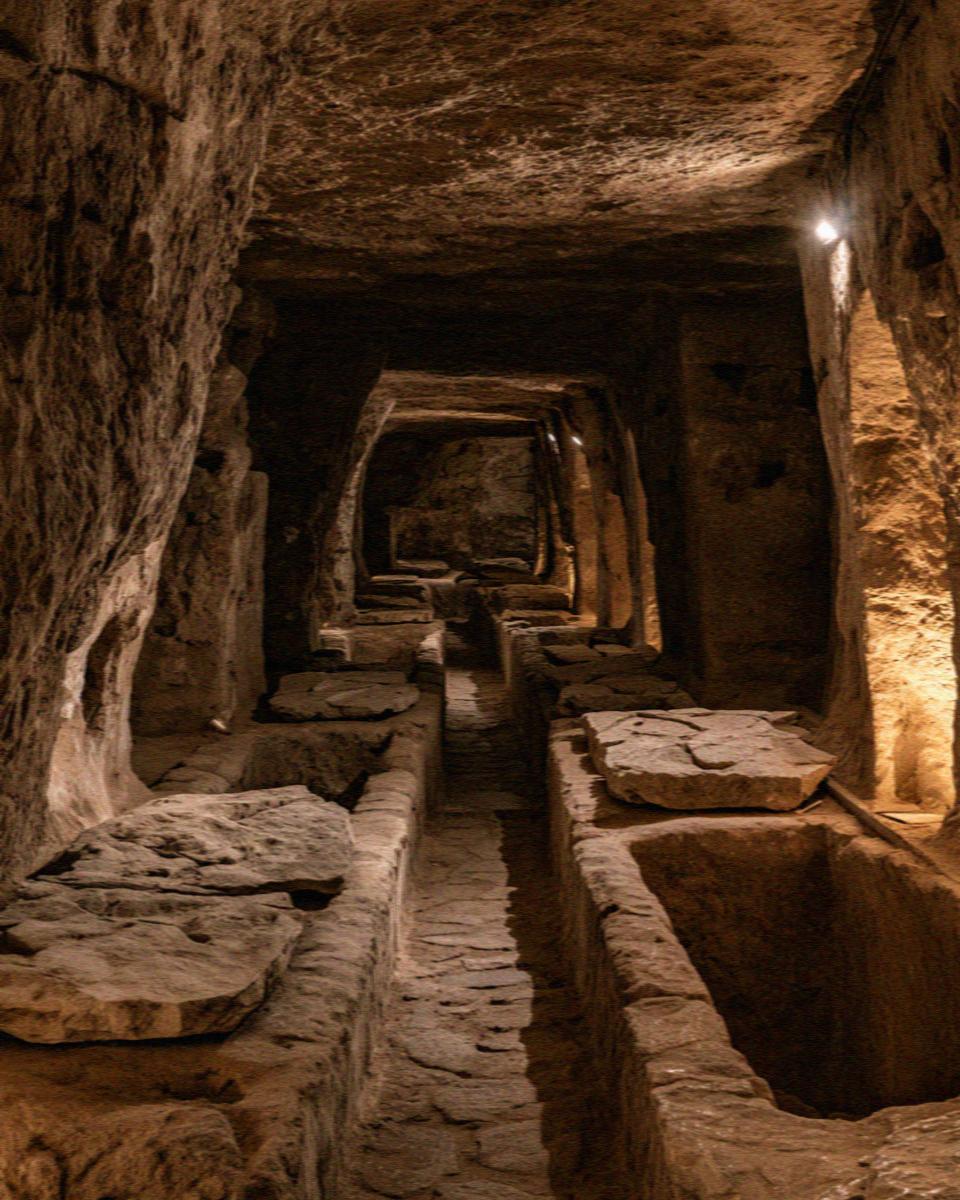
Trypiti sits on a hill of soft volcanic rock above the old harbour. The name means something close to perforated, because the rock is full of holes, and when the rock is this soft a hole becomes a room without much persuasion.
The catacombs are that, repeated about a hundred times.

You go down into a cool corridor cut through the stone, low enough that the tall members of the party learn something about themselves, and on both sides the walls have been hollowed out into shelves for the dead. More graves are cut into the floor and covered with flat unworked stones, the sort you would pick up because they happened to be the right size.
People were being buried here from around the first century until the fifth. Families had their own chambers. It is one of the oldest Christian burial sites anywhere, and almost nobody outside Greece has heard of it, which on the whole it seems to prefer.
The guide told us, without any ceremony at all, that people in the village still use caves further along as storerooms and stables.
I liked that more than I expected to. People have been digging into this island for thousands of years and the holes simply carry on being useful. Somebody’s grandfather keeps his winter potatoes two hundred metres from a fourth-century grave and thinks nothing of it.
Two hundred metres the other way, the theatre.

White marble seats in a half circle, cut into the slope, facing down and out. The Romans rebuilt it over something older and then everyone left and the sea stayed where it was.
Here is the thing about it. Every theatre I have ever sat in was built to make you look at the stage. This one was built so that when you look at the stage you are also looking at the whole bay and the far cliffs and about nine shades of blue. Whatever was performed here had to compete with that, and I do not think it ever won.
I sat about halfway up for a while. A lizard came and sat on the seat in front of me, which is roughly the audience the place gets now.
Then we walked along the path to the wall.
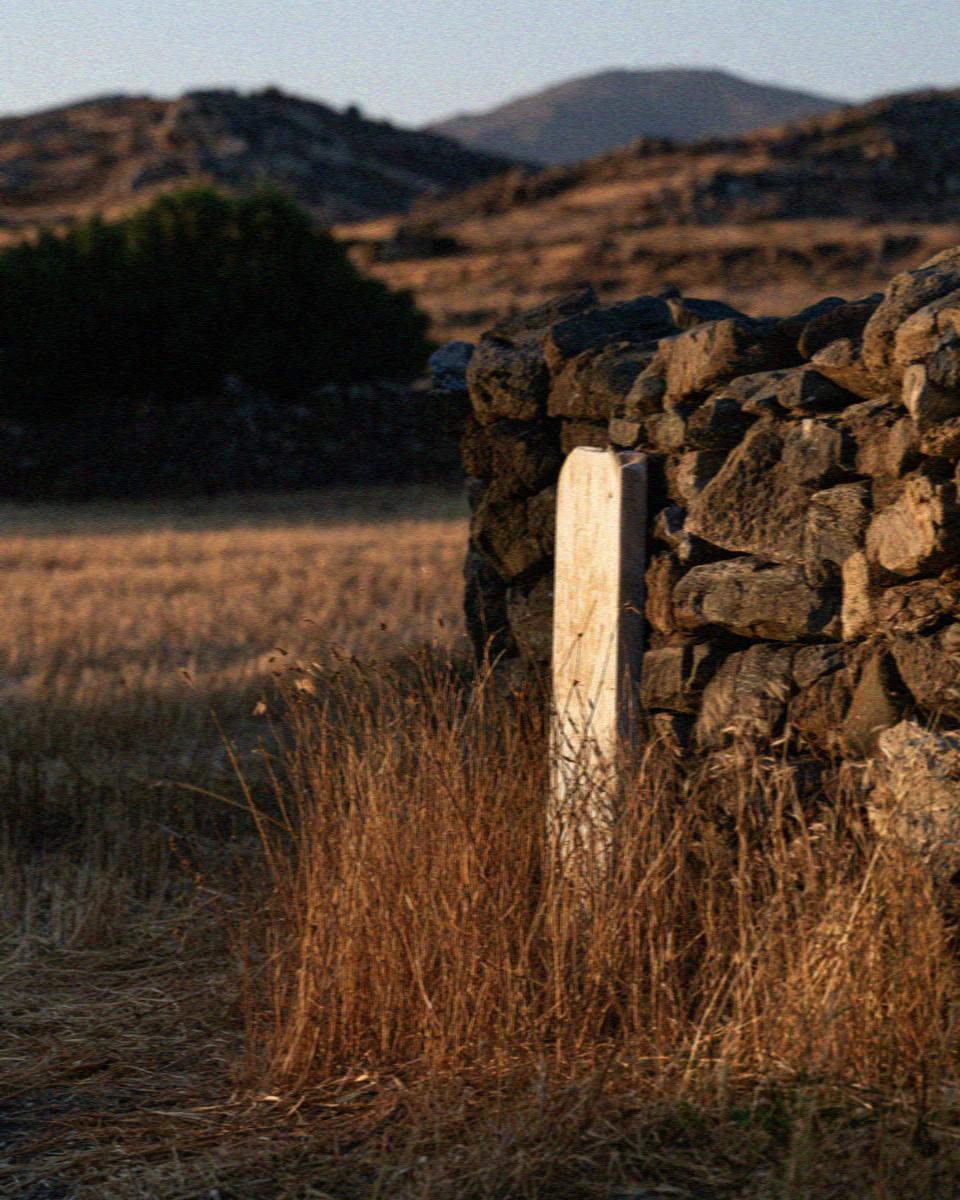
There is a stone retaining wall at the edge of a field, and set into it there is a small marble plaque, about the size of a book. It is easy to walk past. The plaque says that this is where the statue was found.
In 1820 a farmer was pulling stones out of an old structure here, because the stones were good and the structure was finished with them, and he found a woman in two pieces.
She is in the Louvre now. I have walked past her a dozen times on the way to something else, the way you do with the famous ones. Enormous room, polished floor, a crowd of phones held up at head height, and the Venus de Milo on her plinth in the middle of it, very calm about all of it.
And she came out of this field. Out of a wall, in bits, pulled up by somebody who was after building material.
Her arms were never found. People have argued for two hundred years about what she was doing with them. Holding an apple, holding a mirror, holding the edge of her own clothing, spinning wool. Nobody knows, and because nobody knows, everybody gets to be a little bit right.
I stood there longer than the plaque really asks you to.

Afterwards, Plaka, and up.
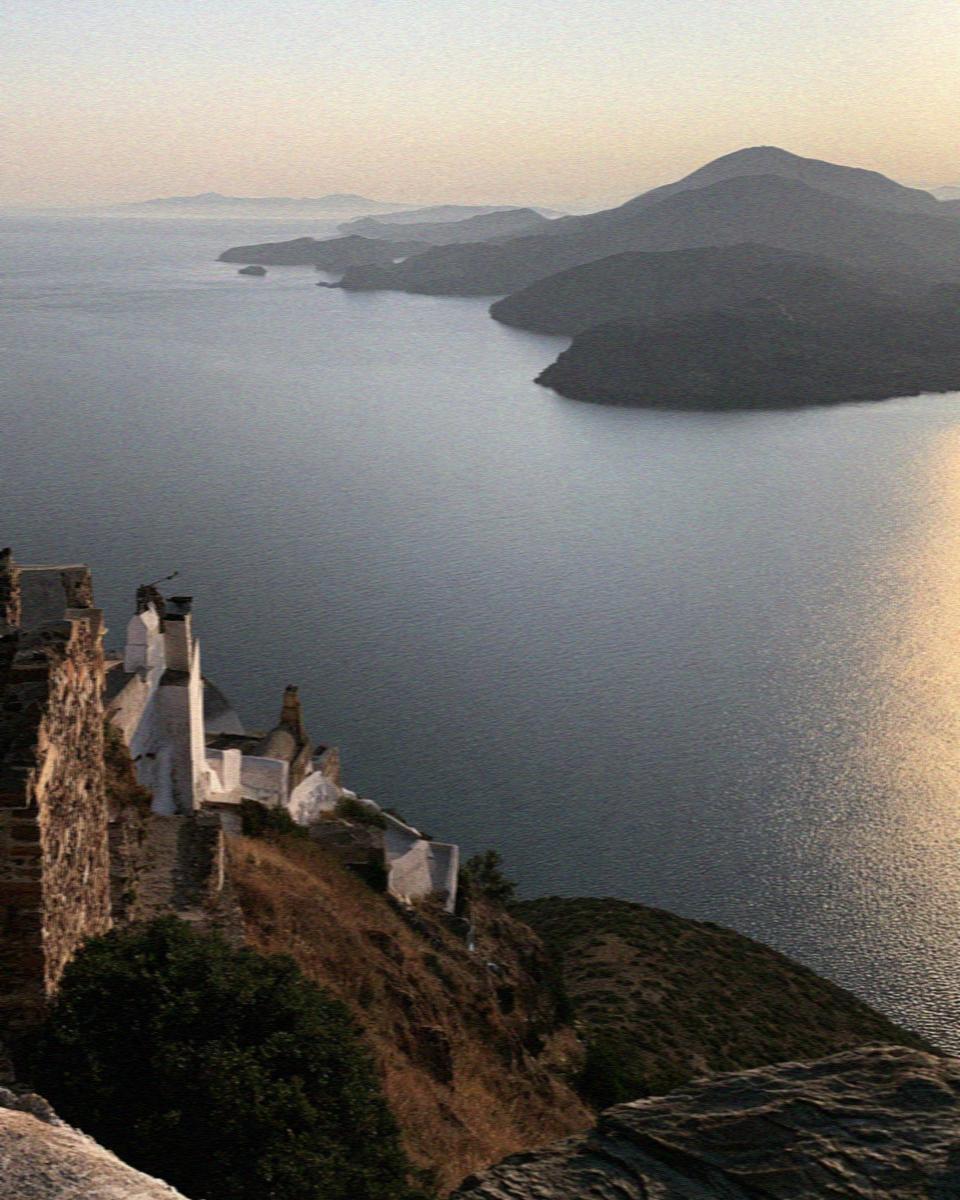
The old castle sits at the top of one of the highest points on the island. Getting there means about two hundred steps, which is free and feels considerably less free around step one hundred and forty. Halfway up there are two small churches built into the rock where you can light a candle and get your breath back, in whichever order you need them.
There is no castle at the top in the way the word suggests. No curtain wall, no battlements. The houses themselves were the defences, built wall to wall in a ring with the governor’s tower above them, so that the village was the fortification.
A town shaped like a shield.
From up there you can see the whole flooded crater of the bay, the drowned mouth of the volcano, and past the far headland the open sea going silver.
We came down for dusk, because of where we were going.
Klima is fifteen minutes of narrow switchback road below Plaka, and there is no bus, and the parking is a joke that everybody is in on. You arrive early or you walk.
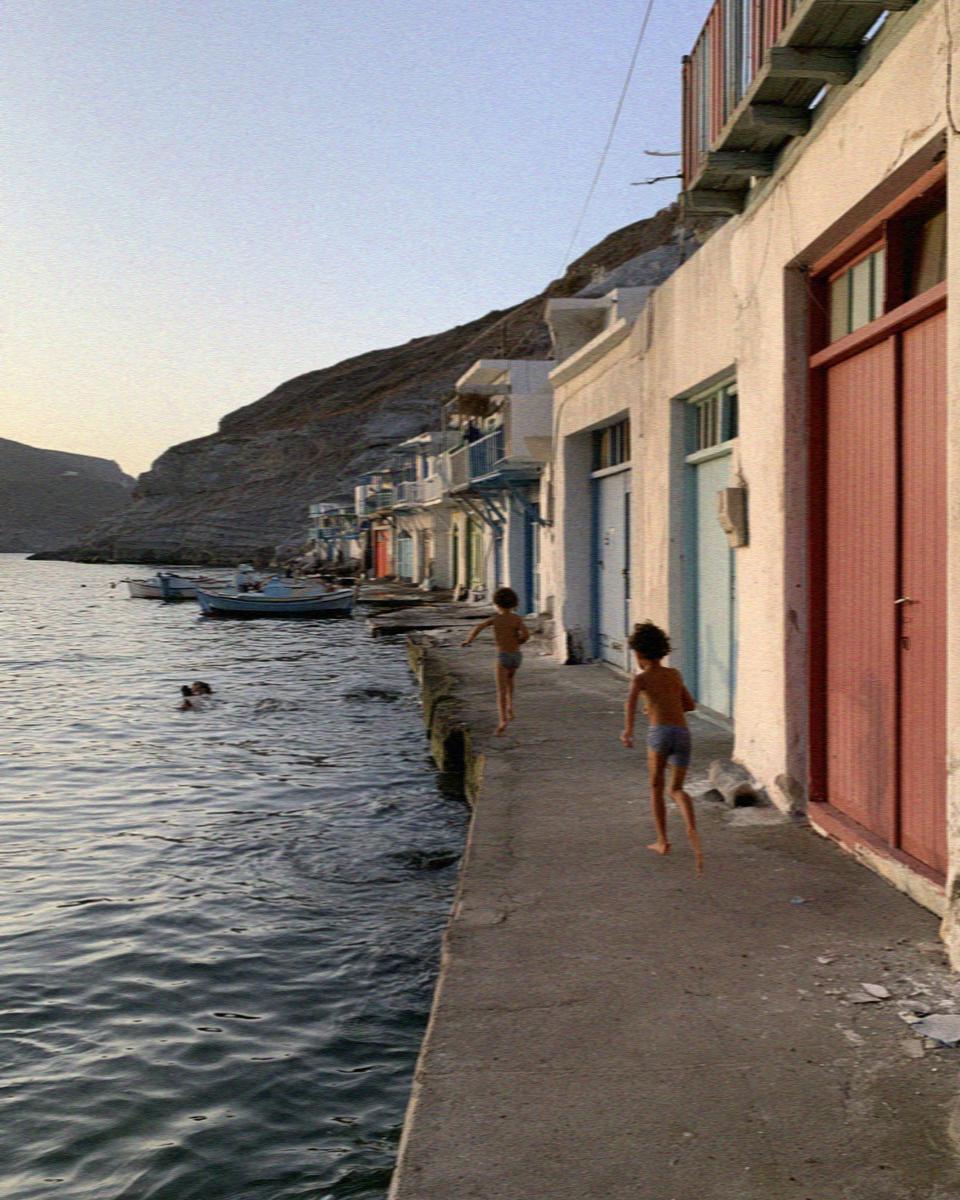
And then you are standing on a strip of concrete at sea level in front of about forty little two-storey houses with their feet in the water.
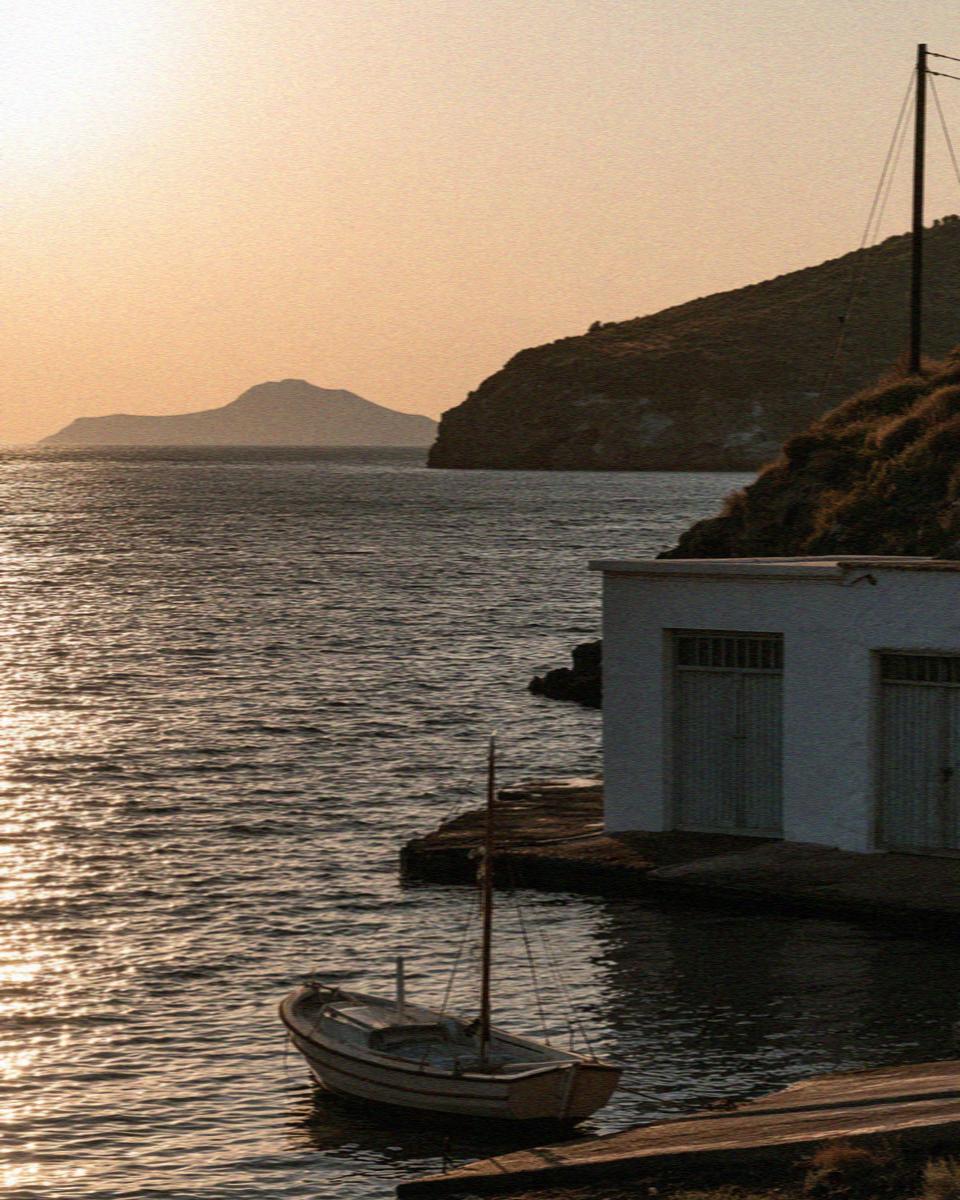
They are called syrmata. The ground floor is a boat garage, cut back into the rock, with a wide door that opens straight onto the sea so a fishing boat can be hauled up out of the winter. The floor above is a room to live in.
Garage underneath, bedroom on top, sea at the doorstep.
The doors and window frames are yellow and red and blue and a particular dark green, and they are those colours for a reason that took me a moment to understand and then would not leave me alone.
They were painted with whatever was left over from the boats.
You paint your caique, and there is half a tin left, and your door is a door. So the village is the exact colour of its own fishing fleet, in the proportions that the fleet happened to be painted that year.
Nobody chose a palette.
The palette is a residue.
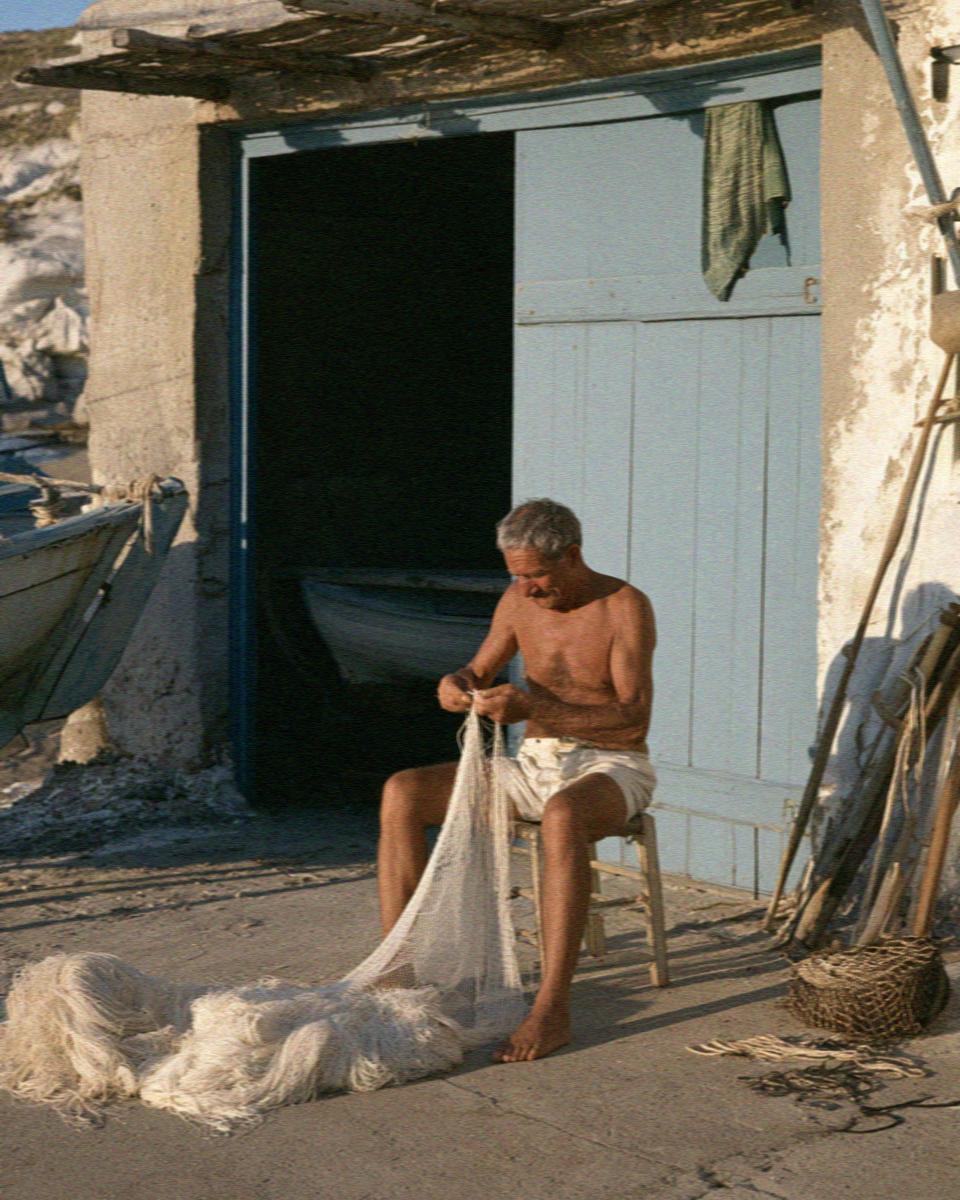
Fishermen still live above some of them. There was washing out on a line between two of the doors, and a cat on a step with the specific confidence of a cat that has never once been moved, and nets folded into a square the way you fold a flag.
There is no beach. There is nowhere to lie down at all. But you can get into the water off the rocks at the end, so I did.

Cold enough to be a decision rather than a drift.
The sun had gone behind the hill behind the village but the sky over the water was still going, and I swam out far enough to turn round and look back at the whole row of coloured doors from the sea.
Which is the way they were meant to be seen.
The people who painted them arrived home facing that way.
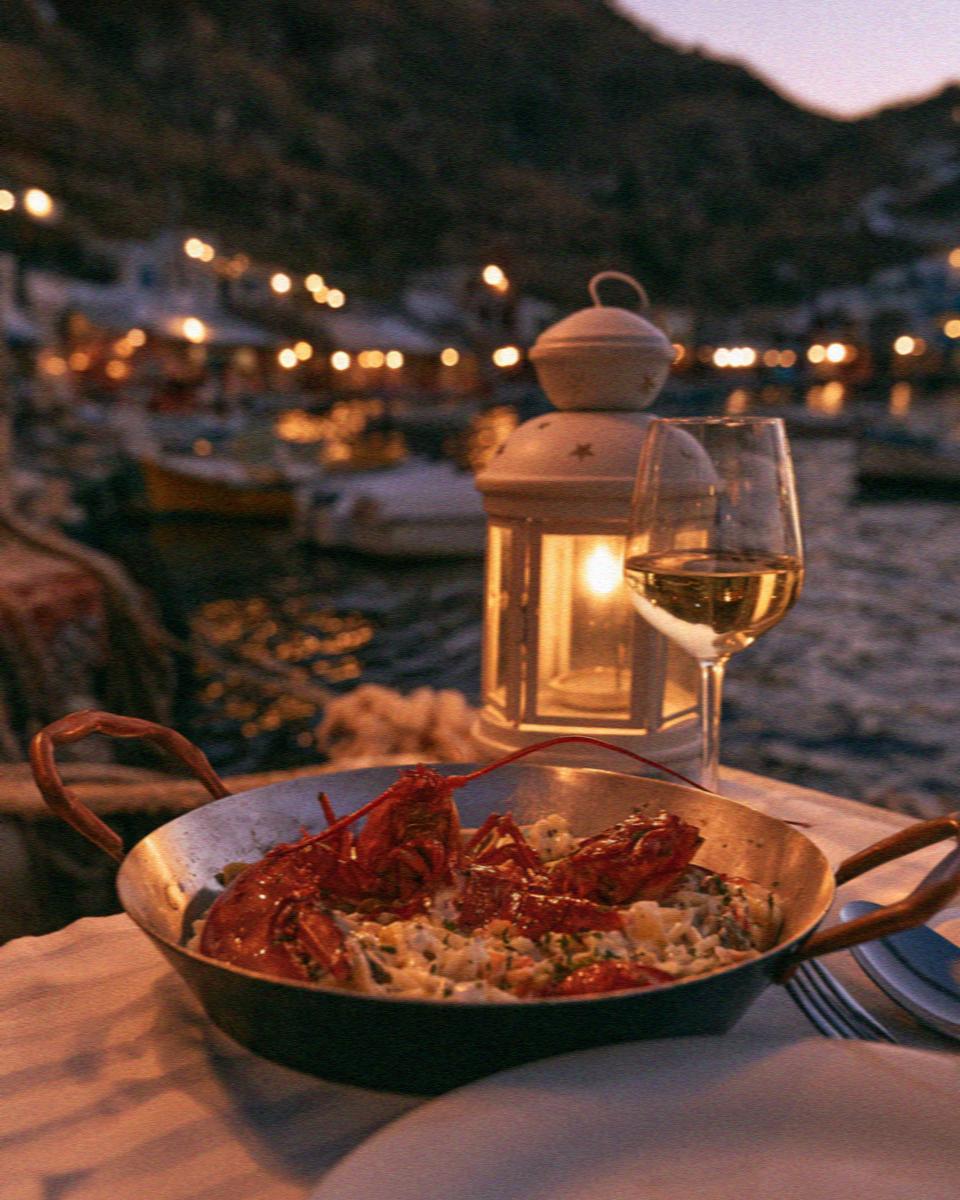
Dinner was at the long table at the end of the row, close enough to the edge that on a windy evening you get the spray with it. Lobster and pasta, which is the dish here, in a flat pan, eaten slowly because it insists on it.
The last of the light went out of the water while we were still at the table.
I have decided which colour my door would be, and I am keeping it to myself.
V.
More images from Milos