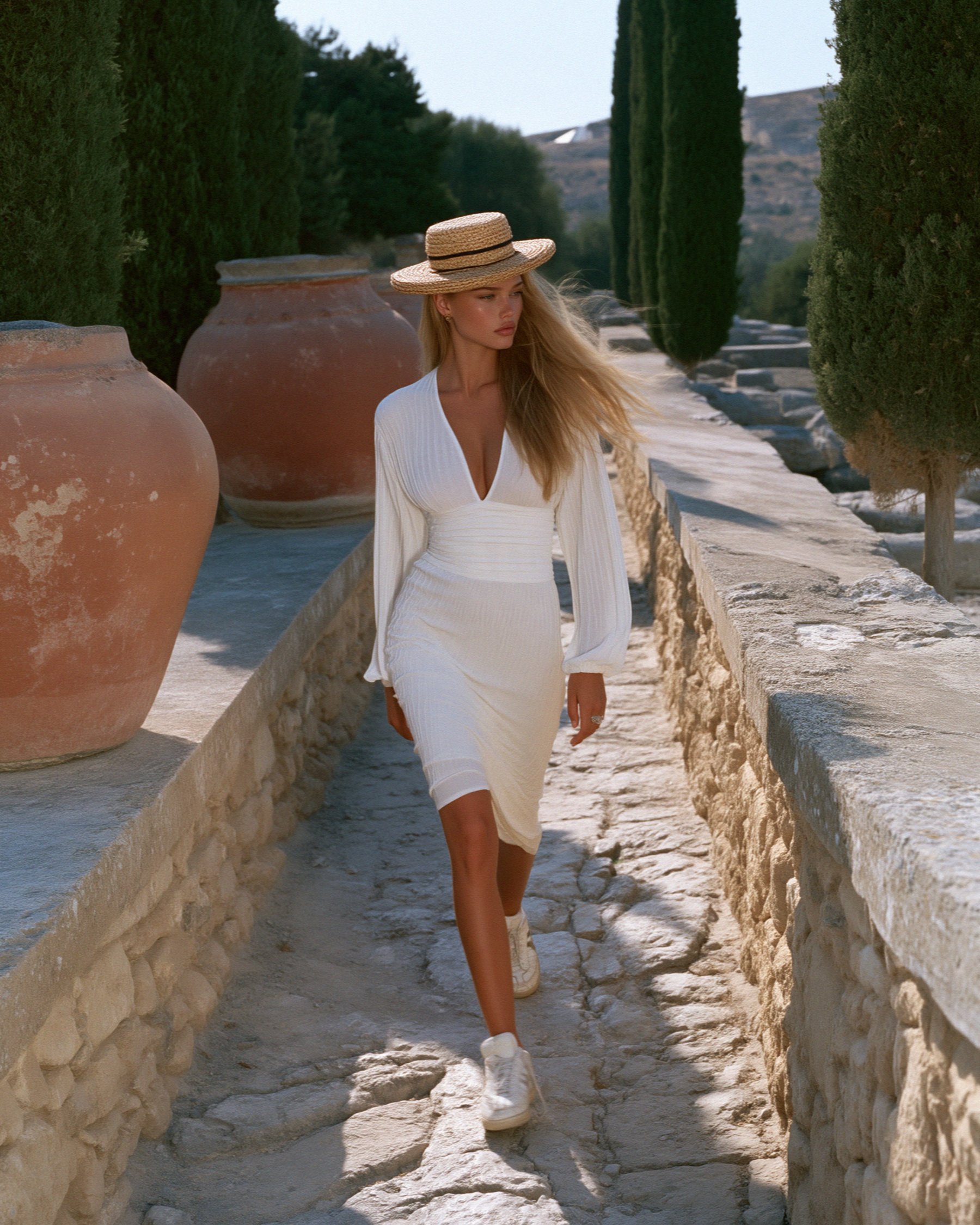
The painted dolphins and the charging bull you photograph at Knossos are copies. The originals hang in a museum in the middle of Heraklion, about 5 km away, and that is the one thing to understand before you plan the day: the palace gives you the place, the museum gives you the things, and either one alone tells you half the story.
Knossos is the part of Crete I left for another trip, since my time on the island went to the west. This guide is built from the site’s own information, the museum’s, and the advice of people who have walked those courtyards many times, and it is meant to save you the two classic mistakes: arriving at 11:00 with every coach on the island, and skipping the museum. For how Heraklion fits with the rest of the island, see my complete guide to Crete.
What Knossos is
Knossos is the largest of the Minoan palaces, the centre of the Bronze Age civilisation that flourished on Crete long before classical Greece. The first palace went up around 1900 BC, was rebuilt after earthquakes, and was finally abandoned around 1350 BC. It was not a palace in the modern sense so much as a vast complex of rooms around a central court: storerooms with giant clay jars, workshops, shrines, stairways, and halls on several levels.
This is also the setting of the old myths: King Minos, the labyrinth and the Minotaur. Whether the maze of rooms inspired the legend is a question nobody can settle, but walking the corridors you can see why people have wondered.
Evans and the reconstructions
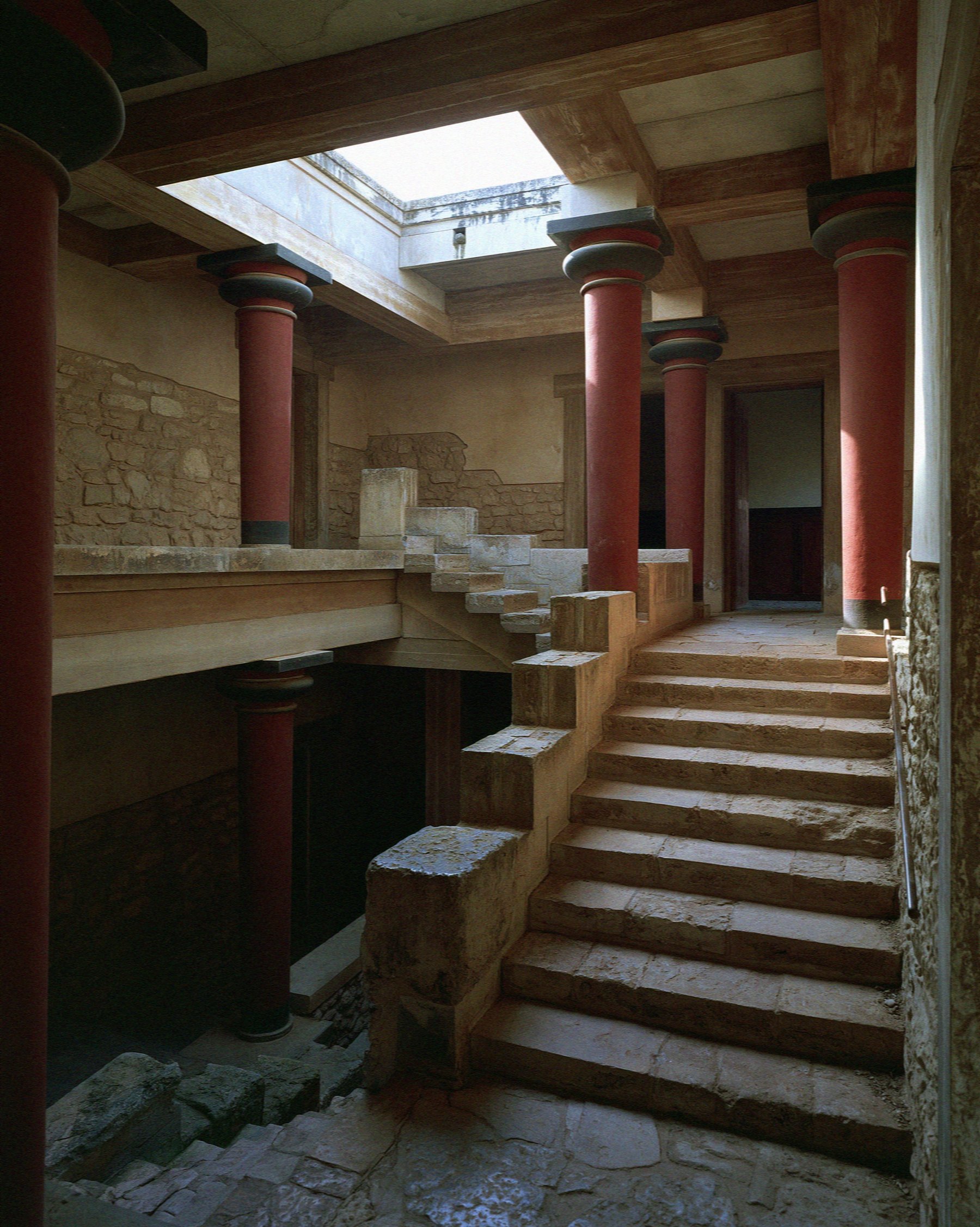
The site was first identified by a local merchant, Minos Kalokairinos, in 1878. The large excavation began in 1900 under the British archaeologist Arthur Evans, and in the 1920s and 30s he did something no archaeologist would do today: he partly rebuilt the palace in reinforced concrete, painted the columns their deep red, and put copies of the frescoes back on the walls.
So the red columns, the throne room, the grand staircase, the dolphin fresco in the queen’s rooms and the charging bull by the north entrance are all, to a greater or lesser degree, Evans’s interpretation. People argue about it endlessly. Purists find it theatrical; others say that without it a visitor would see only low walls and have no idea what stood there. My own view is that it helps, provided you remember you are looking at one man’s educated guess. The museum is where you see what was actually found.
Tickets and opening hours
A full ticket costs €20 for adults in 2026, with a reduced ticket at €10. Under-25s from the EU and non-EU visitors under 18 enter free with ID. The official e-tickets are sold at hhticket.gr, which saves queueing at the gate in summer. Ask about the combined ticket with the museum when you buy.
Opening hours follow the season. From 1 April to 31 August the site is open 08:00 to 20:00. Through September and October the closing time moves earlier, reaching 18:00 by late October. From 1 November to 31 March it is open 08:00 to 17:00. Last admission is 20 minutes before closing. Hours do change, so check before you go.
Getting there from Heraklion
The simplest way is city bus line 2 from the centre of Heraklion, about 20 minutes and a couple of euros. Taxis are easy to find and quick. If you drive, there is a paid car park at the site.
If you are coming from Chania, it is about 2h15 to 2h30 by car or longer by bus, which is too much for a day trip done properly. Spend a night or two in Heraklion instead. My guide to where to stay in Crete covers the hotels by the old harbour, and my Crete itinerary shows how it fits into a week.
How to see the palace
Go at 08:00 when it opens, before the cruise passengers and coach groups arrive, or after 16:00 in summer when they have left. Between those hours the main sights can have queues, and the heat on the open courts is fierce. Shade is scarce, so take water and a hat.
Allow 1.5 to 2 hours. A loose route: enter through the west court, walk up to the central court to get your bearings, then visit the throne room (often with a short queue to look in), the grand staircase and the queen’s rooms with the dolphin fresco. Finish at the north entrance with the charging bull and the storerooms with their great clay jars.
The site has no signposted single route, so a map or an app helps. Look up as well as down: the light wells and the stairs going down through several storeys show how ingenious the builders were.
The Archaeological Museum
The Heraklion Archaeological Museum, on Xanthoudidou street in the centre, holds the originals from Knossos and the other Minoan sites, and it is the best collection of Minoan art in the world. Do not skip it.
Among the things to find: the Phaistos Disc, a clay disc stamped with a spiral of symbols that nobody has deciphered; the small snake goddess figurines; the bull-leaping fresco, with young figures somersaulting over a bull; the bull’s head rhyton, a ritual vessel carved in stone with eyes of crystal; and the tiny gold bee pendant from Malia. The real frescoes from the palace are upstairs.
Tickets in 2026 cost €20 from April to October and €12 from November to March; check before you go. Summer hours are roughly 08:00 to 20:00, shorter on some days and in winter. Allow two hours. Whether you see it before or after the palace is up to you; the important thing is to see it.

Heraklion itself
Heraklion is Crete’s biggest city, busy and not pretty at first sight, with traffic and a lot of concrete. It is better than its reputation, though, and a night or two here repays you.
The Koules, the Venetian sea fortress at the end of the harbour mole, dates from the 16th century and is worth walking out to. The Venetian walls still ring the old centre, and on the Martinengo bastion is the grave of the writer Nikos Kazantzakis, born in Heraklion in 1883. His epitaph reads: “I hope for nothing. I fear nothing. I am free.”
In the centre, the Morosini fountain of 1628, known as the Lions, stands in Lions Square, with the Venetian Loggia and the church of Agios Titos a short walk away. 1866 Street, the market street, is full of herbs, cheese, honey and raki, and is the liveliest few hundred metres in town.

Phaistos and the south
If one palace leaves you wanting another, drive south. Phaistos, the second great Minoan palace, sits on a ridge over the Mesara plain, about 1h15 from Heraklion. It has not been reconstructed, it is far quieter than Knossos, and the views across to Psiloritis, the highest mountain on Crete, are superb. Tickets are a few euros; check.
Nearby is Gortyna, with Roman ruins and the famous law code inscribed in stone, and close by again is Matala, with its cave-cut cliff over the sea. Together they make a full day out of Heraklion.
Is a guide worth it
At Knossos, yes. The site is hard to read on your own: the layers of different periods, the reconstructions and the sheer number of rooms make it easy to wander without understanding what you are looking at. Licensed guides offer tours at the entrance, and an hour with someone who knows the site turns walls into a palace. Agree the length and the price before you start.
At the museum the labels are good and an audio guide or a good book will do. At Phaistos, with its quiet and space, you can manage alone.
Frequently Asked Questions
How much does it cost to visit Knossos?
In 2026 an adult ticket costs €20, with a reduced ticket at €10. EU visitors under 25 and non-EU visitors under 18 enter free with ID. Buy e-tickets at hhticket.gr, and ask about the combined ticket with the museum when you buy.
What time does Knossos open?
From 1 April to 31 August, 08:00 to 20:00; through September and October it closes earlier, by 18:00 in late October; from November to March, 08:00 to 17:00. Last admission is 20 minutes before closing.
How do you get from Heraklion to Knossos?
City bus line 2 from the centre takes about 20 minutes and costs a couple of euros. A taxi is quicker, and there is a paid car park if you drive.
How long do you need at Knossos?
Allow 1.5 to 2 hours for the palace and another two for the Archaeological Museum in Heraklion, where the original frescoes are.
Is the Heraklion Archaeological Museum worth it?
Yes. It holds the originals from Knossos and the other Minoan sites, including the Phaistos Disc, the snake goddess figurines and the bull-leaping fresco. The frescoes at the palace are copies.
Read also: A Crete Itinerary: 5 to 10 Days | Where to Stay in Crete: Chania, Rethymno, Heraklion or Elounda | Victoria’s Complete Guide to Crete