In season, hundreds of people a day, and well over a thousand on the busiest summer days, set off from a wooden-railed staircase high in the White Mountains and keep walking downhill until they reach the Libyan Sea. There is no road at the bottom and no shortcut in between. That single fact shapes everything about planning the Samaria Gorge: how you get to the top, what you carry, and how you get home again from a village that only boats can reach.
I should say plainly what I did and did not do. In October I was driven up before dawn to Xyloskalo, the gate at the top, and watched the hikers go down. I went as far as the first landing on the steps, in a cardigan, and turned back. Everything below that point here comes from the park’s own information, from timetables, and from the people who walk it every year. For the wider west, see my complete guide to Crete.
What the gorge is
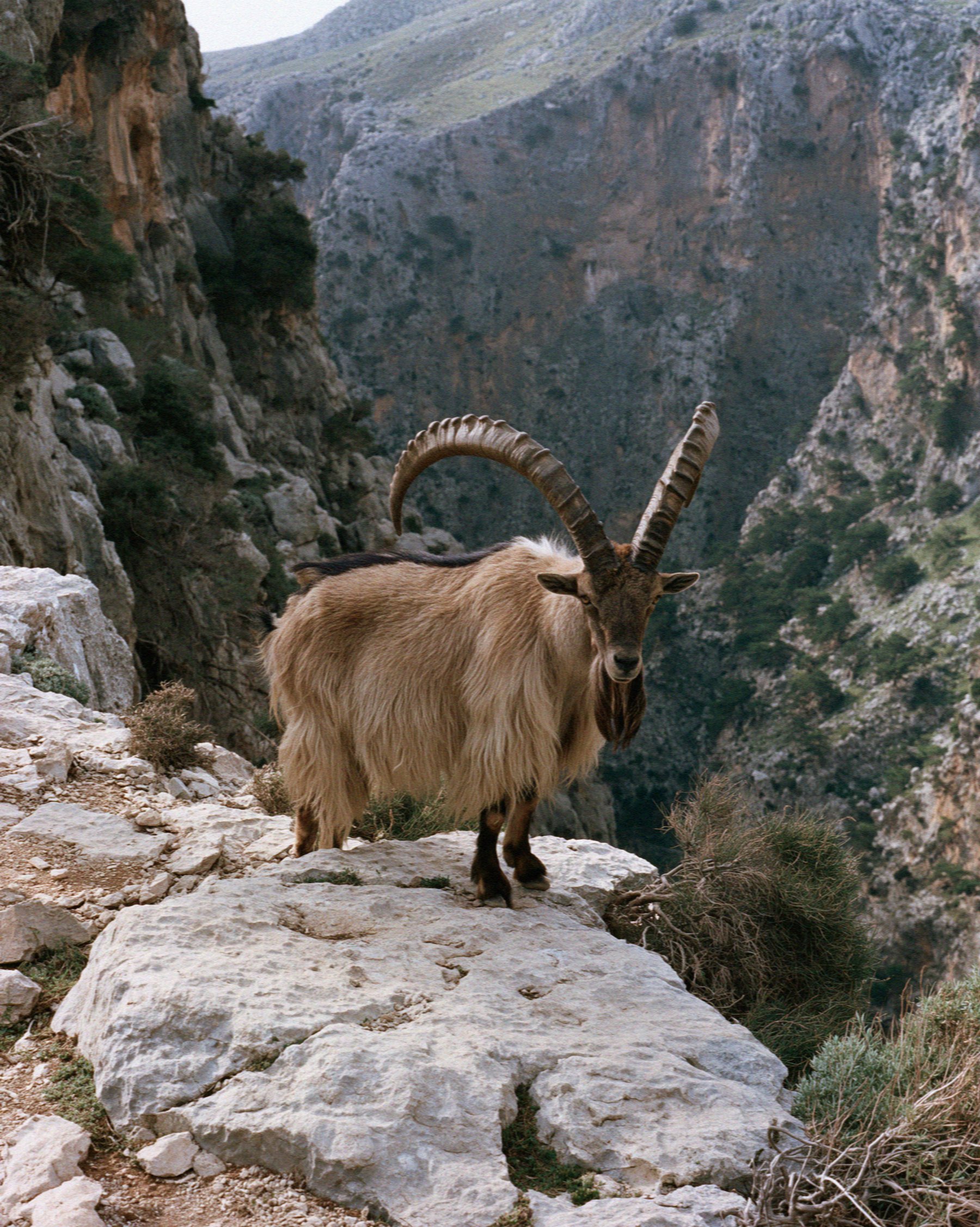
The Samaria Gorge cuts south through the White Mountains, the Lefka Ori, from the edge of the Omalos plateau to the coast at Agia Roumeli. It became a national park in 1962, in good part to protect the kri-kri. This is the Cretan wild goat, a sure-footed climber with heavy, backswept horns, and the gorge is one of the places it was protected when it had become rare.
When the park was created, the people living in the village of Samaria, about halfway down, were moved out. Their stone houses still stand empty beside the path.
The kri-kri are wary in the gorge itself, but at the top they have learned that people mean food. I watched one stand on the wall of the taverna terrace at Xyloskalo as calmly as a cat, which I describe in As Far as the Stairs.
Is it for you
The walk is about 16 km inside the park, plus roughly 2 to 3 km more from the park exit to the village and the harbour. Most people take 5 to 7 hours. It needs no climbing skill, but it is long and almost entirely downhill: about 1,250 metres of descent.
That is the part people underestimate. Going down for hours punishes knees and ankles far more than going up, the path is loose stone and riverbed for much of the way, and the first 2 km from the top are steep switchbacks and steps. If you have bad knees, use walking poles or think about one of the easier options below.
Children used to long walks manage it; anyone who has not walked five or six hours in a day recently should practise first.
Opening dates and the ticket
The gorge usually opens in spring, in recent years in May, and closes in the second half of October, but both depend on the weather and the state of the path. It can close at short notice for heavy rain or rockfall, and some years it opens late: in 2026 it did not open until 19 May. Do not book a holiday around a particular day without a back-up plan.
Entry is from 07:00. To walk the whole gorge you need to be through the gate by about 13:00 (later in the day, entry has been limited to the first couple of kilometres), and everyone must be out of the park by early evening, which is why almost everyone starts early. The rules have changed from year to year, so check the current hours before you go.
The ticket costs €10 (the price since 2025). Under-18s and over-65s go free, and there are other exemptions, so check the list before you buy. You can buy it online at samaria-tickets.necca.gov.gr or at the gate. Keep it until the end, because it is checked when you leave. In 2026 free helmets were handed out at both entrances.
Getting to Xyloskalo
Xyloskalo sits at about 1,230 metres, above the Omalos plateau, roughly 40 km south of Chania and about an hour’s drive up a winding mountain road. There are four ways to get there.
The KTEL bus leaves Chania early in the morning in season; check the timetable at e-ktel.com before you go. An organised tour takes a coach to the top, then a boat and a coach home. A taxi works well for two or three people sharing.
The fourth way, your own hire car, is where people go wrong. You walk away from the car at the top and finish at the sea on the other side of the mountains, with no road back to it. Unless someone is driving it round to meet you, leave it in Chania.
Lakki, on a ridge halfway up the road, has a view over the whole valley to the sea, and the top is cold at dawn even when the coast is warm.
The walk, top to bottom
From the gate the path drops straight into the gorge down Xyloskalo, the wooden stairs that gave the place its name, now a long series of steps and switchbacks through pines and cypresses. This first stretch is the steepest, and it is where you set your pace. Go gently: there are hours still to come.
After that the gradient eases and the path follows the riverbed, crossing it again and again on stones and small wooden bridges. In summer the stream is low or dry; in spring there is more water. Along the way there are rest areas with springs, toilets and wardens at intervals, which is reassuring, though you should still carry water of your own.
The abandoned village of Samaria comes at roughly the halfway point, a natural place to stop and eat. Below it the walls begin to close in and grow taller, and the air in the shade stays cool well into the morning.
The Iron Gates
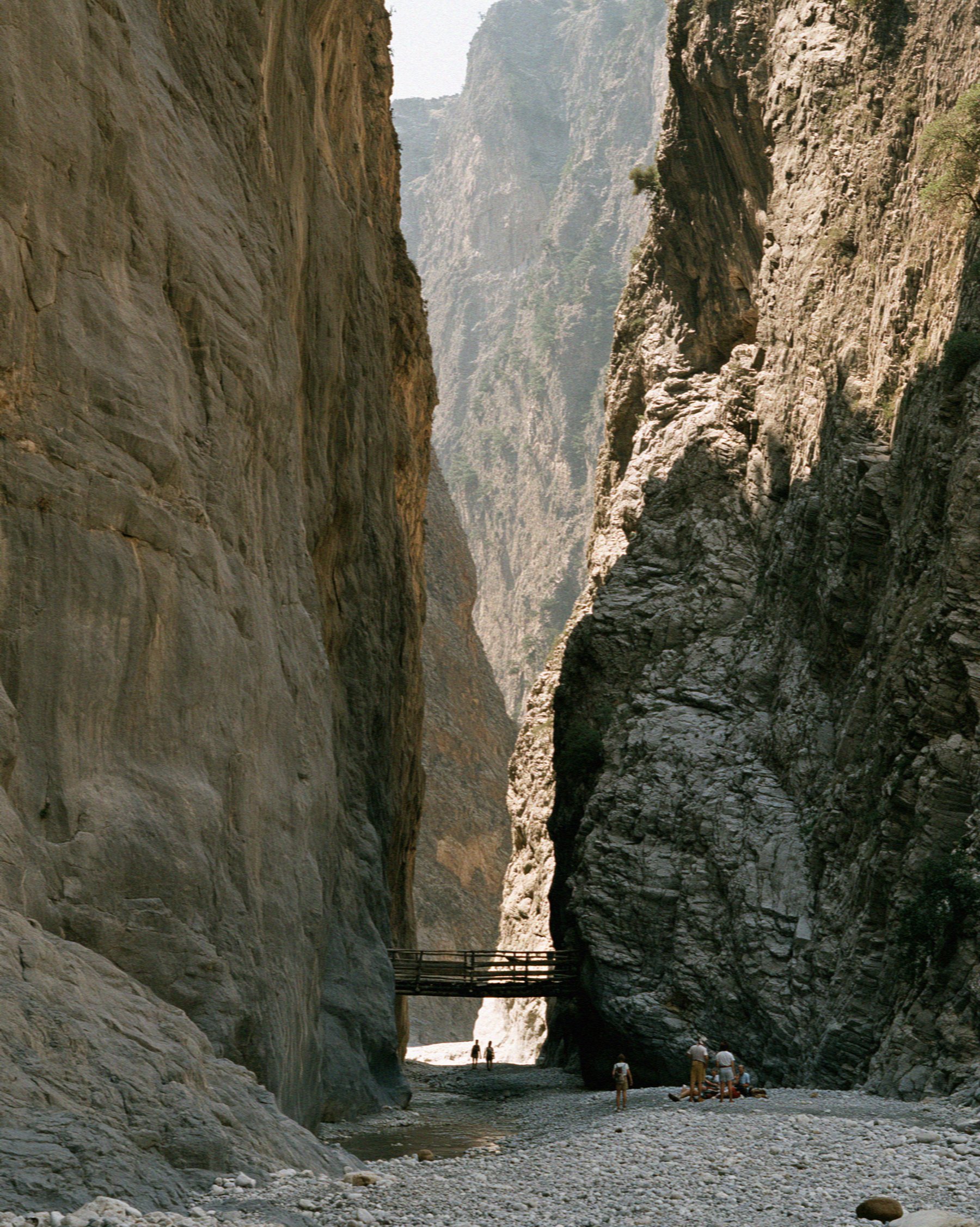
The Sideroportes, the Iron Gates, are the narrowest point of the gorge, where the walls come in to about 3 to 4 metres apart and rise several hundred metres above you. The path crosses the stream on wooden walkways between them. It is the picture on every poster: a corridor of rock with a strip of sky at the top.
It comes late in the walk, when your legs are tired, so it is often crowded with people stopping for photographs. Watch your footing on the boards when they are wet.
Agia Roumeli and the boat out
After the Iron Gates the gorge opens out, you pass the park exit (hand in or show your ticket), and walk the last 2 to 3 km into Agia Roumeli. It is a small village of rooms and tavernas on a pebble beach, and after six hours of stone the sea is the best thing you have ever seen.
No road reaches it. The ANENDYK boats run in season west to Sougia and Paleochora, and east via Loutro to Chora Sfakion, at about €15 a person. The Chora Sfakion boat takes a little over an hour, and a KTEL bus timed to meet it in season brings you back to Chania in about 1h30 to 2 hours.
Check the last boat before you start, not when you arrive. Miss it and you spend the night in Agia Roumeli, which is no hardship (there are rooms) but may not be what you planned.

Doing it with a tour
An organised tour from Chania, Rethymno or the resorts solves the logistics in one ticket: the coach to the top before dawn, the boat out of Agia Roumeli, and a coach waiting at the other end. You walk at your own pace in between. Prices vary by company and where you start, so compare and check what is included (the park ticket and the boat fare are sometimes extra).
The downside is that the coaches all arrive at Xyloskalo together, so the first hour is busy. The public bus is cheaper, but then the boat and the return bus are yours to manage.
What to carry
Proper walking shoes or boots with grip. Not trainers with smooth soles, and never sandals. Water: there are springs on the way, but carry a litre or so between them. Food for lunch, plus something salty. A hat and sun cream, because the lower gorge is hot by midday. A warm layer for the top, which can be properly cold at 07:00 in spring and autumn. Cash for the boat and for a cold drink in Agia Roumeli. Poles if your knees complain on long descents.
Easier gorges if Samaria is closed
If the gorge is shut, or you want something shorter, there are good alternatives nearby. The Imbros Gorge runs about 8 km from near Imbros village down to Komitades, close to Chora Sfakion, and takes 2 to 3.5 hours. It is open for more of the year and charges a small fee at most.
The Agia Irini Gorge, above Sougia, is about 7 km of shady walking. The Aradena Gorge, near Anopoli, is deep and dramatic and better for experienced walkers.
There is also the easy way into Samaria itself: take the boat to Agia Roumeli and walk up the gorge to the Iron Gates and back. For how this fits into a week, see my Crete itinerary, and for the buses and boats, my guide to getting to Crete and getting around.
Frequently Asked Questions
How long does it take to walk the Samaria Gorge?
Most people take 5 to 7 hours to walk the roughly 16 km inside the park, plus about 2 to 3 km more to the village of Agia Roumeli and the harbour.
When is the Samaria Gorge open?
Usually from 1 May until the second half of October, weather permitting. It can close at short notice for rain or rockfall, and in 2026 it opened late, on 19 May. Entry starts at 07:00, and to walk the full route you need to start by about 13:00; check the current hours before you go.
How much is the Samaria Gorge ticket?
€10, the price since 2025. Under-18s and over-65s enter free. Buy it online or at the gate, and keep it until you leave the park.
How do you get back from the Samaria Gorge?
By boat from Agia Roumeli, which no road reaches. The boat to Chora Sfakion takes a little over an hour, and a KTEL bus timed to meet it returns to Chania in about 1h30 to 2 hours.
Is the Samaria Gorge hard?
It is long rather than technical. The 1,250 metres of descent are hard on knees and ankles, and the first 2 km are steep steps, but regular walkers in good shoes finish it every day of the season.
Read also: Getting to Crete and Getting Around | A Crete Itinerary: 5 to 10 Days | Victoria’s Complete Guide to Crete