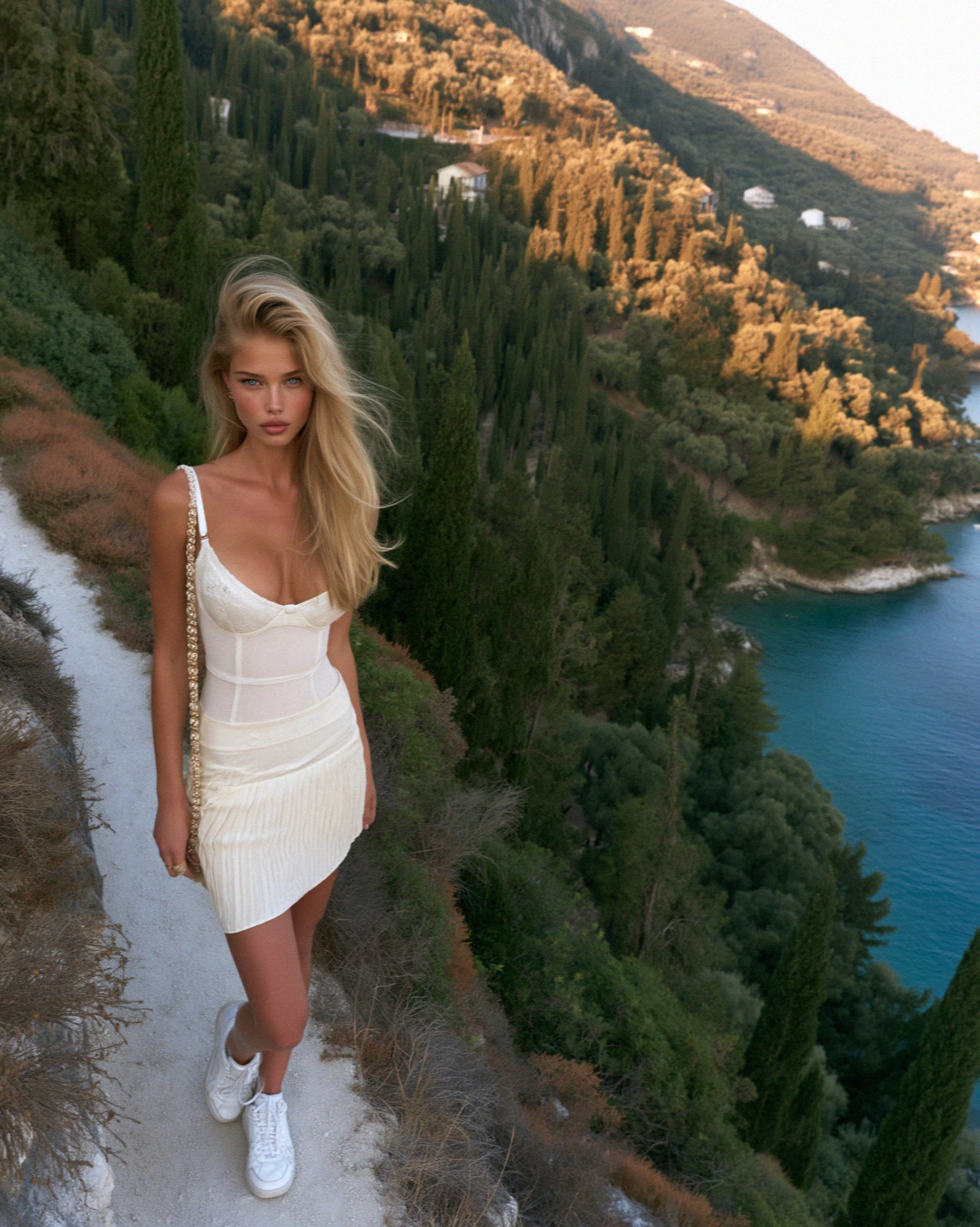
Corfu is the green island. That is the first thing to understand about it, and it is the thing that surprises people most. You fly in expecting the Greece of postcards, white cubes and bare brown hills, and instead the plane drops low over a lagoon, past a tiny monastery on its islet, and the hills beyond are dark with olive and cypress all the way to the top.
I spent September on Corfu, living upstairs from an old olive press, and this guide is everything I would tell a friend before they went. It covers when to come, the Old Town, the beaches, the boats, where to sleep, what to eat, how to get around without losing your nerve on the mountain roads, and how to fit it all into a few days.
Every section points to a longer guide where there is more to say. Start here, and follow the threads that suit your trip.
Why Corfu is not the Greece you expect
Corfu sits at the top of the Ionian Sea, closer to Italy in spirit than to Athens, and a long way from the Cyclades in every sense. It also escaped the centuries of Ottoman rule that shaped the rest of Greece: the Ottomans laid siege to it several times, in 1537 and 1716 among others, and Venice held them off every time. Venice held it for about four centuries, then the French came, then the British, and each of them left something you can still see, hear or eat.
The Venetians left the fortresses, the tall shuttered houses of the Old Town and a kitchen built on red sauces and thick pasta. The French left the Liston, the arcade of cafés along the great square. The British left cricket on that same square and a ginger beer that the island still makes. The result is a Greek island that does not look like the others, sounds slightly Italian in its place names and eats in its own way.
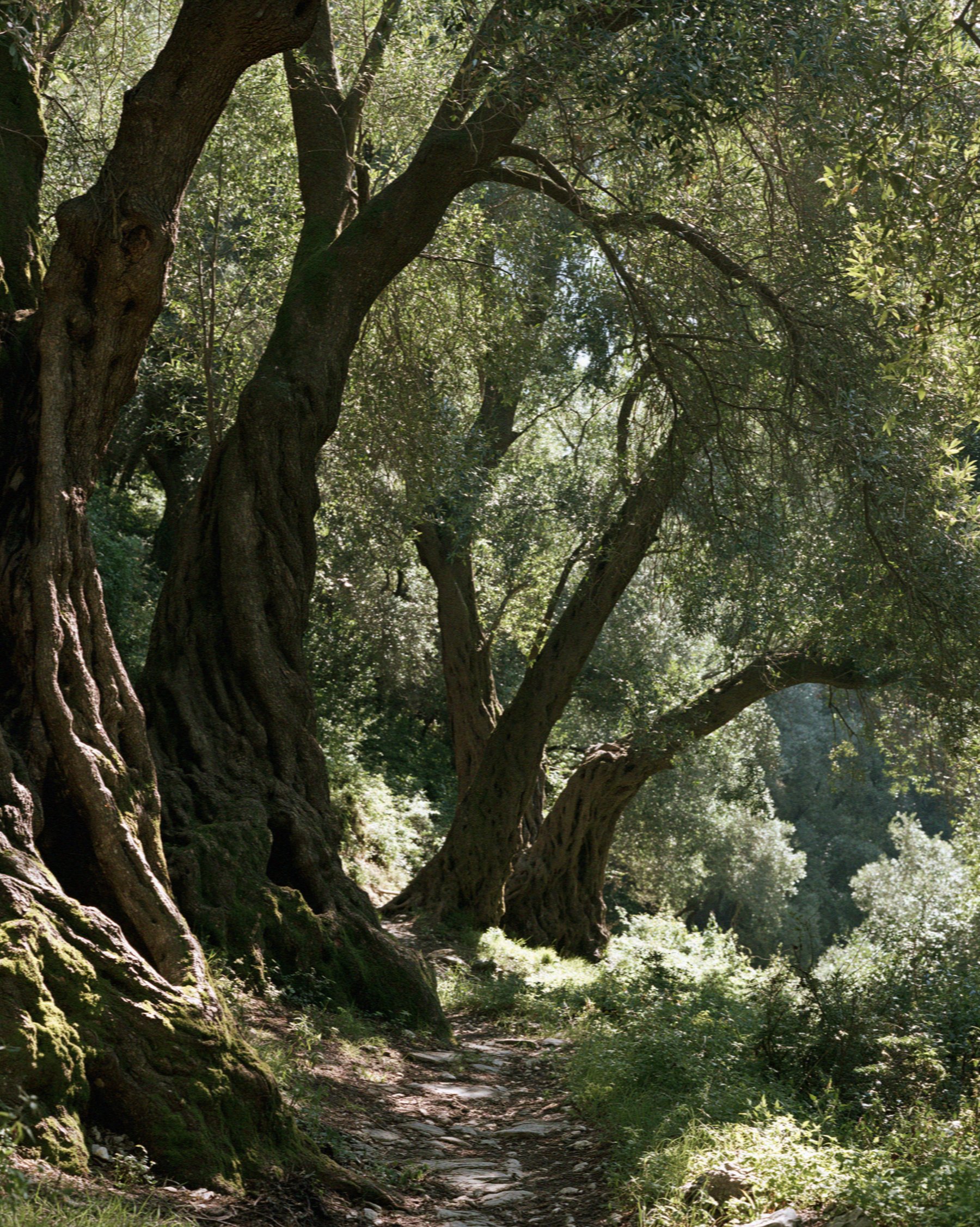
Then there is the green. Corfu is the wettest of the Greek islands, and the rain is the reason it looks the way it does. The olive trees here are enormous, gnarled, often taller than a house, because for generations nobody cut them back. They were the first thing I wrote about here, in Nobody Prunes Them. Under them in winter you see black nets spread for the harvest. Above them the island climbs to Mount Pantokrator, from whose summit Albania is so close across the strait it feels like the next valley.
It is also a big island, up to about an hour from coast to coast, with very different coasts. The west has the long sandy beaches and the sunsets. The north-east has calm, clear water, pebble coves and a view of the Albanian mountains. The middle is olive groves and hill villages. The south is quieter and flatter. Most of what goes wrong on a Corfu trip comes from treating it as small.
When to go
September is my month. The sea has had all summer to warm up and sits at about 24 C, the air is in the high twenties, the August crowds have gone home and the island has about six rain days in the whole month. That is when I went, and I would go again at the same time.
Late May and June are the other sweet spot. The island is at its greenest, the wild flowers are out under the olives and the days are long. The sea is cooler, around 19 C in May and 22 C by June, which is bracing rather than warm.
July and August are hot, highs in the low thirties, and busy. The beaches fill and the roads clog, and you need to book everything early. If those are the only weeks you have, stay on the north-east coast, swim early and late, and keep the middle of the day for the shade.
October is softer and cheaper. The sea is still about 22 C and the days are often lovely, but it rains far more, around ten days in the month, and the island begins to close for the season towards the end. November is wet. Winter is mild and green, many hotels and tavernas are shut, and the olive harvest is under way.
Easter deserves its own line. Corfu’s Orthodox Easter is the one the rest of Greece travels to see, with processions, philharmonic bands and, on Holy Saturday morning, red clay pots full of water thrown from the balconies around the Liston. In 2027 Orthodox Easter falls on Sunday 2 May. Book months ahead.
I go through each month in detail, including what is open and what the sea feels like, in my guide to the best time to visit Corfu.
Plan Your Visit to Corfu
A few things worth sorting before you come. These help support the blog, at no cost to you.
- Hotels in Corfu Town and on the coastFrom the Venetian lanes of the Old Town to the quiet bays of the north east
- Boat days, Paxos and the Blue CavesDay trips, Old Town walks and tours across the island
- Hire a car for the north and the hillsThe olive country, the mountain villages and the west coast beaches need one
- Stay connected with a travel eSIMData from the moment you land, no roaming charges
This section contains affiliate links. If you book through them I may earn a small commission, at no extra cost to you.
The Old Town
UNESCO listed Corfu Town’s old centre in 2007, for what it plainly is, a Venetian port town built inside its own fortifications, and it is the single best reason to spend at least one night in town rather than out on a beach.
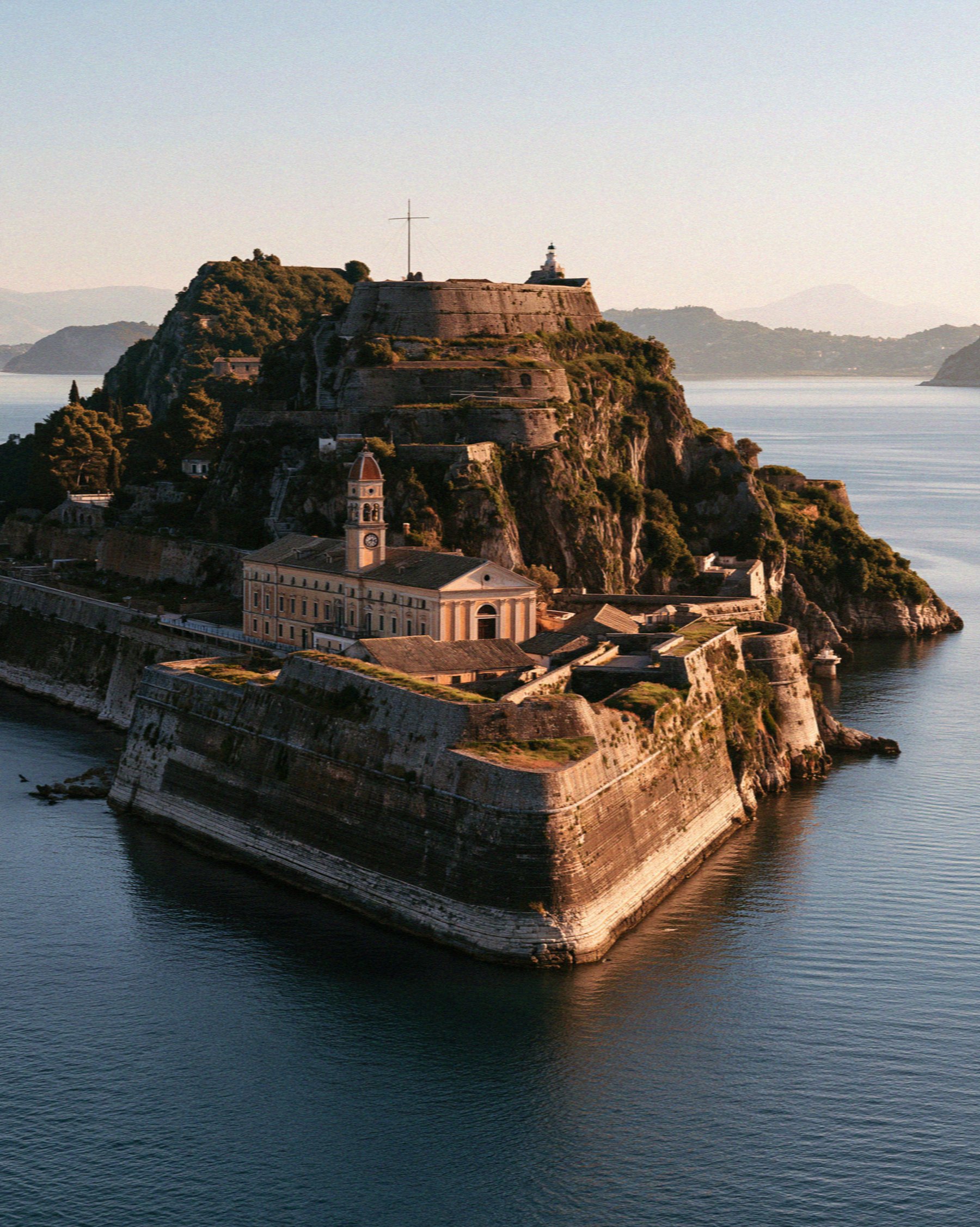
It is built between two fortresses. The Old Fortress holds the eastern headland, two rocky peaks the Venetians severed from the town with a sea moat, the Contrafossa, and if you climb to the lighthouse at the top you see the whole town, the strait and the mountains of the mainland at once. Summer hours run from eight in the morning to eight at night, winter’s are much shorter, and the ticket is a few euros. The New Fortress rises behind the Old Port on the other side of town.
Between them is the Spianada, the Esplanade, the biggest square in Greece, where cricket is still played on summer afternoons. On its west side runs the Liston, the arcade of cafés built under the French in 1807 on the model of the Rue de Rivoli in Paris. At its north end stands the Palace of St Michael and St George, built by the British in the 1810s and 1820s and now the Museum of Asian Art. It holds more than ten thousand objects, and no other museum in Greece is devoted to the art of Asia.
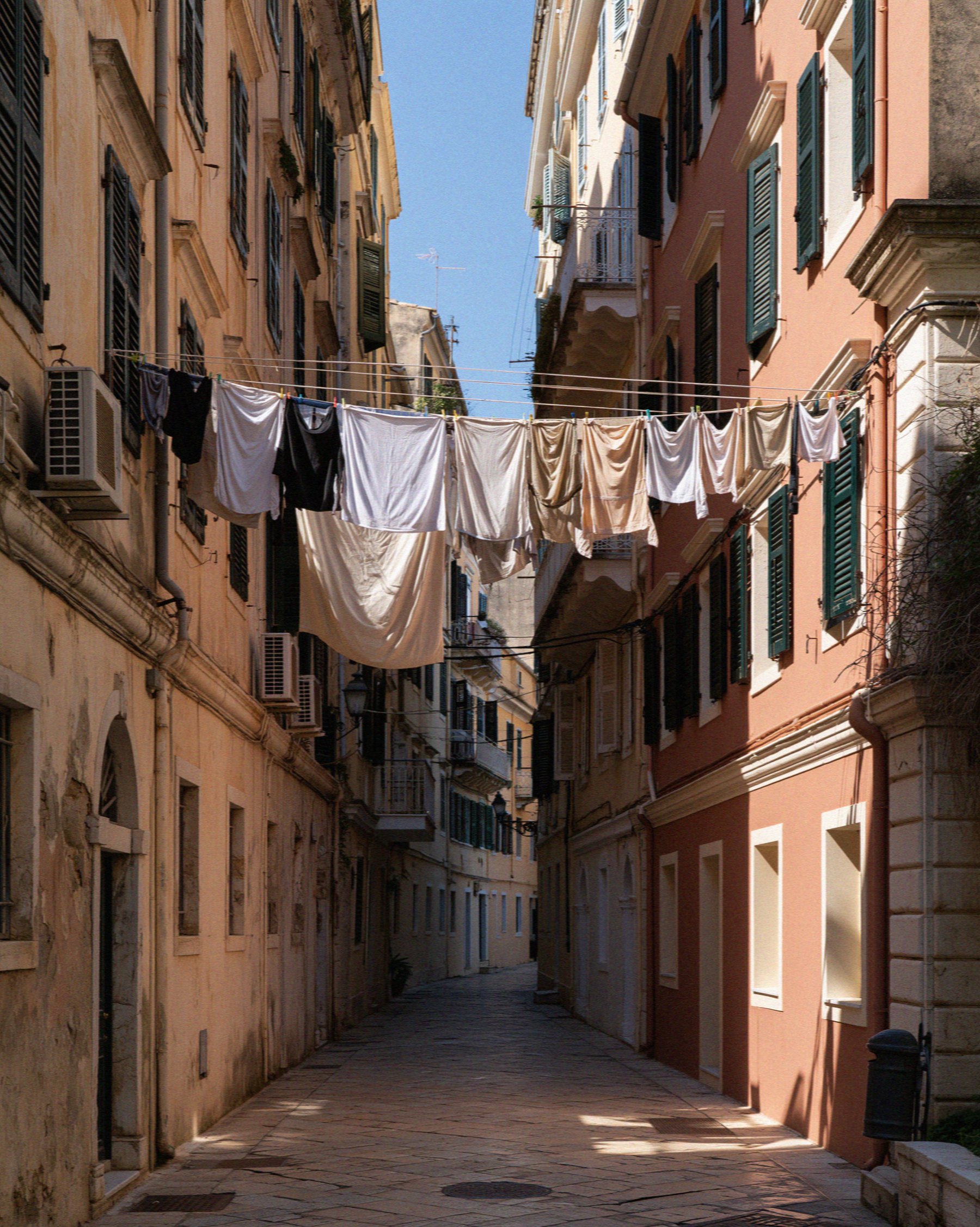
Behind all this the lanes begin. The Corfiots call them kantounia, stone alleys between tall green-shuttered houses, with laundry hung across the gap overhead. The oldest and densest quarter is Campiello, behind the Old Port, where you can lose yourself completely in ten minutes. The red-domed bell tower of the Church of Saint Spyridon, built in 1589 and the tallest in the Ionian, is how you find your way back. The island’s patron saint lies inside, and several times a year he is carried through the streets in procession.
The bands are the other thing. Corfu has eighteen philharmonic societies, the first founded in 1840, and on an ordinary evening you hear one rehearsing somewhere behind a shutter. One afternoon I heard a child practising clarinet scales through an upstairs window, which is how The Band They Started by Accident began.
A short way south of the centre, the villa of Mon Repos stands in a wooded park over the remains of the ancient city. Prince Philip was born there on 10 June 1921, and it is now the Museum of Palaiopolis. Walking there from the Spianada takes about 35 minutes; a bus or taxi is quicker.
I lay out a full route through all of it, fortresses, lanes, churches and the best place for a coffee, in my walking guide to Corfu Old Town.
The best things to do
If I had to choose the handful of things that make a Corfu trip, they would be these.
Walk the Old Town early, before the cruise passengers arrive, when the lanes are being swept and the cafés on the Liston are setting out chairs. Then climb the Old Fortress while it is still cool.
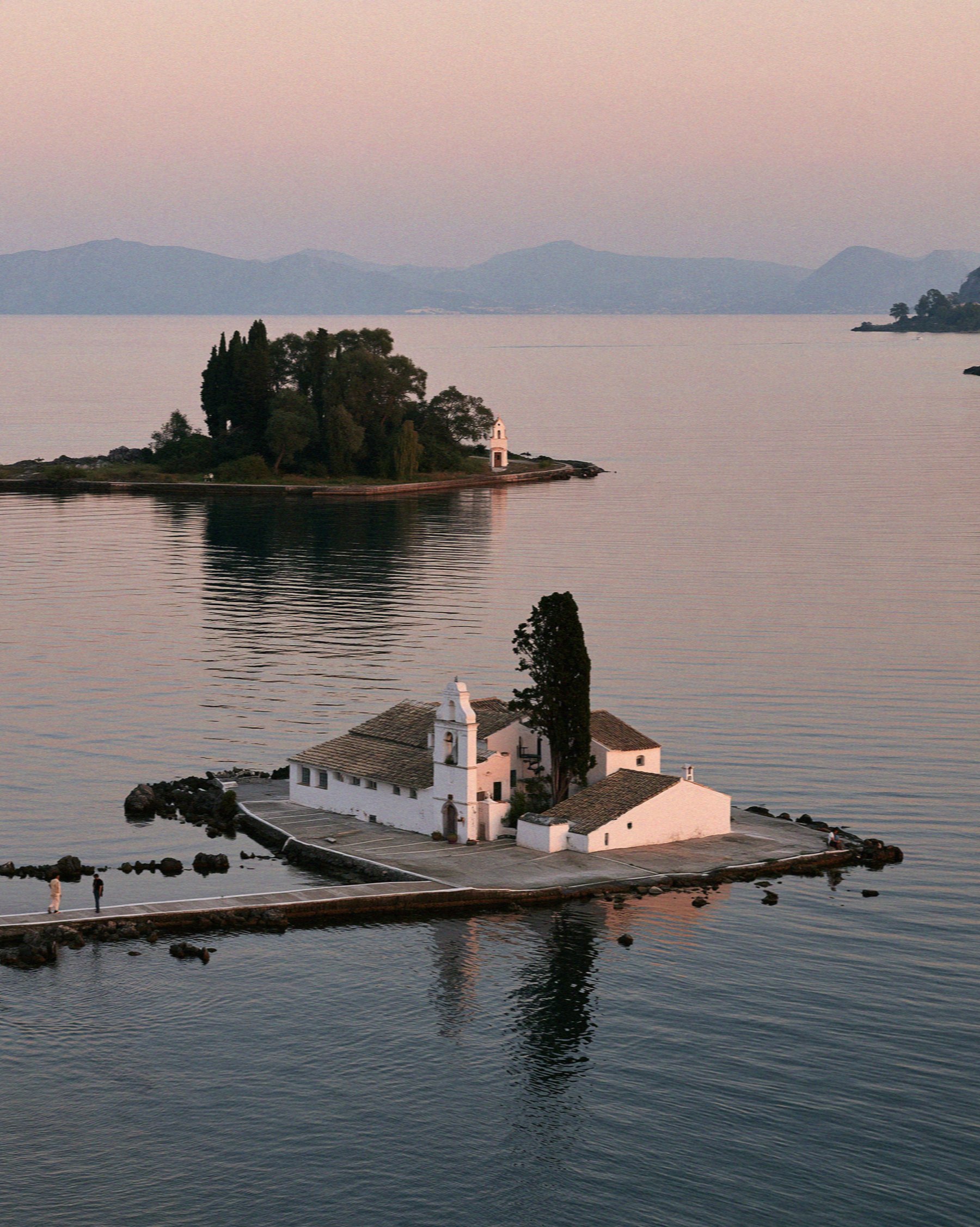
Go to Kanoni at the end of the day. From the viewpoint on the peninsula south of town you look down on the white monastery of Vlacherna, on its islet at the end of a causeway, and beyond it the wooded hump of Pontikonisi, Mouse Island, with its small Byzantine chapel. Legend says Mouse Island is Odysseus’s ship turned to stone. Planes come in to land directly overhead, close enough to read the livery, which is either thrilling or absurd depending on your mood. The causeway is free, and small boats run out to Mouse Island for a few euros.
Swim at Paleokastritsa, on the west coast, where the bays tuck in under wooded headlands and a monastery keeps watch from the hill.
Take a boat to Paxos and Antipaxos for a day of caves and impossible water.
Walk down to Porto Timoni, the twin bays below Afionas in the north-west, and earn your swim.
Drive up Mount Pantokrator and stop on the way at Old Perithia, the oldest village on the island, mostly ruins now, with a few tavernas among the stone houses. I drove up on one of my last days and it was the hour of the trip I think about most.
Have lunch at Kalami, at the White House on the rocks, the Durrells’ home in the late 1930s and a taverna today.
See the Achilleion gardens at Gastouri, south of town, the palace Empress Elisabeth of Austria had built for herself, later owned by Kaiser Wilhelm II. Restoration has kept the palace rooms shut since 2021, and the work is not due to finish until June 2029; for now you pay a lower price and see the gardens alone. Go knowing that, and you will not be disappointed.
Come for Easter, if you can face the crowds.
I expand on each of these, with how to do them and when, in my full list of the best things to do in Corfu.
The beaches
Corfu’s beaches split cleanly by coast, and choosing a coast is choosing a kind of day.
The west is where the sand is. Glyfada, about 16 km from town, is a long curve of golden sand with a Blue Flag and a sunset over open sea. Myrtiotissa, between Ermones and Glyfada, is reached down a steep track and is wilder, partly naturist, the kind of beach people describe with a slightly lowered voice. Agios Gordios is sand below dramatic rock formations, another sunset beach. Issos, in the south-west, runs long with dunes behind it.
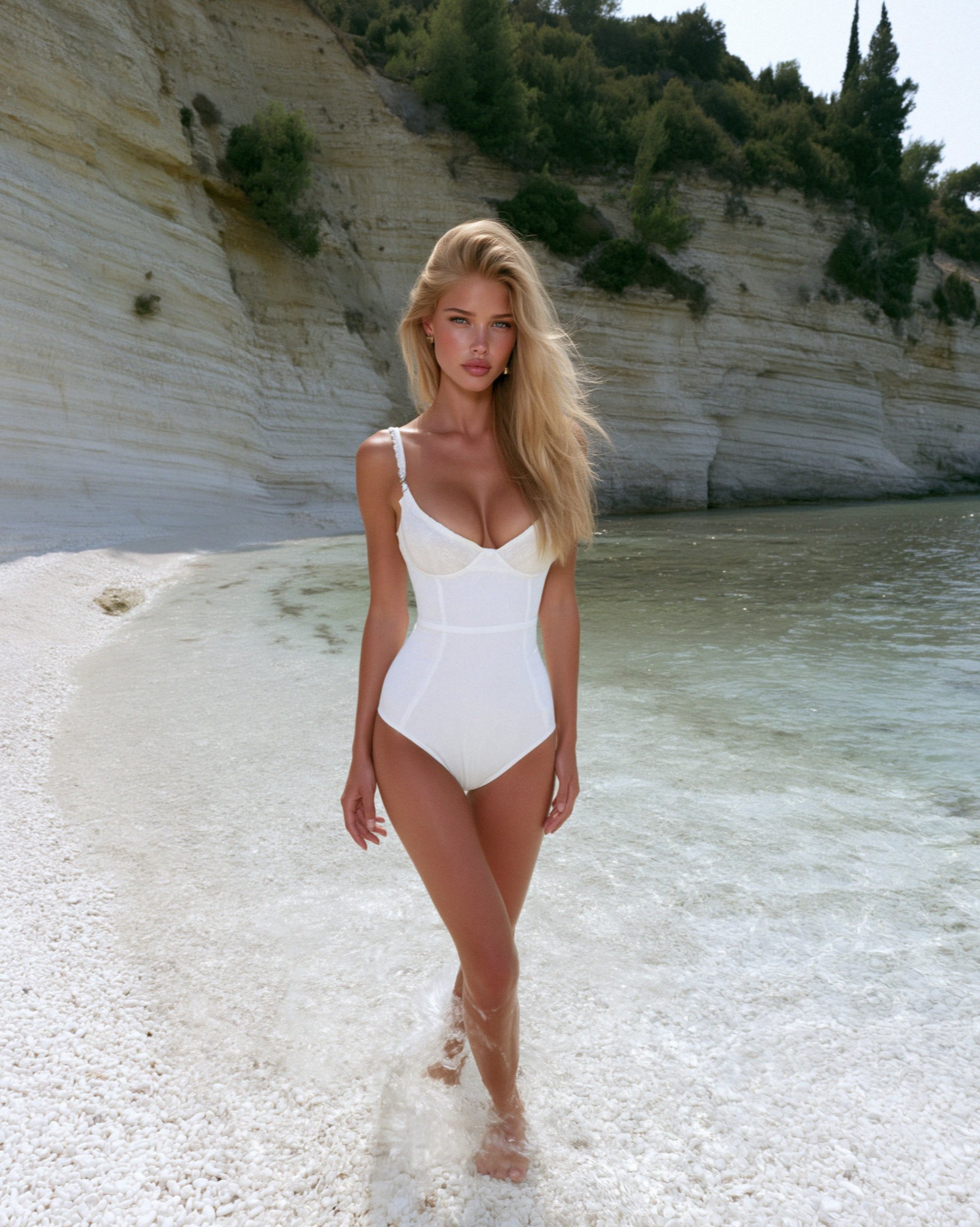
Paleokastritsa, some 25 km out of town on the west side, is the classic west-coast bay: not one beach but several small bays folded into the cliffs, with small boats waiting on the main beach to run you round the sea caves. Close by, Rovinia can only be reached by boat or a steep path, which keeps it calmer.
Porto Timoni is in a class of its own: two bays back to back on a narrow neck of land below the village of Afionas. The way down from Afionas, where you leave the car, is a steep, stony path of a little over a kilometre; allow an hour or more there and back. There is nothing at the bottom, so bring water and shoes you can trust. Water taxis also run round from Agios Georgios if your knees disagree.
The north-east is the opposite: pebbles, not sand, and water so calm and clear it looks poured. Kalami, Agni and Barbati are the names to know, with the Albanian mountains filling the horizon across the strait. It is the best snorkelling on the island.
Canal d’Amour at Sidari, on the north coast, is a set of pale sandstone channels and arches cut by the sea. It is pretty, and it is busy. Go early.
I rank them, with how to get to each and when to go, in my guide to the best beaches in Corfu.
Out on the water
Corfu is an island best seen at least once from the sea, and there are three very different ways to do it.
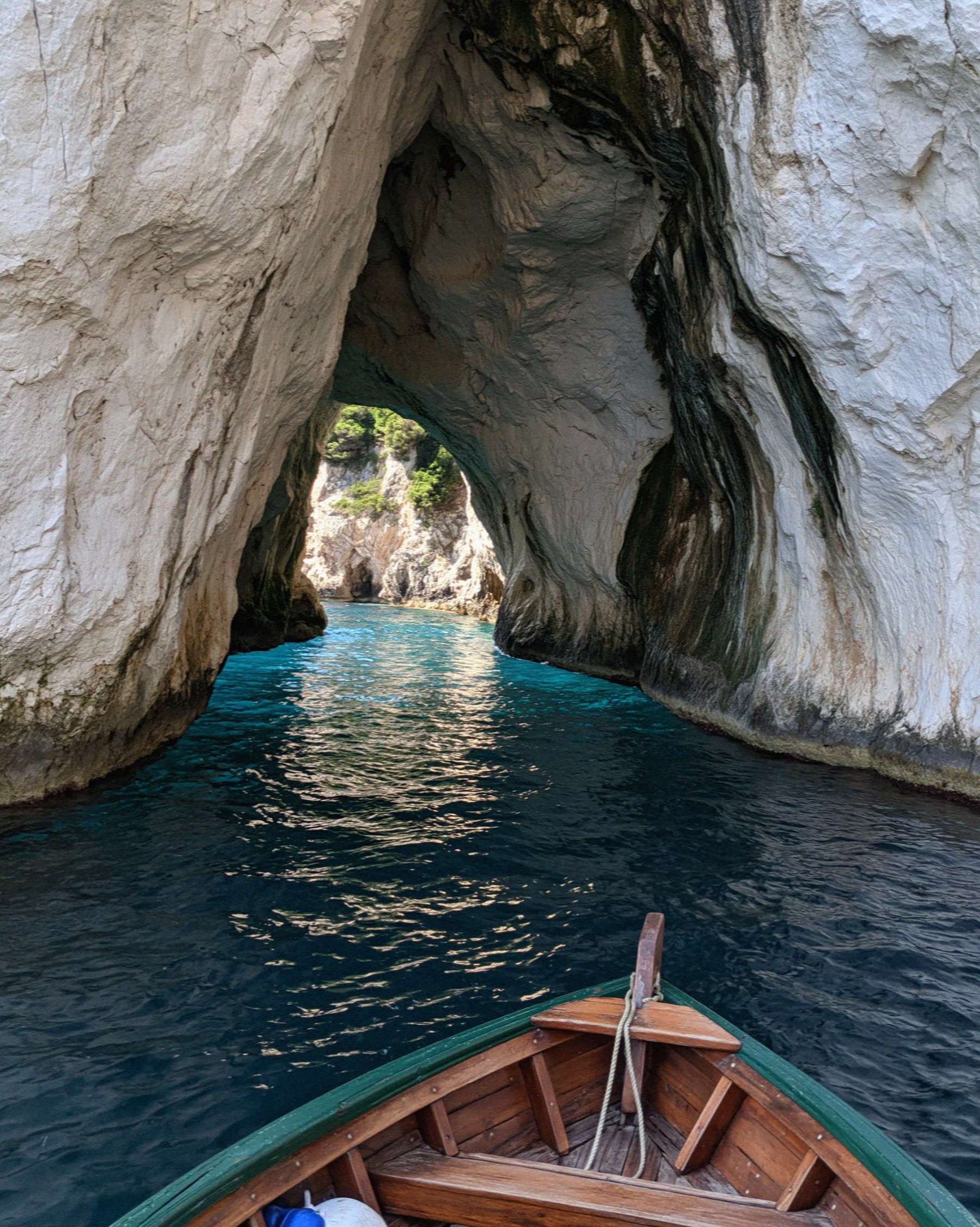
The big day out is Paxos and Antipaxos. Group cruises leave from Corfu Town and take most of the day, breakfast to early evening, or from Lefkimmi in the south, which saves two or three hours. The usual pattern is the Blue Caves on the west side of Paxos, a swim off Antipaxos at Voutoumi, where the water is the colour of a swimming pool, and time ashore in Gaios, Paxos’s harbour village. Expect to pay roughly 45 to 70 EUR per adult. The crossing is open sea, and on a rough day it is not comfortable, so pick your day and keep an eye on the wind.
The short version is Paleokastritsa. From the main beach, little boats run out to the caves under the cliffs, the Blue Eye and Nausicaa’s among them, and have you back in thirty or forty minutes. Longer outings in small groups, from one hour to three, and sunset cruises also go from there.
The one I loved most is driving yourself. On the sheltered north-east coast you can hire a small boat with an engine under 30 hp, which needs no licence, from Agni, Kalami, Kassiopi and a handful of other bays, and potter from cove to cove with a picnic. Roughly 130 to 200 GBP a day, usually with fuel on top, for four to seven people. It is calm, the coves are close together, and you can stop wherever the water looks best.
For something grander, private charters to Paxos start in the high hundreds of euros before fuel, and some hire boats can come with a skipper for a supplement.
I compare every option, with prices checked this November, in my guide to the best Corfu boat tours.
Where to stay
Where you sleep on Corfu decides what kind of trip you have, more than on most islands, because the coasts are so far apart in time if not in distance.
Corfu Town is the right choice for a first visit, a short stay or anyone without a car. You get the Old Town on your doorstep, the evenings on the Liston and the bus station for the resorts. The hotels are mostly converted mansions: Siorra Vittoria, a restored nineteenth-century house with breakfast in its garden; Bella Venezia, neoclassical, whose earlier lives include a consulate and a bank; and Cavalieri, beside the Spianada, whose rooftop bar looks straight at the Old Fortress.
The north-east coast (Kalami, Agni, Kassiopi) is where I would send anyone who wants calm water, good fish tavernas and a hire boat. It is mostly villas and small hotels, and you will want a car.
The west coast, Paleokastritsa, Agios Gordios and Glyfada, is for sand and sunsets.
South of town, Benitses is a fishing village turned low-key resort. In the hills above it, Angsana opened in 2022. Further down, at Moraitika, Domes Miramare is an adults-only hotel in the Luxury Collection on the site of the old Miramare, which had its moment in the Onassis era.
Kommeno and Dassia, just north of town, have the big resort hotels, Rodostamo at Kommeno among them, and Ikos Dassia for all inclusive.
And then there is the option I took: a house in an olive grove, somewhere inland, with a car outside the door and the whole island within an hour. The Olivar Suites, near Messonghi in the south, is a small high-end version of the idea; I stayed more simply, over that old press, and would do the same again.
I match each base to the trip it suits, with price bands, in my guide to where to stay in Corfu.
Three hotels I would book in Corfu
From the areas above, with their Booking.com star rating.
- Bella Venezia ★★★★A neoclassical mansion in Corfu Town, once a consulate
- Rodostamo Hotel & Spa ★★★★★Polished luxury on the Kommeno peninsula, north of town
- Domes Miramare ★★★★★Adults only, on the coast at Moraitika, part of the Luxury Collection
- See every hotel in CorfuCorfu Town, Kassiopi, Paleokastritsa and the olive groves
- Add a hire carMost of these bases are easier with your own wheels
What to eat
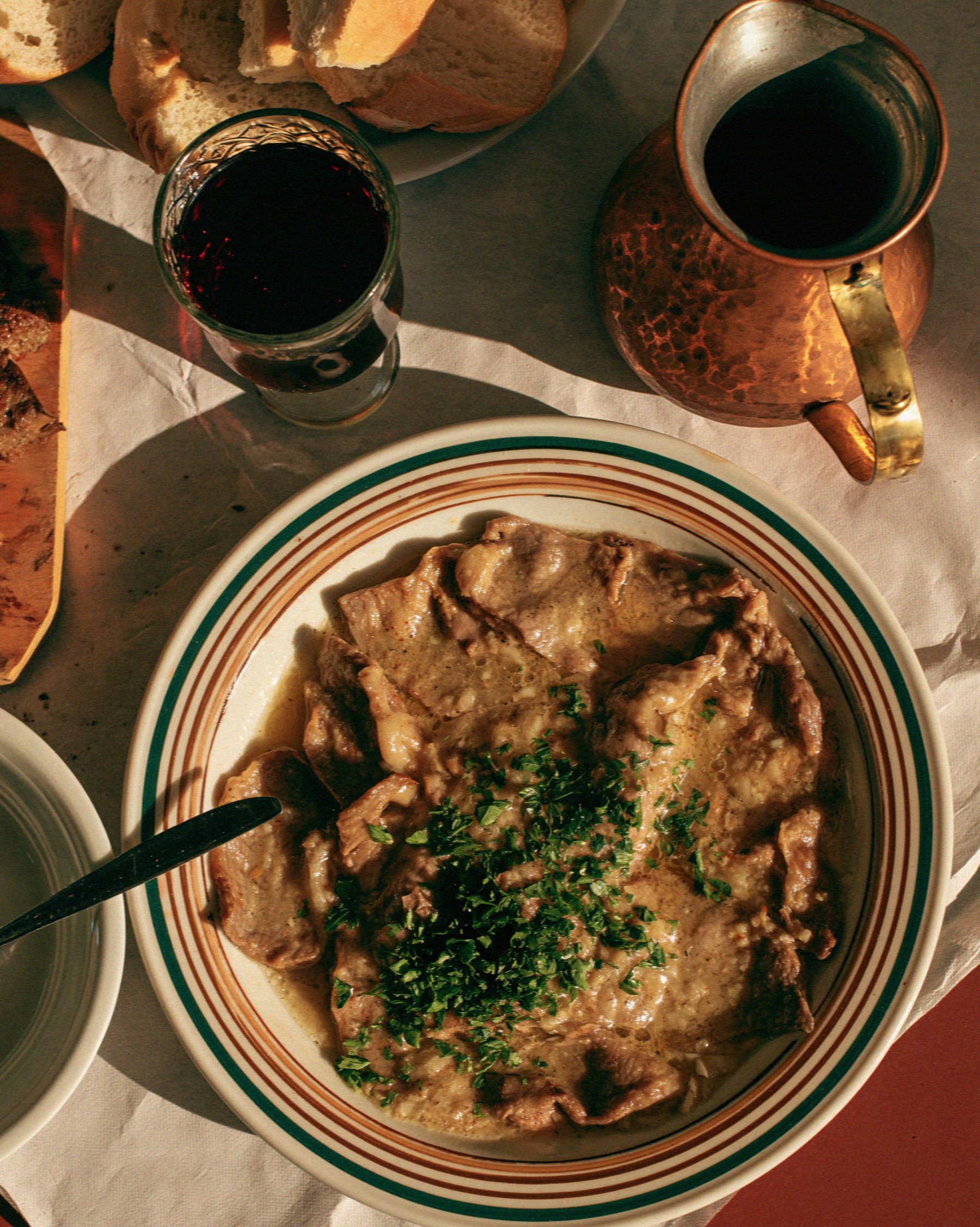
Corfiot food is its own cuisine, and much of it came from Venice. If you eat only one thing here, make it pastitsada: rooster or beef cooked slowly in a red sauce warm with spices, over thick pasta. It is the island’s Sunday dish. Sofrito is thin veal cooked in white wine, garlic and parsley, gentle and sharp at once. Bourdeto is scorpionfish in a fiery red pepper sauce, and bianco is its pale opposite: white fish, garlic, lemon and potato, slow-cooked into a pale, sharp stew.
Then the oddities. Kumquats grow here, with a protected designation, and turn up as a sticky orange liqueur and as candied fruit in every shop in the Old Town. Tsitsibira is the island’s ginger beer, a leftover from the British years, still made and still worth ordering. Mandolato is the nougat.
Corfiots traditionally eat their main meal at midday, which is worth knowing when you pick a taverna.
A few places to start. Rex, by the Liston, has been serving pastitsada and sofrito since 1932. On the coast, Klimataria “Bellos” in Benitses is a family fish taverna the Bellos family has run since 1997, open roughly February to November, and you must book. At Agni, Toula’s Seaside has been on the beach since 1982, with Taverna Agni and Nikolas beside it. In the villages, Taverna Tripa at Kinopiastes is an institution from the Durrell years, Taverna Elizabeth at Doukades is slow village cooking, and Taverna Rouvas at Strinylas is where to stop for lunch on the way up Pantokrator. For the one big night, Etrusco, near Dassia, is the island’s most celebrated restaurant, run by the Botrini family, with tasting menus. Book it well ahead.
I go through the dishes properly and the tavernas I would return to in my guide to where to eat in Corfu.
Getting there and getting around
Flying in. Corfu’s airport sits on the edge of town by the lagoon, only a few kilometres from the centre. The approach takes you low over the water past Vlacherna and Mouse Island. I landed that way in September, and it is still the best arrival I have had on any island.
Into town. Line 15 of the blue city buses links the airport with San Rocco Square and the port. Pay the driver 1.70 EUR, or a little less with a ticket bought beforehand, and expect one every thirty to sixty minutes, with nothing late at night. The dark blue taxis do the trip in a few minutes for around 15 EUR, nearer 20 EUR after dark.
By ferry. From Igoumenitsa on the mainland, local boats cross in about an hour and a quarter, many times a day, for a few euros on foot. Some run to Lefkimmi in the south instead. From Italy, Brindisi is the shortest crossing at about seven hours, Bari about nine, and Ancona and Venice far longer.
Buses. Green KTEL buses leave the intercity station for the resorts: Sidari, Kassiopi, Afionas and Arillas, Paleokastritsa among them, for a few euros. They are fine for a beach day from town, but they stop short of the hill villages and the wilder beaches.
Driving. A car is what opens Corfu up, especially the north-east, the west coast and the villages. The roads are narrow and the mountain ones twist, and on a blind bend you will sooner or later meet a bus swinging wide across the middle. Hug your own side and brake before the corner, not in it. Choose one coast for a day rather than crossing the island back and forth.
I cover the airport, ferries, buses, car hire and the boats to Paxos and Albania in my guide to getting to Corfu and around.
A few days on Corfu
Three days is enough to see the essentials if you split them sensibly: one in Corfu Town, one on the west coast for Paleokastritsa and a sunset beach, one on the north-east for a boat and a long fish lunch.
Five days lets you add the two things that need a full day each: a boat to Paxos and Antipaxos, and a slow drive up Mount Pantokrator by way of Old Perithia, coming down through the north.
The principle is to group your days by coast, not by sight. Corfu Town and Kanoni belong together. Paleokastritsa, Angelokastro and Porto Timoni belong together. Kalami, Agni and a hire boat belong together. Try to do Paleokastritsa in the morning and Kassiopi in the afternoon and you will spend the best of the day behind a bus.
I lay out the days, in order, with where to sleep for each version, in my Corfu itinerary for three to five days.
Day trips
Corfu is a good base for leaving Corfu for a day, and two of the best trips are across water.
Albania is right there. Fast boats from Corfu Town reach Saranda in about thirty minutes, slower ferries in about an hour, and tickets run roughly 19 to 30 EUR each way. From Saranda it is a short drive to Butrint, on the UNESCO list since 1992, with a Greek theatre and the ruins of a city layered through the centuries in a wood beside a lagoon. Bring your passport, remember Albania is an hour behind Greece, and check the return times: the summer timetable is far fuller, and from around mid November you can no longer get there and back in a day. Organised day trips from Corfu take care of all of it.
Paxos and Antipaxos make the other great day by sea, as above.
On the island itself, Mount Pantokrator and Old Perithia fill a day, and so does Angelokastro, a Byzantine castle on a crag above the west coast near Krini, about fifteen minutes uphill from its ticket office. In summer it opens 10:00 to 18:00 and closes on Tuesdays.
Further out, off the north-west tip, are the Diapontia islands, Mathraki, Ereikoussa and Othonoi, three small inhabited islands reached by a little ferry from Corfu Town, or by boat from Sidari and Agios Stefanos in the north-west. They are the farthest you can get from the crowds without leaving Corfu’s waters.
I go through each, with how to do it and how long it takes, in my guide to the best day trips from Corfu.
Who Corfu suits
Couples do well anywhere on the island, but especially in an Old Town mansion for a few nights followed by a villa on the north-east coast.
Families do well too. The north-east has calm water and short distances, the west has sand to dig, and the resorts north of town are built for children.
Walkers should know that Corfu is green and hilly enough to reward it, from the path down to Porto Timoni to the old tracks around Pantokrator. Spring and autumn are the seasons for it.
People who love food will find a cuisine here that exists nowhere else in Greece.
People who want white villages, blue domes and a bare volcanic landscape should go to the Cyclades instead. Corfu is a different idea of Greece, and the people who love it best are the ones who came for that difference.
And if you do not drive, Corfu still works, but stay in town, use the buses for a beach day or two and take boats rather than roads.
What to pack
Pack for an island that is green because it rains. Even in September I was glad of a light waterproof one afternoon, and in spring or October it is essential.
Shoes matter more than usual. Bring something with a proper grip for the steep paths to Porto Timoni, Myrtiotissa and Angelokastro, and sandals or water shoes for the north-east, where the beaches are pebbles and the snorkelling starts straight off the stones.
For the sea, a mask and snorkel are worth their space, especially if you plan to hire a boat. Bring high-factor sun cream and a hat; the light off the water on a boat day is fierce.
For churches and monasteries, including Saint Spyridon and the monastery above Paleokastritsa, keep shoulders and knees covered. A light scarf in a day bag solves it.
Evenings are warm in summer and cooler by October, when a jumper earns its place for dinner outside. The Liston at night is not formal, but people dress for it a little.
Your passport goes in the bag if there is any chance of Albania.
And leave room for a bottle of kumquat liqueur and a bag of candied fruit. Everyone does.
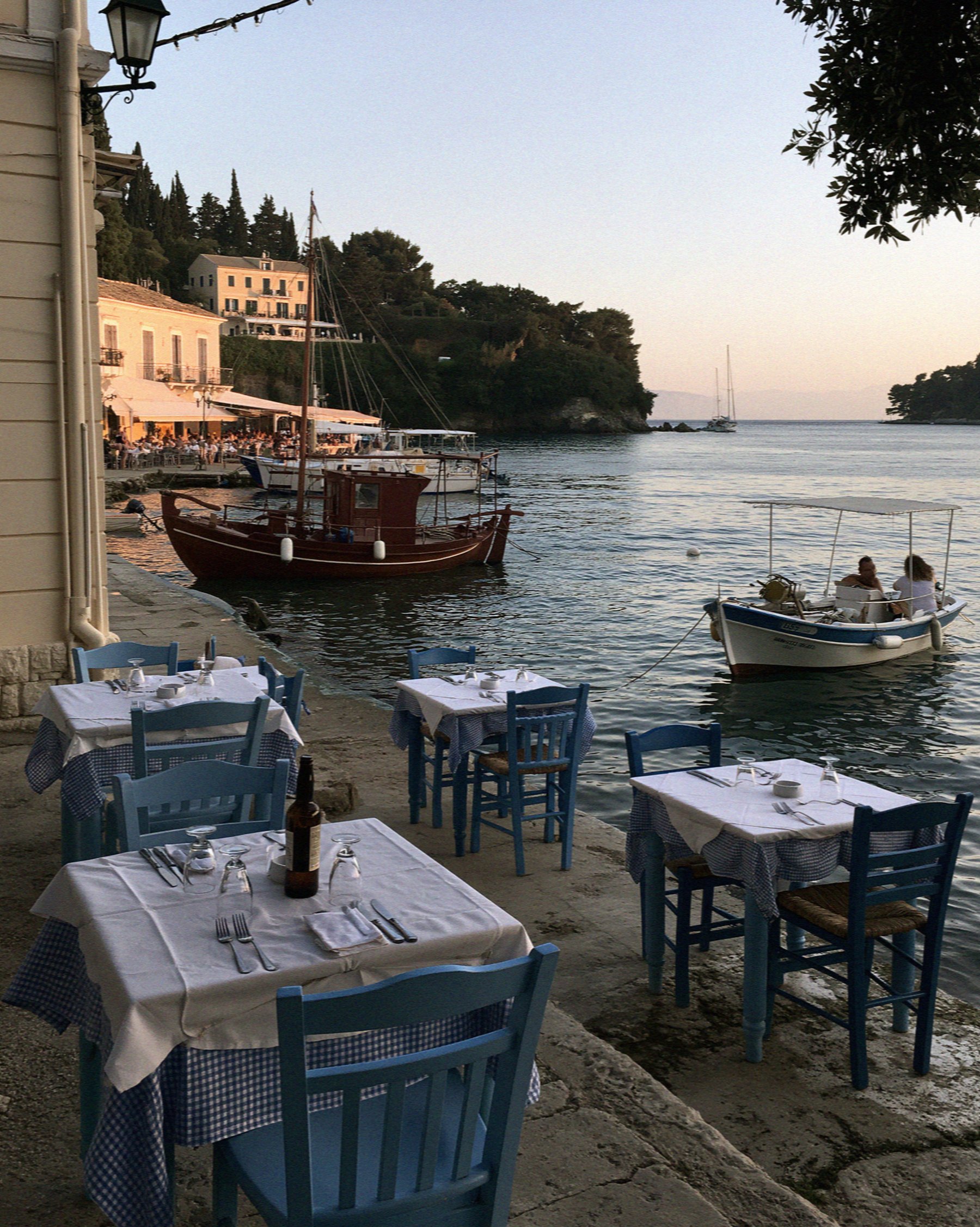
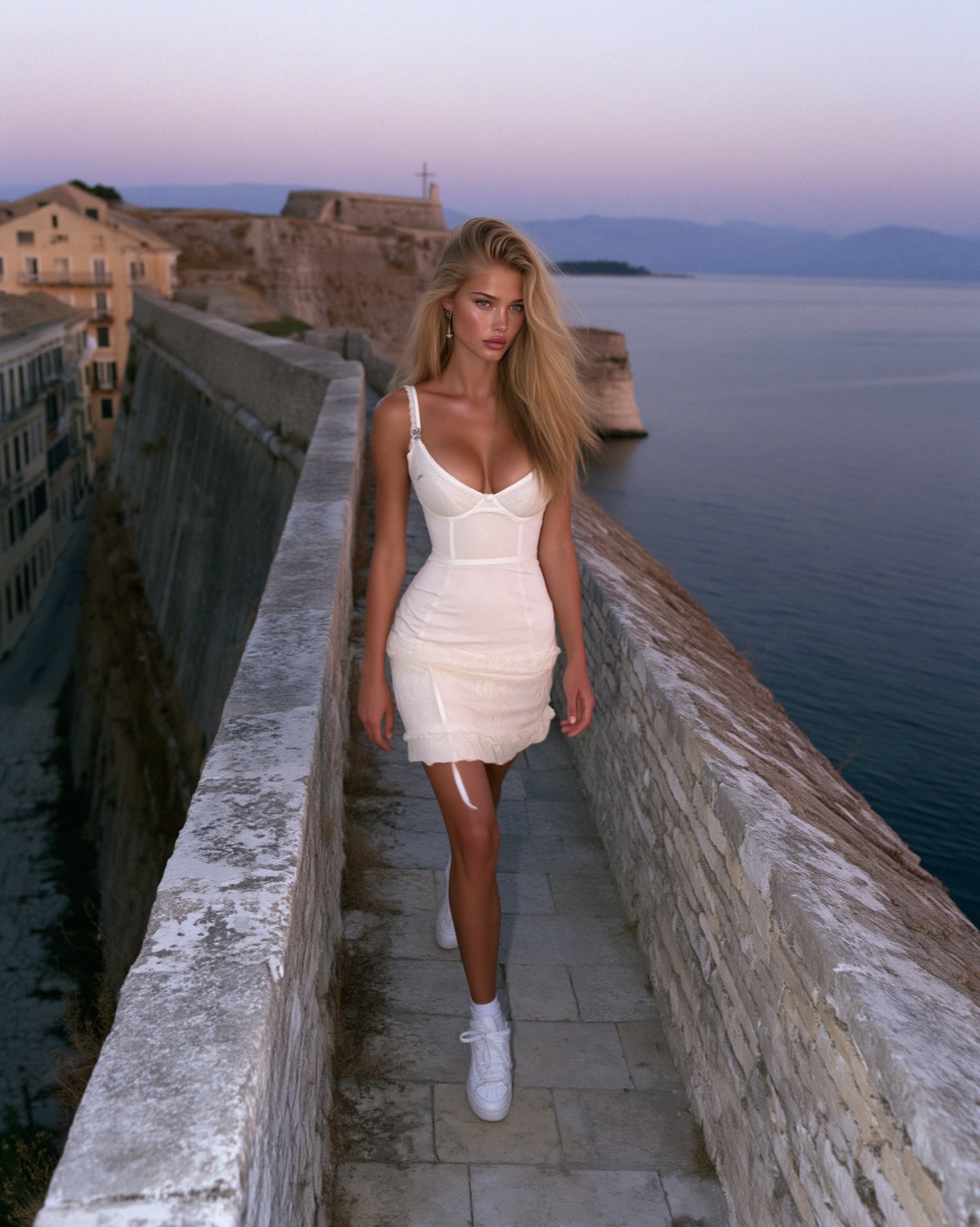
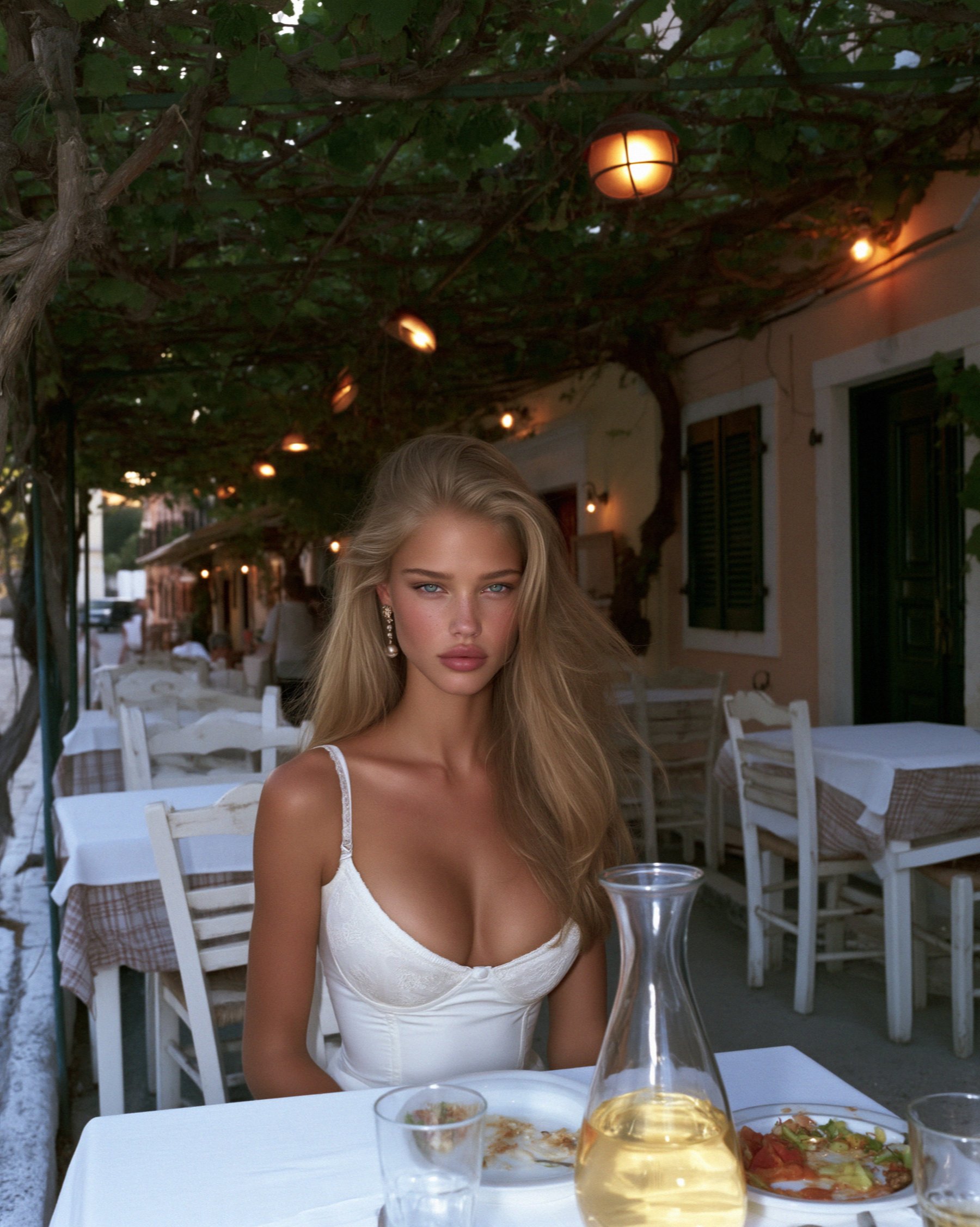
More images from Corfu






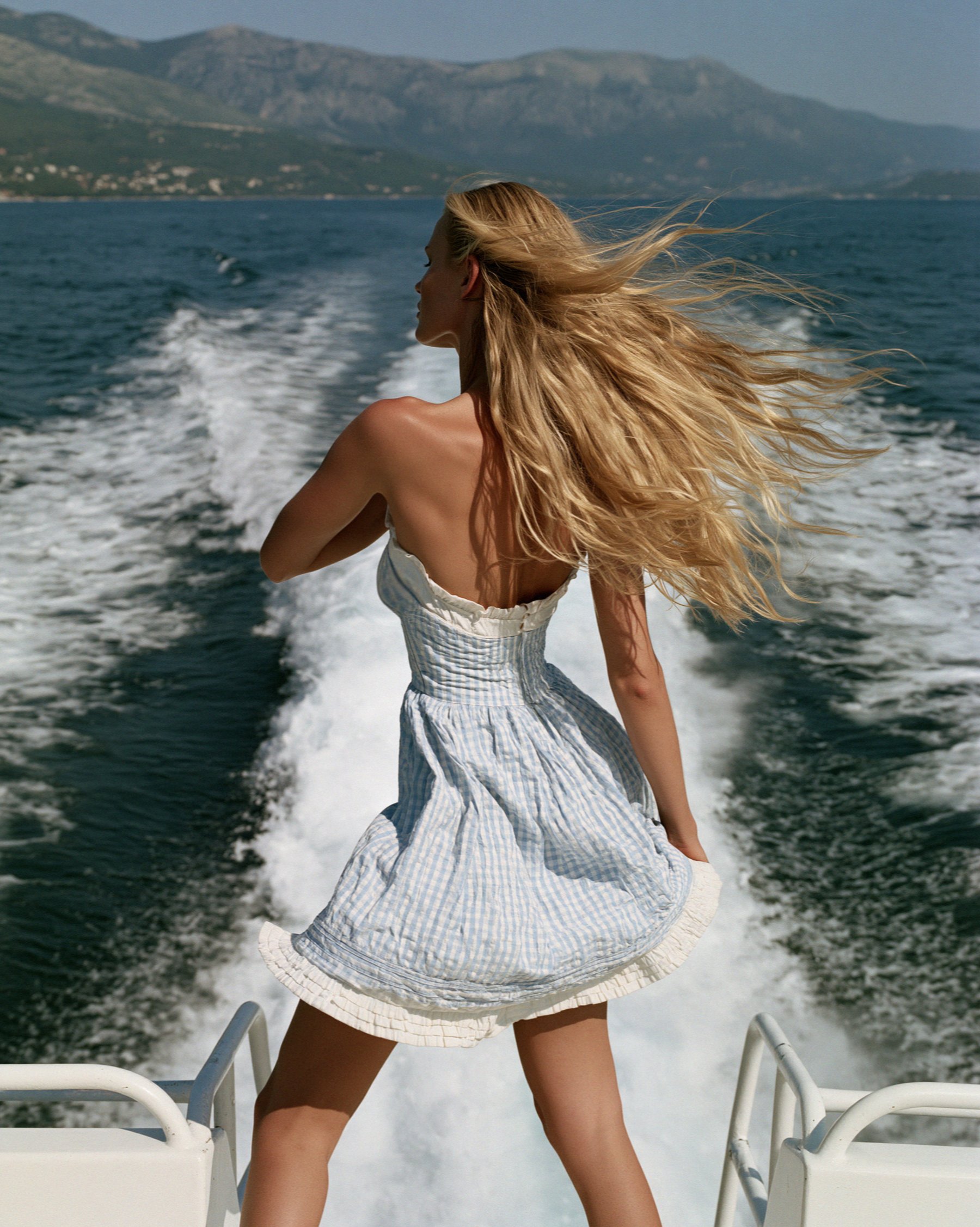
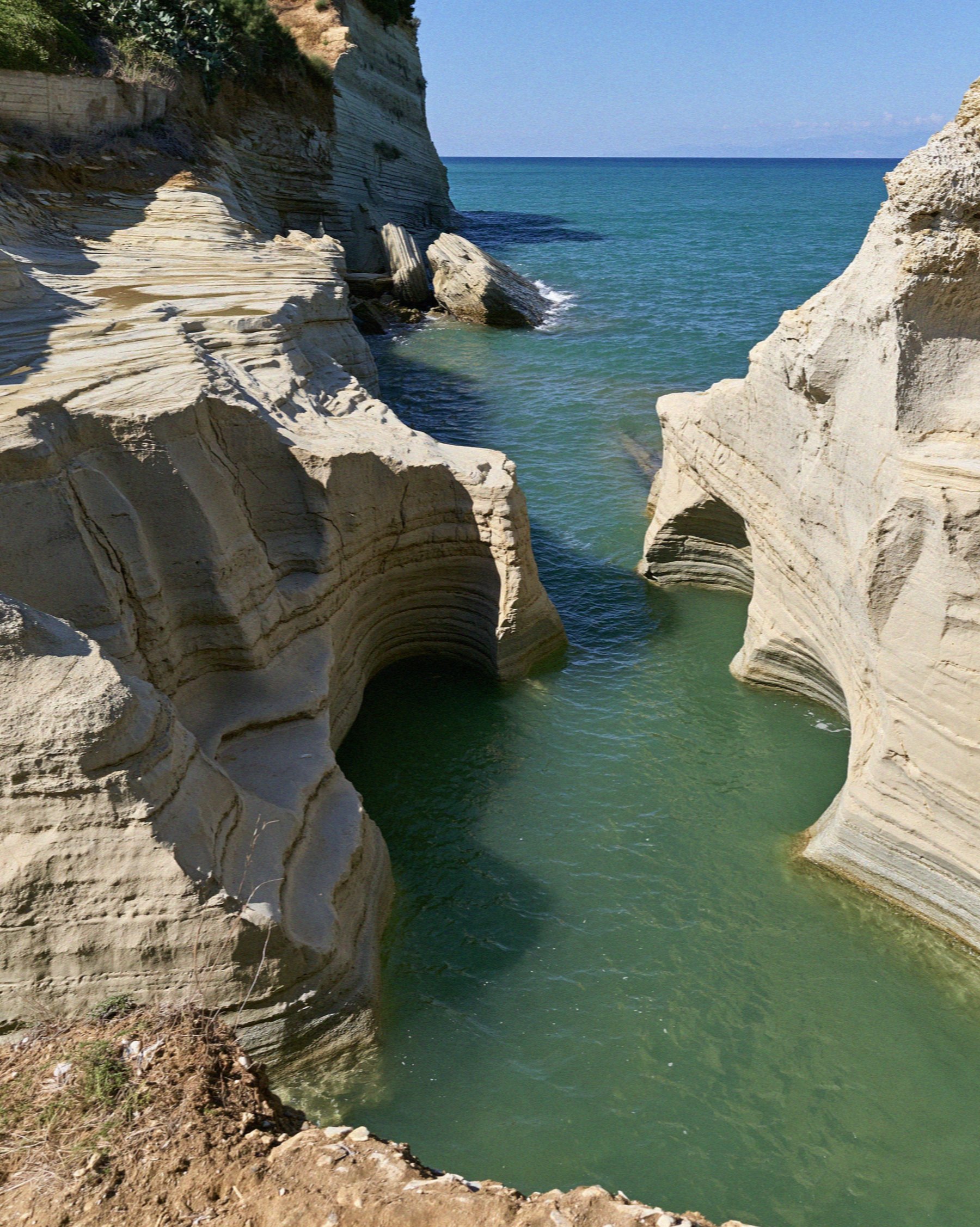
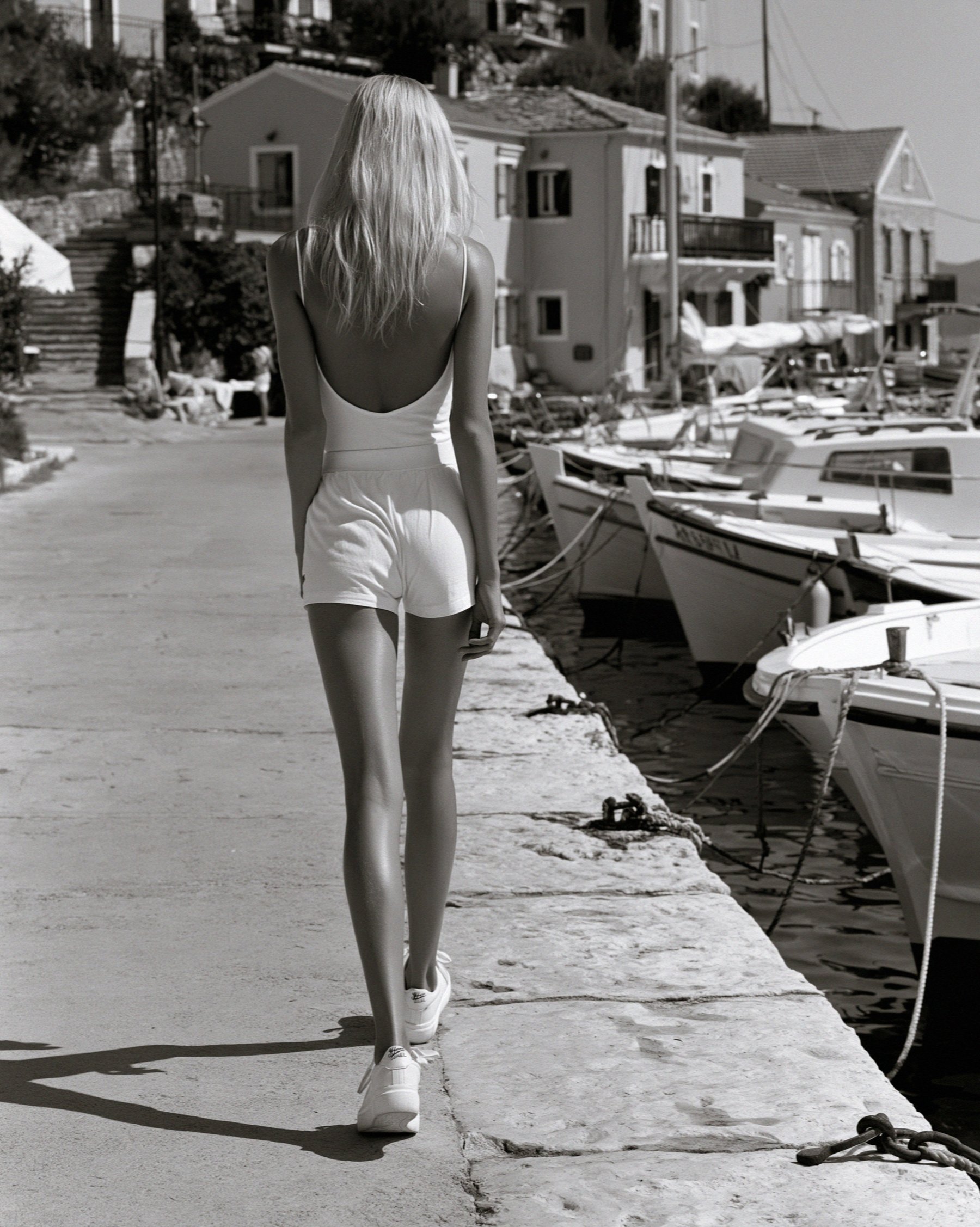


Your Corfu Guides
Everything here in detail, guide by guide.
- The Best Things to Do in Corfu
- Corfu Old Town: A Walking Guide
- Where to Stay in Corfu: Choosing Your Base
- The Best Beaches in Corfu
- The Best Corfu Boat Tours
- Where to Eat in Corfu and What to Order
- A Corfu Itinerary: 3 to 5 Days
- The Best Time to Visit Corfu
- Getting to Corfu and Around
- The Best Day Trips from Corfu
Corfu Travel Diaries
Frequently Asked Questions
Is Corfu worth visiting?
Yes, if you want a Greek island that is green rather than bare. It has a Venetian Old Town on the UNESCO list, sandy beaches on the west coast, calm clear water on the north-east, a cuisine of its own and boat days to Paxos and Albania. If you want white cubes and blue domes, go to the Cyclades.
Is September a good time to visit Corfu?
It is the month I would choose. The sea has warmed to around 24 C, the days sit in the high twenties, the August crowds have left and rain usually falls on only about six days. Late May and June come next, greener, with cooler water.
Why is Corfu so green?
Rain. Corfu is the wettest of the Greek islands, so its hills stay covered in olive and cypress, and the olive trees themselves grow enormous because for generations nobody cut them back.
Is Corfu good for families?
Very. Children do well in the calm coves of the north-east, on the long sandy beaches of the west, and in the big resorts at Dassia and Kommeno, just north of town.
Was Corfu ever under Ottoman rule?
No, which is one reason it feels so unlike the rest of Greece. The Ottomans attacked it several times, with great sieges in 1537 and 1716, and Venice repulsed every one. Venice held the island for about four centuries, followed by the French and the British, before it joined Greece in 1864.
Can you visit the inside of the Achilleion?
Not yet. The rooms have been shut for restoration since 2021, and the work is due to be finished by June 2029. Until then the gardens are the whole visit, on a cheaper ticket.
Do you need a passport to go from Corfu to Albania?
Yes, bring your passport for the boat to Saranda. Remember too that Albania runs an hour behind Greece, so set your watch by the Greek clock for the boat home.
What should I bring home from Corfu?
Something made from kumquats, which grow here under a protected designation: a bottle of the liqueur or a bag of the candied fruit. Mandolato, the island’s nougat, travels well too.