Naxos and Paros sit side by side in the middle of the Cyclades, close enough that from the top of one you can see the other lying low across the water. That geography is the whole secret of getting here. The big ferries from Athens call at both, usually Paros first, so you can arrive on one island, cross to the other in under an hour, and carry on south or west without ever going back to the mainland.
This is how to reach them, cross between them, go on to Milos, and get around once you land. For everything else on each island, start with my complete guide to Naxos and my complete guide to Paros.
Greek ferry timetables change with the season, so treat every time below as a range and check the live timetable before you book.
The short answer
From Athens, cheapest and simplest: the conventional ferry from Piraeus, about 4 to 5.5 hours to Paros and 5 to 7 hours to Naxos.
From Athens, fastest by sea: a fast boat from Piraeus or, in season, from Rafina, roughly 2 hours 40 to 4 and a half hours.
Short on time: fly from Athens to either island in about 40 minutes.
Between the two islands: 25 minutes to a little over an hour, several boats a day in season, and cheap.
By ferry from Athens
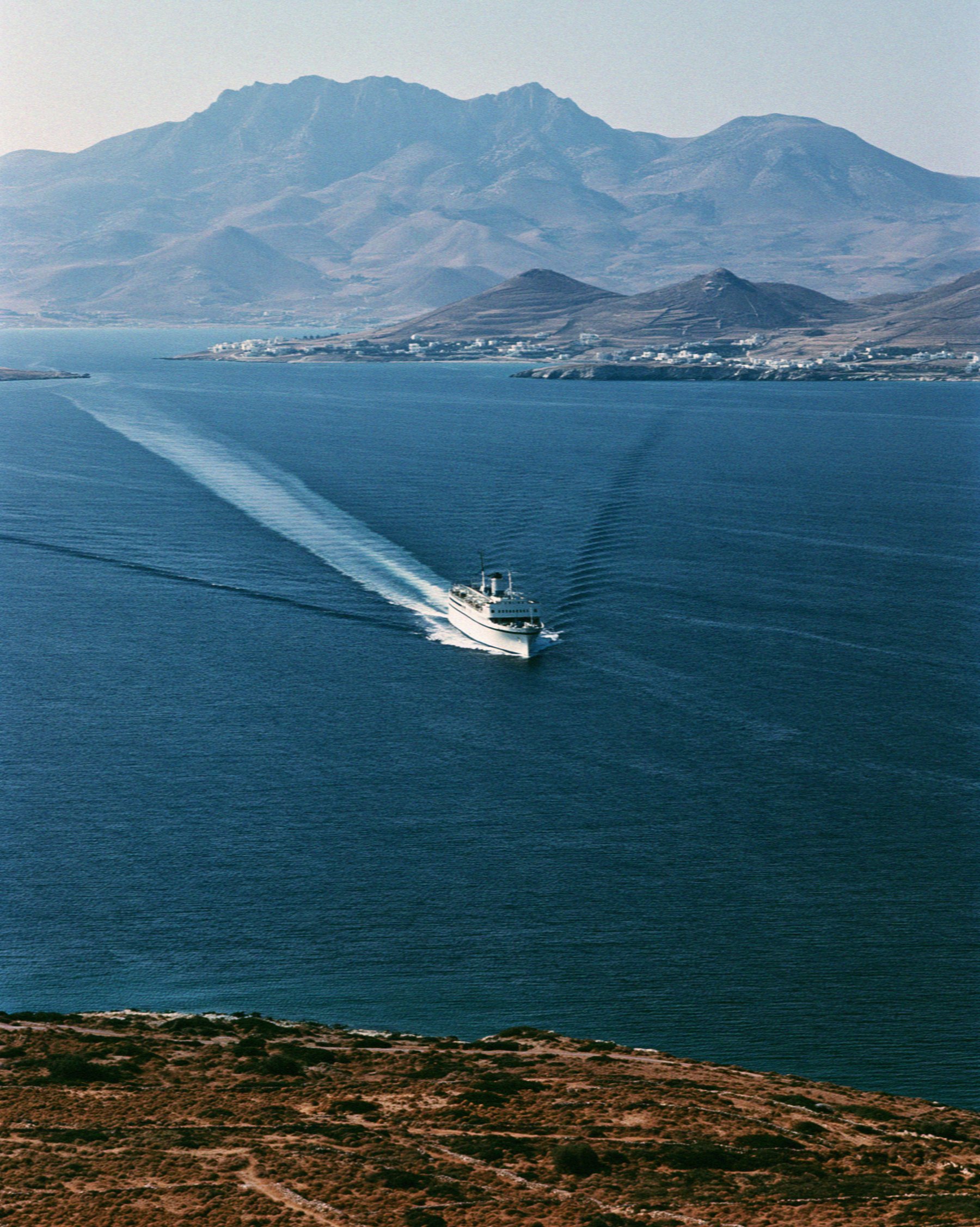
Most people arrive by sea, and most arrive from Piraeus, the main port of Athens. Blue Star Ferries run the big conventional boats all year: roughly 4 to 5.5 hours to Paros, and roughly 5 hours 15 to 7 hours to Naxos, because the same boat usually calls at Paros on the way. Deck fares start at roughly 40 to 55 euros, depending on the date and the island. They are large, steady ships with cafes, outside decks and space for cars, and the least likely to be cancelled in wind.
Fast boats, mostly Seajets in this part of the Aegean, cut the trip to roughly 2 hours 40 to 3 hours 45 for Paros and 3 hours 15 to 4 hours 25 for Naxos, with fares to Naxos from around 62 euros. They run mainly from spring to autumn, you sit indoors, and they feel every wave on a windy day.
Rafina and, less often, Lavrio have services in season too. Rafina is much closer to Athens airport, which helps if you land and sail the same day.
In winter the schedule thins out to a few sailings a week on some routes, and in July and August the good boats fill up, especially around the middle of August. Book ahead for summer. Arrive at least half an hour early; Piraeus is enormous and some gates are a long walk from the metro.
Coming from Mykonos, my guide to getting to Mykonos covers that end. It was my own route to Naxos, about forty minutes across a bright sea.
Flying in
Both islands have small airports with flights from Athens of about 40 minutes.
Naxos has two to four flights a day all year, with Sky Express and Aegean (under its Olympic name). The airport is about 4 km from Naxos Town, and a taxi in costs around 15 euros.
Paros has flights from Athens with Olympic and Sky Express. The airport is on the south-west coast, near Alyki, and a bus runs from there to Parikia. The runway is being enlarged, with an extension approved in August 2026, but do not plan around international flights yet; for now you come through Athens.
Flying suits anyone connecting from an international arrival in Athens, but the planes are small and baggage allowances tight.
Between Naxos and Paros
This is the easiest crossing in the Cyclades. The conventional ferry takes about 45 to 70 minutes, and fast boats do it in about 25 to 30. In season there are several sailings a day in each direction, and on the slow boat the fare is usually around 15 euros.
The big ferries usually run Piraeus, Paros, Naxos and on, so the boat you take between the islands is often the same Athens ferry passing through. It can run late if it was held up at Piraeus, so leave slack before a flight.
I made the crossing from Naxos to Paros on the big boat in about forty-five minutes, standing on deck to watch Naxos Town shrink, which I wrote about in Ninety-Nine Doors. Take the slow boat if you can: cheaper, steadier, and you can be outside. Paros also makes an easy day out from Naxos, which is in my guide to the best day trips from Naxos.
On to Milos and the other islands
From Paros the fast boat to Milos takes about 1 hour 45, at roughly 80 to 90 euros. A conventional ferry also runs, much slower, at roughly 5.5 to 8 hours depending on how many islands it stops at, but from around 12 euros. My catamaran over took a little under two hours, and the island at the other end is in The Stone That Keeps an Edge.
From Naxos the lines fan out south and east. Fast boats reach Santorini in roughly two hours in season, and the same routes serve Ios and Amorgos. For Koufonisia and the Small Cyclades there are fast boats of about 35 to 45 minutes, or the little Express Skopelitis, a slow, cheap local boat that takes around two and a half hours via Iraklia and Schinoussa and sets off from the small marina by the ferry quay.
Mykonos, Naxos, Paros, Milos is the natural shape of a trip in this direction; Paros, Naxos, Santorini is another. For the end of that line, see my complete guide to Santorini.
Getting around Naxos
Naxos is the largest of the Cyclades, and how you get around depends on where you are going.
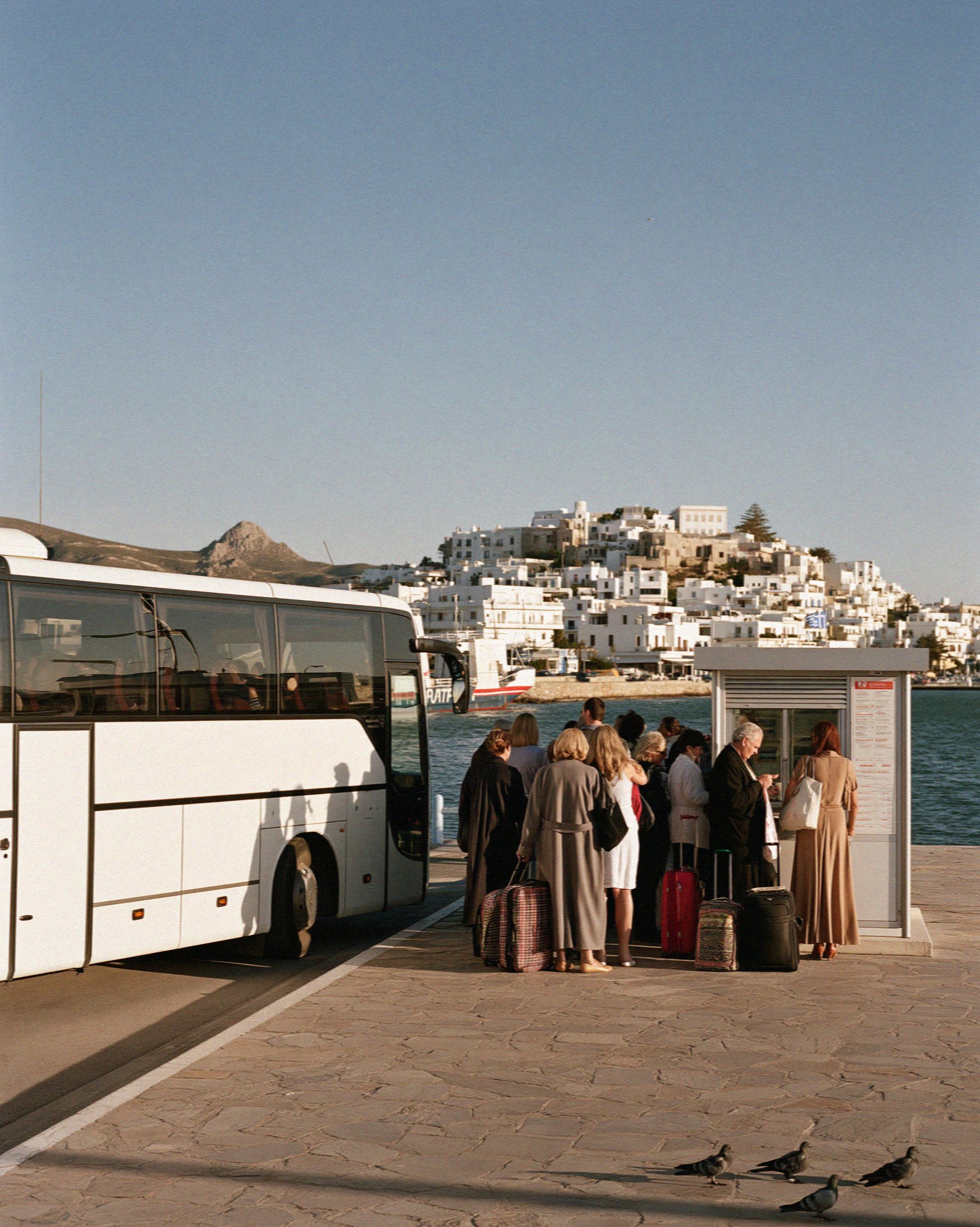
Buses. The KTEL buses leave from the port in Naxos Town. One line runs down the west coast to Agios Prokopios, Agia Anna and Plaka, with the south-coast buses reaching Mikri Vigla in summer, and fares of roughly 2 to 3 euros. Another climbs inland to Halki, Filoti and Apeiranthos. Buy tickets at the port kiosk, not on board, and on the village line check the last bus back. I took the early bus up to Filoti for Mount Zas.
For the west coast the bus is all you need; my guide to the best beaches in Naxos matches stops to beaches.
Getting around Paros
Buses. KTEL Paros runs from Parikia, by the port. The Parikia to Naoussa line is very frequent in season. Others go inland to Lefkes and Prodromos, round to Marpissa, Piso Livadi, Golden Beach and Drios on the east and south coasts, and from the airport into Parikia. In 2026 the buses took card payment only, so do not rely on cash.
For Antiparos, there is a bus from Parikia to Pounta, where the little car ferry crosses in about 7 minutes, every 20 to 30 minutes in summer. A seasonal boat also goes direct from Parikia in about half an hour. The details are in my guide to an Antiparos day trip from Paros.
I took the Lefkes bus out of Parikia and got off at the quarries on the way. The buses cover most of the island; the only gaps are the remote coves and the late evenings.
Hiring a car or scooter
On both islands, a car makes the villages and the far beaches easy. On Naxos it is close to essential if you want to see the mountain villages, the kouroi, Apollonas or the beaches beyond Mikri Vigla in one trip. On Paros the bus does a great deal, but a car gives you the quiet coves and late dinners in the villages.
There are hire offices at both ports and airports. In July and August book ahead, especially for automatics. Drivers with licences from outside the EU are often asked for an International Driving Permit, so check before you travel.
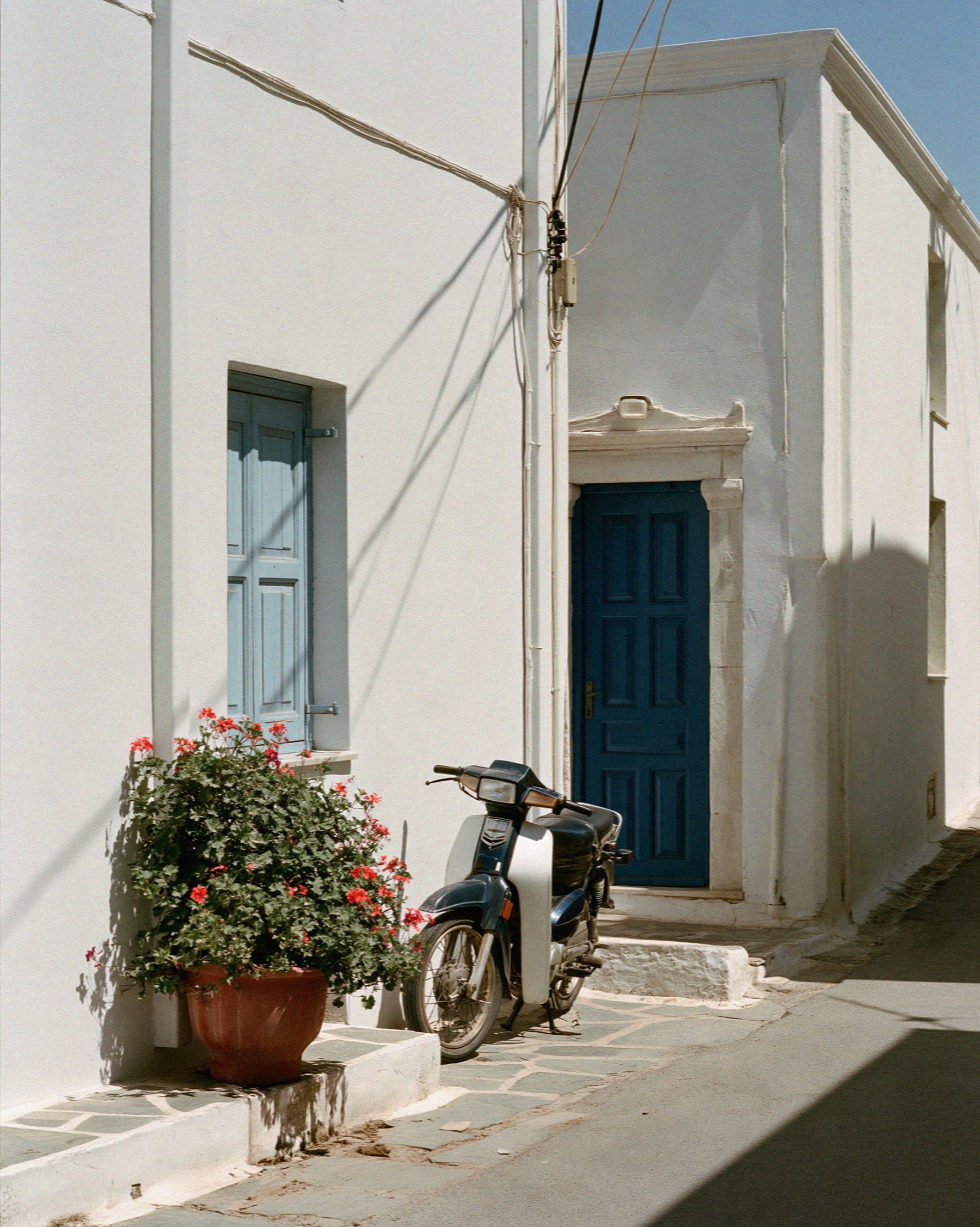
Scooters and quads are everywhere, and they are cheap and fun on a calm day. Helmets are compulsory in Greece. The Naxos mountain roads are steep and winding, and the meltemi can push a small scooter across the lane. An island is not the place to learn.
In Naxos Town and Naoussa, park on the edge and walk in.
Taxis and transfers
Taxis meet the boats and planes on both islands, but there are not many, and in August the queue is long. On Naxos, the ride from the airport into town is around 15 euros. For a late ferry or anywhere further, book ahead by phone or ask your hotel; many good hotels on both islands will collect you, and a car waiting at the bottom of the gangway after a long crossing is a very civilised thing.
Frequently Asked Questions
How long does the crossing between Naxos and Paros take?
About 45 to 70 minutes on a conventional ferry and about 25 to 30 minutes on a fast boat, with several sailings a day in season and slow-boat fares from around 15 euros.
Is it better to fly or take the ferry to Naxos or Paros?
The ferry from Piraeus is cheaper and runs all year, taking about 4 to 7 hours. Flying from Athens takes about 40 minutes and suits international connections.
Which Athens port do ferries to Paros and Naxos leave from?
Mostly Piraeus, where the Blue Star ferries sail all year. Rafina, which is closer to Athens airport, and Lavrio also have services in season.
Can you get from Paros to Milos by ferry?
Yes. A fast boat takes about 1 hour 45 and costs roughly 80 to 90 euros. A conventional ferry is much cheaper but takes roughly 5.5 to 8 hours.
Do you need a car on Naxos and Paros?
Not for the towns and main beaches, which the buses cover. On Naxos a car is the easy way to the mountain villages and far coasts; on Paros it helps for remote coves.
Read also: The Best Time to Visit Naxos and Paros | Victoria’s Complete Guide to Naxos | Victoria’s Complete Guide to Paros