Milos rewards two kinds of traveller: the one who is out of the door before nine and the one who is still out after dark. The hours in between belong to the heat, the glare off the white rock and the tour coaches, and the island is at its least itself then.
So this list is arranged around the clock as much as the map, with opening hours and prices where they exist. How it all fits together, and where to sleep while you do it, is in my complete guide to Milos.
Sarakiniko early
Sarakiniko, about 4.5 km north of Adamas and on the summer bus route, is the image of Milos: pale volcanic rock worn into smooth ridges around a deep blue channel.
Go first thing. Before about 09:00 the rock is cool underfoot, the light is soft enough to see the shapes properly, and you share it with a handful of swimmers and photographers rather than the midday crowd. The lifeguards come on at 10:00 in summer, so if you want to swim the channel with someone watching, time it for then. I came in the afternoon, which is the other good window, once the sun has dropped and the white stops burning. Whenever you go, stay off the edges and out of the water when the north wind is up.
A boat to Kleftiko
If you do one thing on Milos besides Sarakiniko, make it a day on the water. Kleftiko, on the south-west coast, is a group of white sea stacks pierced with arches and caves, with no road anywhere near it, and the boats anchor among the rocks while you swim through the gaps.
Full-day sailing boats with lunch leave Adamas in the morning and cost roughly €110 to €160 a person. I have set out the routes, boat types and what to do when the wind cancels them in my guide to Milos boat tours.
Sunset from the Kastro in Plaka
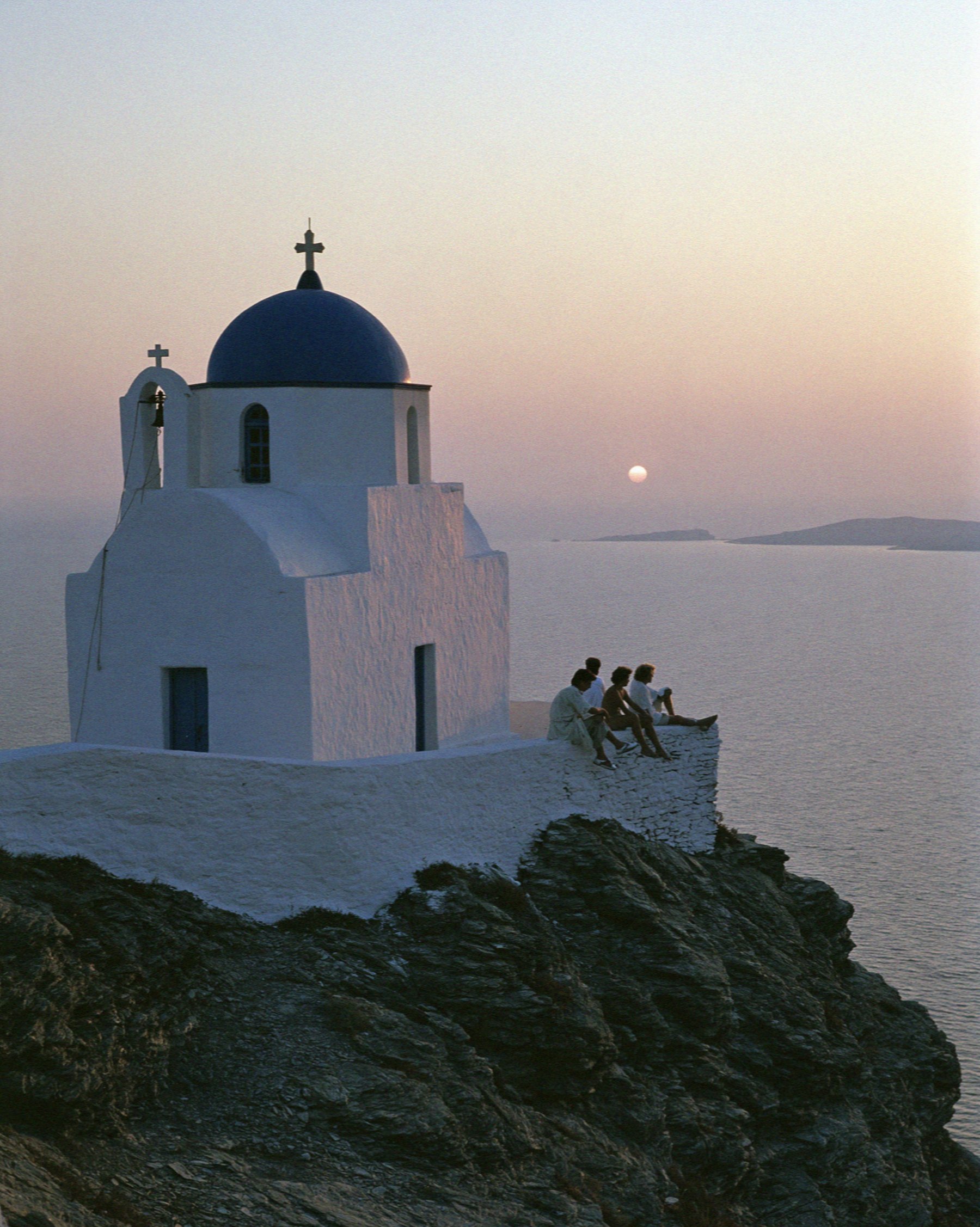
Plaka, the island’s capital, sits high on a ridge above the bay, and above Plaka is the Kastro, the hill where the Venetians built their castle in the 13th century. Little of the castle survives, but the climb up through the old quarter is lovely, past the church of Panagia Thalassitra, the Virgin of the Sea, to the small church at the very top.
From there you see the whole bay and the west coast, and in the evening the sun drops into the sea beyond it. It is the island’s classic sunset and it is busy, so start up at least forty-five minutes early, in shoes with some grip. I went up on my third day, after a morning at the catacombs and the theatre, which I wrote about in The Colour of the Boats.
The catacombs
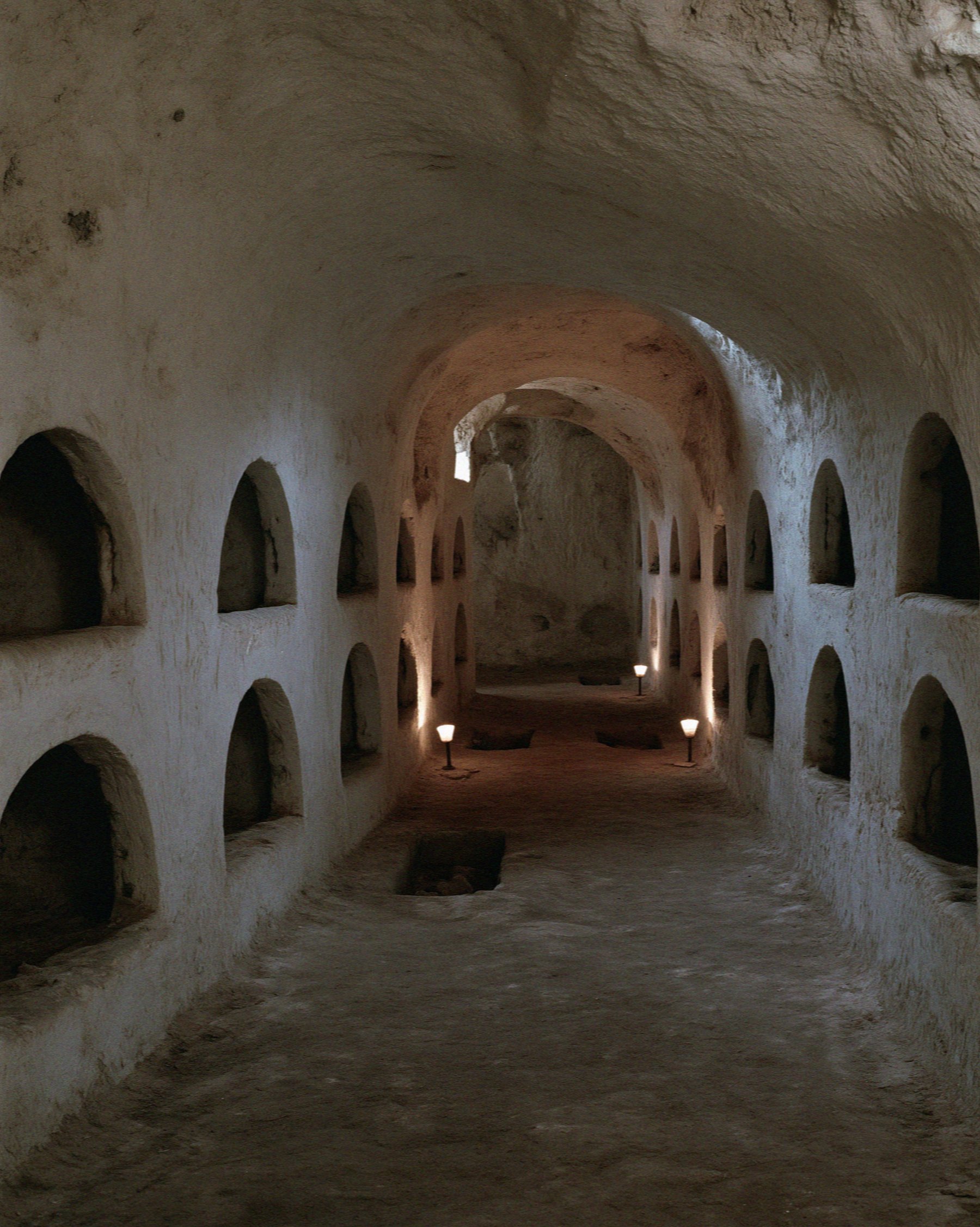
Below the village of Trypiti, cut into the soft volcanic rock of the hillside, are the Catacombs of Milos, an early Christian burial complex used in the early centuries AD and into the 5th century. Low corridors run back into the hill, lined with arched niches for the dead. Only part of the complex is open to visitors.
Hours: April to October daily from 08:30 until 15:30 except Tuesdays. November to March, Thursdays and Sundays only, until 14:00. Last entry is 20 minutes before closing.
Tickets: €10, reduced €5. E-tickets are available, which saves queuing at the small entrance in summer.
Go when it opens; it pairs naturally with the theatre a short walk away.
The ancient theatre and the Venus field
From the catacombs road a path leads down the slope to the ancient theatre of Milos. What you see is Roman-era marble seating, built over an earlier Hellenistic theatre, set into the hillside so that the audience faced out across the bay.
On the way, beside the path, a small plaque marks the spot. This is where, in 1820, a farmer called Yorgos Kentrotas, digging out stone, uncovered the statue we now call the Venus de Milo, and within a short time it had been taken to France. It is in the Louvre now. The plaque is easy to walk past, so look for it.
The archaeological museum in Plaka
The Archaeological Museum of Milos, in Plaka, is small and worth an hour. Its best-known exhibit is a plaster cast of the Venus, but the more interesting things came out of Phylakopi, the prehistoric town on the north coast: painted pottery and figures from a town that was trading across the Aegean thousands of years ago.
Hours: in summer, 08:30 to 15:30 daily except Tuesday. In winter it opens on Wednesday, Friday, Saturday and Sunday.
Tickets: €5, reduced €3.
Phylakopi itself is listed as temporarily closed, so the museum is the place to see what came out of it. The Folklore Museum, also in Plaka, is a pleasant extra if you are there anyway; check its hours locally.
The Mining Museum in Adamas
The Mining Museum, a short walk along the front from the Adamas quay, opened in 1998, the work of S&B Industrial Minerals, whose successor, Imerys, still mines here. It tells the story that explains the island: Milos has been dug for its minerals for as long as people have lived here.
The piece that matters most is the obsidian. Milos obsidian, a black volcanic glass that breaks into razor edges, was being carried away across open water from roughly 11,000 years ago, and is among the earliest evidence anywhere in the Mediterranean of people deliberately going to sea. There are also minerals, tools and a documentary room. It was the first place I went on Milos, and I wrote about the obsidian case in The Stone That Keeps an Edge.
Check before you go; it keeps shorter hours out of season.
Klima and the syrmata
Below Plaka and Trypiti, Klima is a line of brightly painted syrmata, fishermen’s houses whose ground floors were built to shelter boats. It is at its best in the hour before dusk, and there is no bus, with only a few parking spaces, so arrive early or walk down from Trypiti.
Klima and the other syrmata villages are covered properly in my guide to Plaka, Klima and the villages of Milos.
Papafragas
On the north-east coast near Pollonia, Papafragas is a narrow inlet between pale rock walls with a tiny beach at the end, reached by steps cut into the stone. Go on a calm morning and combine it with lunch in Pollonia. On a meltemi day, my guide to the best beaches in Milos suggests where to go instead.
The old sulphur mines
On the east coast, at the bay of Paliorema, are the old sulphur mines, known as Thiorichia. The mines closed around the middle of the last century and were simply left: ruined buildings and rusted rails above a little bay.
Getting there is half the point. A dirt road runs from Zefyria, and the last stretch, about 500 m, is on foot. It is rough, so it suits a 4×4, an ATV or a good walk rather than an ordinary hire car. Bring water and a swimsuit for the bay, and I would give it a whole morning.
Kimolos for the day
From Pollonia, a small local ferry crosses to Kimolos in about 25 to 30 minutes, several times a day in season. Tickets are bought at the quay, and the boat carries cars and ATVs if you want to take your own.
Walk up to Chorio, the main village, with its old fortified quarter, swim at Prassa, and be sure of the return sailing before ordering lunch. My guide to day trips from Milos has the details.
What not to plan around
Tuesdays. The catacombs and the archaeological museum both close on Tuesdays in summer.
Phylakopi. The Bronze Age site is listed as temporarily closed. Visit the museum in Plaka instead.
Kleftiko by road. There is no road to it.
Sarakiniko at midday in August. Hot, glaring and crowded. Go early or late.
Winter. From November the catacombs open two days a week, and most boats and beach bars stop.
Buses after dark. There are few, and taxis are scarce, so book one back from Klima or Plaka in advance.
Frequently Asked Questions
What is Milos best known for?
Its volcanic coastline, from the white rock of Sarakiniko to the sea stacks of Kleftiko, and as the place where the Venus de Milo was found in 1820.
How much does it cost to visit the Catacombs of Milos?
Tickets are €10 full price and €5 reduced. From April to October they open every morning except Tuesday; in winter, only Thursday and Sunday mornings.
Where was the Venus de Milo found?
In a field near the ancient theatre below Trypiti, in 1820, by a farmer named Yorgos Kentrotas. A small plaque marks the spot; the statue is in the Louvre.
Where is the best sunset in Milos?
From the Kastro, the hilltop above Plaka. It is the classic sunset point and gets crowded, so start the climb at least forty-five minutes before the sun goes down. Klima, below Plaka, is quieter and lovely at dusk.
Can you visit the old sulphur mines in Milos?
Yes. Thiorichia, at Paliorema bay on the east coast, is reached by a rough dirt road from Zefyria, then about 500 m on foot. A 4×4, an ATV or walking boots are best. The mines closed around the middle of the 20th century.
Read also: Milos Boat Tours: Kleftiko, Sykia and Polyaigos | Plaka, Klima and the Villages of Milos | Victoria’s Complete Guide to Milos