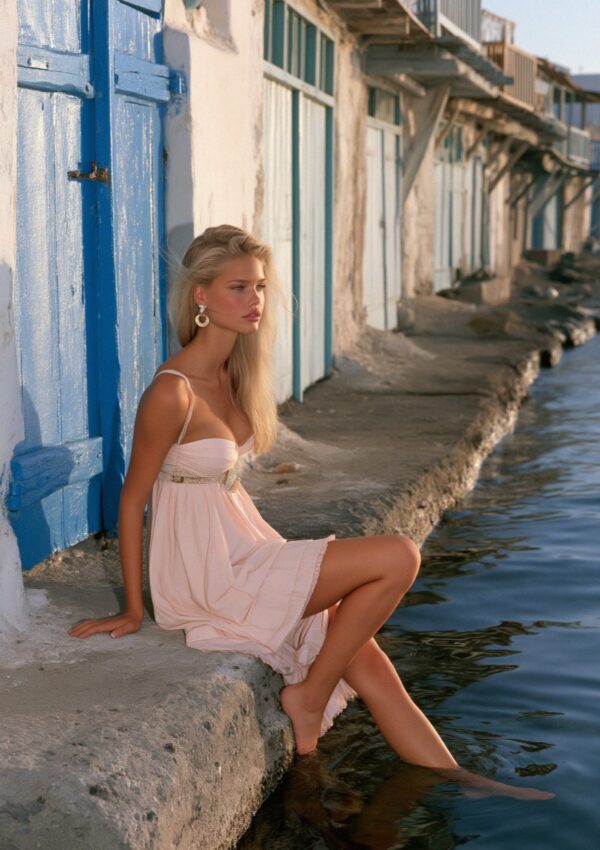
Milos has somewhere between seventy and seventy-five beaches, which sounds like a boast until you start driving and find that hardly two of them are alike. There is white rock you lie on rather than sand, a cove you climb down to on a rope, a beach where the sand is warm from underneath, and a whole stretch of coast that no road reaches at all.
My first swim on the island was in the long channel at Sarakiniko, on an October afternoon. This guide is the whole coast, beach by beach: which side to pick on a windy day, which beaches suit children, and how to reach each one. Everything else about the island, from the villages to the boats, is in my complete guide to Milos.
Which coast, which wind
Milos is shaped roughly like a horseshoe around its great flooded bay, and the beaches fall into three groups. The north coast, with Sarakiniko, Papafragas and the little coves near Pollonia, is the dramatic one: pale rock, inlets, deep clear water. The south coast, from Firiplaka round to Paleochori, is where the long sandy beaches and the coloured cliffs are. And inside the bay itself are the calm, shallow beaches near Adamas and the airport.
What decides your day is the meltemi, the summer wind that comes down the Aegean from the north. It blows hardest in July and August, sometimes for several days at a stretch, and when it does the north coast takes it head on: waves run into the inlets, the water churns and the rocks become slippery and dangerous. The south coast, with the bulk of the island behind it, stays sheltered and often glassy.
So: on a calm morning, go north; when the wind is up, go south or stay in the bay. Check the forecast the evening before, because a windy north coast will not improve by the time you get there.
Sarakiniko
Sarakiniko is the beach everyone has seen before they arrive, about 4.5 km north of Adamas. There is very little sand. What there is instead is a sweep of pale volcanic ash and pumice, laid down in layers and worn into smooth curves and ridges by weather and waves, with a narrow channel of deep turquoise water cutting through it. People jump into the channel from the sides; others, like me, prefer to climb down.
Go early or late in the day. At midday there is no shade, the white rock throws the sun back at you and the coaches arrive. Bring water, a hat and shoes with some grip.
After drownings the previous summer, 2026 was the first year Sarakiniko had lifeguards: two of them, from 1 June, watching the water between 10:00 and 18:00. The place is also fragile and still legally unprotected, and islanders have spent years resisting plans to build beside it; a helicopter landing on the rocks in summer 2026 caused a real outcry. When the meltemi is blowing, stay away from the edges and out of the water.
I wrote about my own afternoon there in The Stone That Keeps an Edge.
Firiplaka
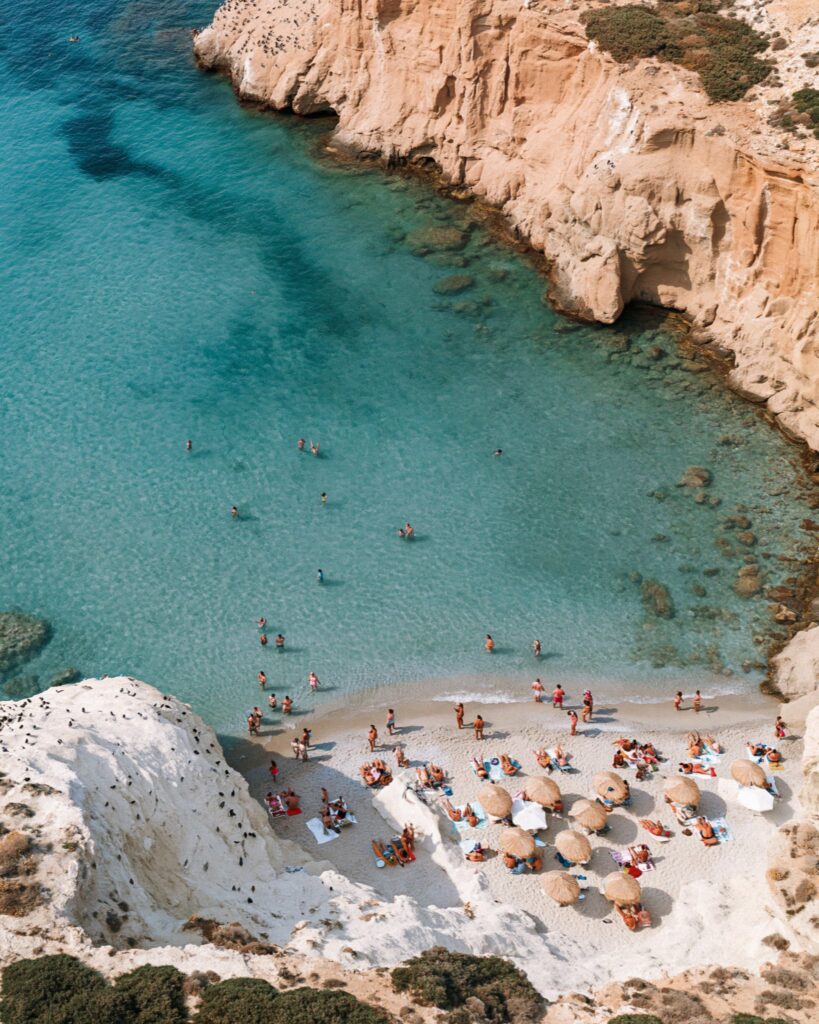
Firiplaka is the best all-round sand beach on the south coast and the one I would send most people to on a windy day. It is long, the sand is soft, and the water shelves so gently that you can wade out a long way before you need to swim. Behind it the cliffs are banded in colours, cream and rust and grey.
There is a beach bar with umbrellas along part of the sand and free space beyond. In July and August it is busy, because everyone has had the same idea about the wind, so come in the morning. A summer bus runs this way from Adamas a few times a day, but most people come by car or ATV.
Tsigrado
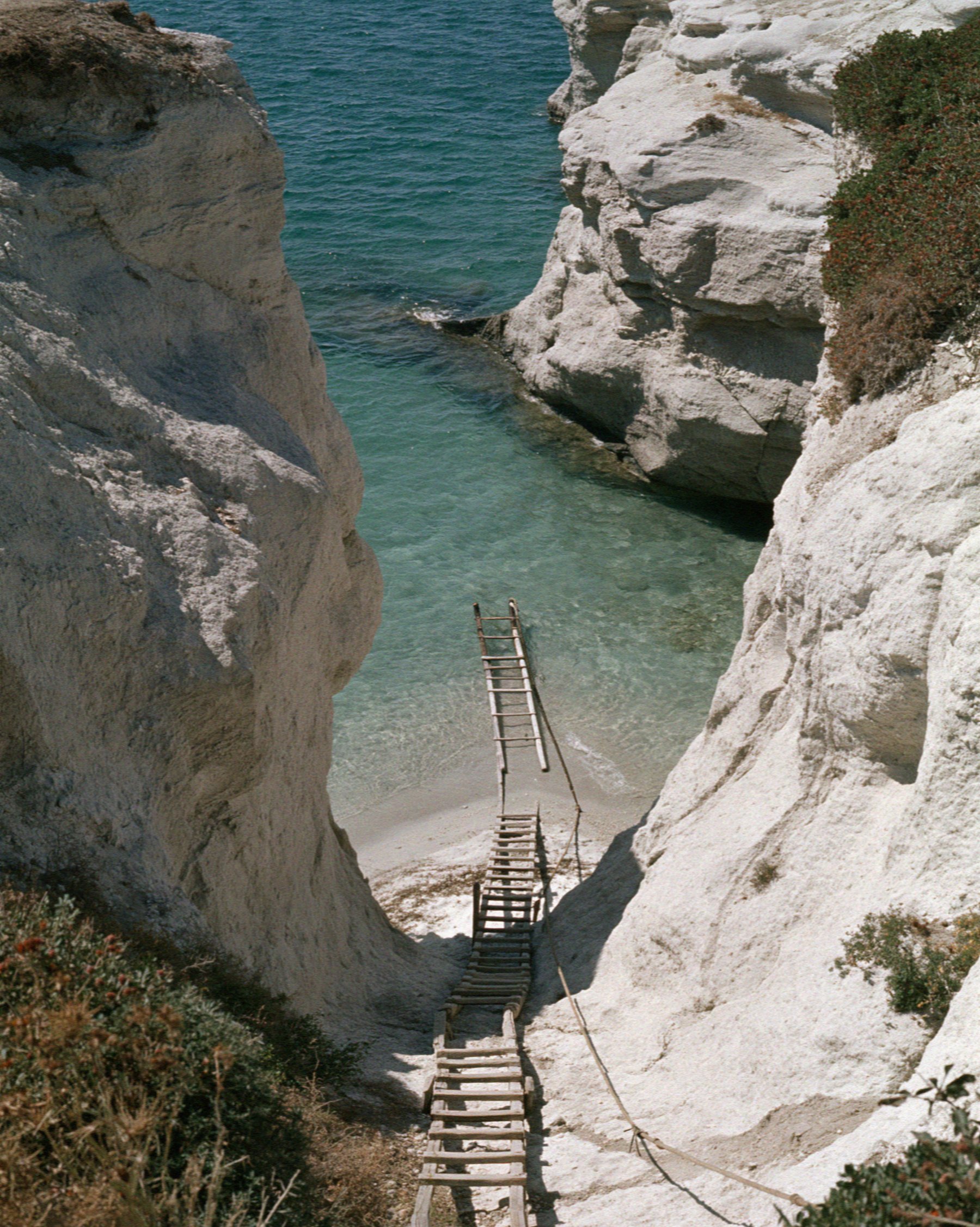
Tsigrado is the next cove east of Firiplaka, and it is tiny: a scoop of fine pale sand and very clear water at the bottom of a rock chute. The way down is a rope and an old wooden ladder, and it is every bit as steep as it sounds.
It is not for small children or for anyone unsteady on their feet, and it is not a place to arrive with a cool box and a parasol, because you carry everything down and back up again. Go early, before the day boats that stop offshore arrive. If the descent looks wrong to you from the top, go back to Firiplaka.
Paleochori
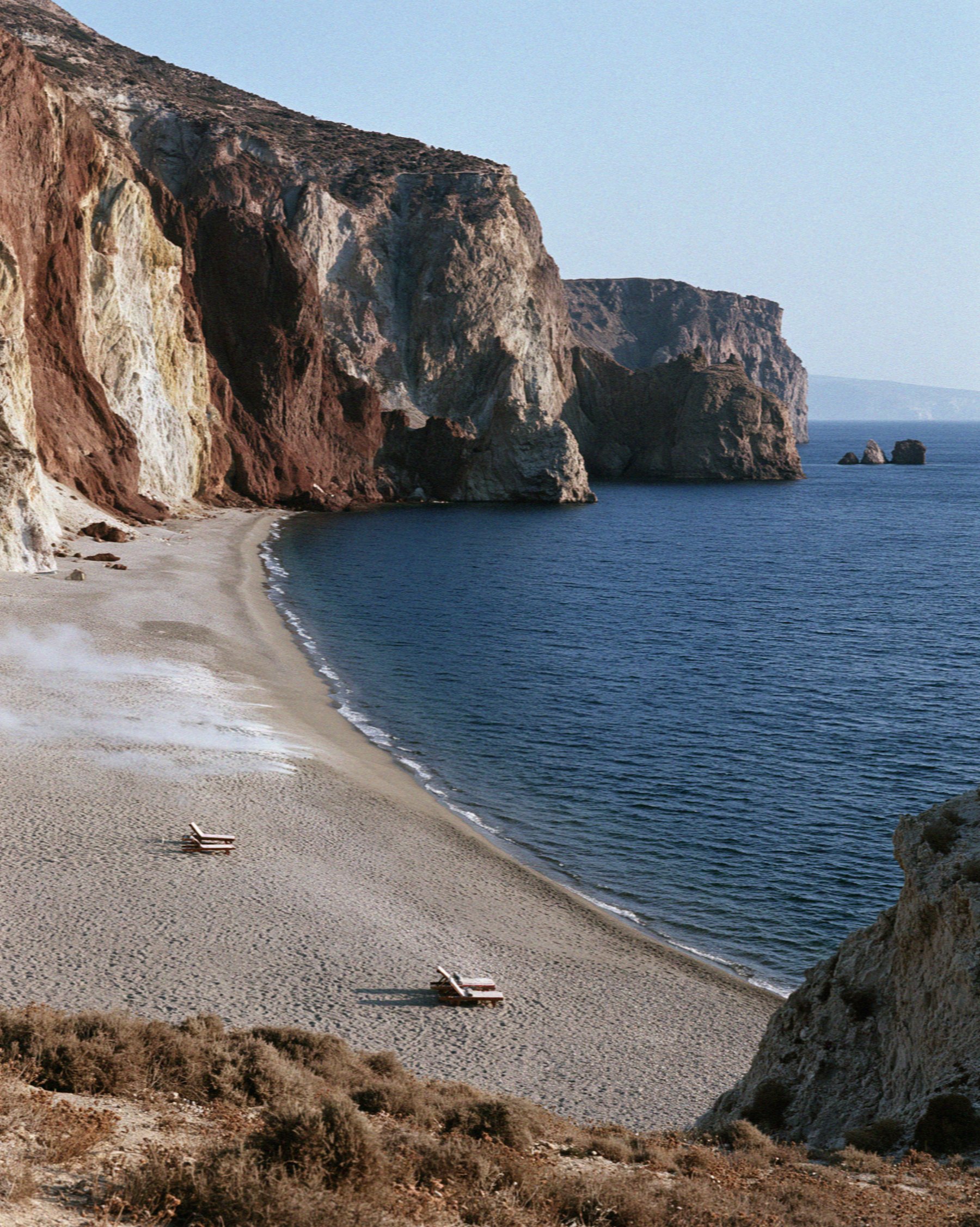
Paleochori, in the south-east, is a long beach of pebbles and coarse sand under cliffs streaked red, yellow and white. It is also where the island’s volcanic past is easiest to feel. The ground is geothermally warm here: dig your toes into the sand in places and it is hot, and warm water seeps up through the sea floor near the rocks.
The restaurant Sirocco cooks dishes in clay pots buried in the hot sand. Paleochori is sheltered from the north wind and on the summer bus route, which makes it one of the easiest good beaches to reach without a car.
Papafragas
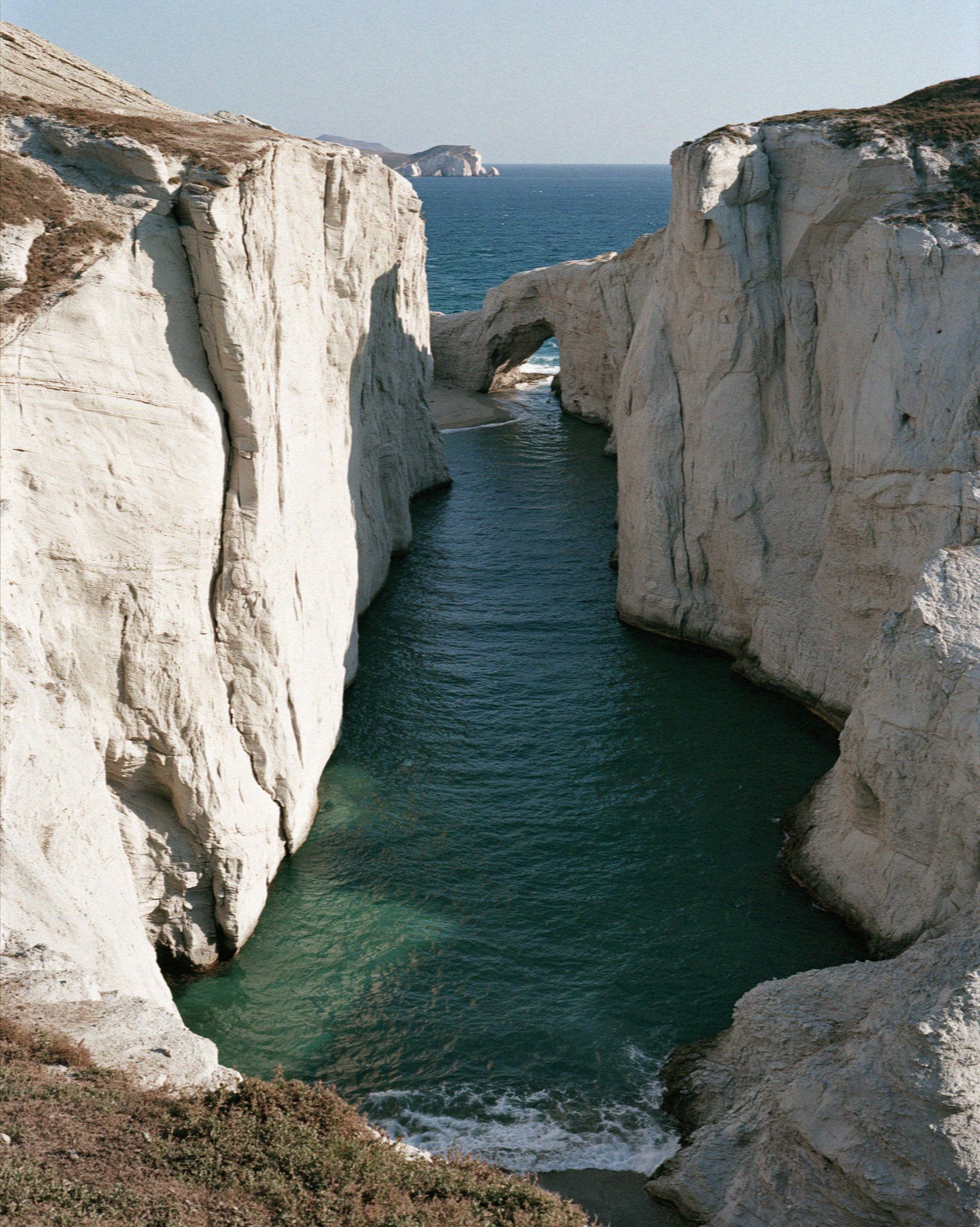
Papafragas is not really a beach so much as a slot in the rock. On the north-east coast, a few minutes’ drive from Pollonia, the sea has cut a long, narrow inlet between pale stone walls, with a tiny patch of sand at the very end. You reach it by steps cut into the rock, then swim the length of the channel towards the open sea.
It is at its best on a still morning and the wrong place to be in a meltemi. The remains of Phylakopi, the Bronze Age settlement, are close by, though the site is listed as temporarily closed, so for now it is something to look at on the way rather than visit.
Provatas and Agia Kyriaki
These are the two easiest south-coast beaches for a family. Provatas is wide and soft, with shallow water a long way out and red cliffs at either end. The summer bus comes here from Adamas.
Agia Kyriaki, a little further east, is long, part sand and part small pebbles, sheltered and usually quieter. Some boat trips leave from here when the wind closes the west coast.
Achivadolimni and the bay beaches
Inside the bay, the water is almost always calm. Achivadolimni, near the airport on the eastern shore, is a long beach sheltered from the north, with the bus passing in season. It is reliable rather than beautiful.
Closer to Adamas, Papikinou is the strip of beach a short walk from the port, where O! Hamos, the island-famous farm taverna, sits right behind the sand. My guide to where to eat in Milos has the tavernas along the bay.
Plathiena and Firopotamos
Plathiena, west of Plaka, is a sheltered sandy bay at the end of a rough road. It is easier and far more pleasant to arrive by boat, and several trips stop here.
Firopotamos, on the north coast just below Plaka, is the prettiest small bay on Milos: a little pebble beach, a white chapel on the rock, and a few syrmata, the old fishermen’s boat houses, painted at the water’s edge. Its inlet keeps the swell out most of the time, and the snorkelling over the pebbles is excellent. Parking is minimal, so arrive early. The fishing villages around it are in my guide to Plaka, Klima and the villages of Milos.
Beaches you reach by boat
Kleftiko, on the south-west coast, is a scatter of pale rock towers cut through with tunnels, and you swim off the boat through the gaps. Sykia is a cave that lost its ceiling at some point in the distant past, so you swim in a pool of sea enclosed by cliff, lit from above. Gerakas, on the west coast, is a remote beach that some boats stop at in calm weather.
I spent a whole day on a sailing boat out of Adamas reaching the first two, which I wrote up in The Thieves’ Cove. I have compared the boats, routes and prices in my guide to Milos boat tours.
Getting to the beaches
In summer the KTEL bus runs from Adamas to Sarakiniko, Paleochori, Provatas, Achivadolimni and Pollonia, which covers a good spread of north, south and bay. Check the last bus back.
For everything else you need a car or an ATV. Many beach roads are dirt, so ask what your rental insurance covers off the asphalt, and bring water, because the best coves often have nothing on them. My guide to getting to Milos and getting around covers the buses, the hire companies and the roads.
Frequently Asked Questions
Which is the best beach in Milos?
Sarakiniko is the most famous, for its white volcanic rock, but it has almost no sand. For a classic beach day, Firiplaka on the south coast is the best all-rounder.
Which Milos beaches are sheltered from the meltemi?
The south coast: Firiplaka, Tsigrado, Paleochori, Provatas and Agia Kyriaki, plus the beaches inside the bay such as Achivadolimni. The north coast, including Sarakiniko and Papafragas, takes the full force of the wind.
Is Sarakiniko safe to swim?
On a calm day, yes, and in summer 2026 it had lifeguards from 10:00 to 18:00 for the first time. When the north wind blows, keep out of the water and away from the edges.
Which beach in Milos is best for children?
Provatas, with wide soft sand and shallow water, or Achivadolimni inside the bay. Avoid Tsigrado, which is reached by a rope and a wooden ladder, and the deep channels at Sarakiniko and Papafragas.
Can you get to the Milos beaches without a car?
Some. The summer bus from Adamas reaches Sarakiniko, Paleochori, Provatas, Achivadolimni and Pollonia. Firiplaka, Tsigrado and Papafragas lie on or near summer bus lines, but services are few, so check the timetable. Firopotamos and the remoter coves need a car or ATV, and Kleftiko only a boat.
Read also: Milos Boat Tours: Kleftiko, Sykia and Polyaigos | Getting to Milos and Getting Around | Victoria’s Complete Guide to Milos